




Pronunciation: CHIH-lee-SOR-us
Meaning: Chile lizard
Author/s: Novas et al. (2015)
Synonyms: None known
First Discovery: Aysén, Chile
Acta Ordinal: #912
Chilesaurus diegosuarezi
When palaeontologists revisited a site at Aysén where seven-year-old Diego Suarez had found some bone fragments in 2004, they thought he had stumbled upon a graveyard containing remnants of three great dinosaur lineages. Hips with a backwards-pointing pubis bone to make room for a large gut as seen in ornithischians, long thin necks, small rounded skulls and broad, four-toed feet akin to sauropodomorphs, and short arms with two clawed fingers as seen in some theropods, were all strewn about the site. But they were wrong.
The big surprise arrived with four complete skeletons that each sported all of those features, prompting stunned workers to compare them, metaphorically, to Platypus: the oddball, egg-laying, duck-billed mammals from Australia. They were Christened Chilesaurus, referring to the country that yielded their remains. But we can't help thinking that the authors missed a trick by not naming them after Chile-con-carne, a creation of the culinary variety that has also come to be represented by a hotch-potch of weird and wonderful components.
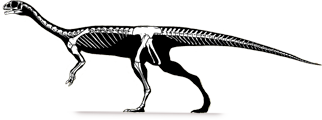
To deduce their true affinities, Novas et al. compared these new remains to those of a broad range of species from each of the three groups that they were suspected of belonging to and totted up the aggregate score of similarities. The best-supported conclusion is that Chilesaurus belongs to Theropoda, the branch of saurischian dinosaurs that are renowned for their fondness for flesh. But long, forward-slanting, leaf-shaped teeth suggest they were vegetarians, perhaps with a beaked snout, and not particularly swift ones judging by the design of the pelvis, legs and feet.
Of course, vegetarian theropods are nothing new. Ornithomimids, oviraptorosaurs, therizinosaurs, and even a ceratosaur have all dabbled with herbivory or at least omnivory. What is unusual, however, is that theropods (carnivorous or otherwise) are far outnumbered in most eco-systems by herbivorous ornithischians and sauropodomorphs, but Chilesaurus had independently evolved a plethora of features in common with both lineages of herbivorous dinosaur, and they outnumbered everything else. Unfortunately, their numerical dominance in the Aysén assemblage and modest size suggest Chilesaurus occupied the niche normally reserved for herbivores and were the major food source for larger predators in their ecosystem.
The big surprise arrived with four complete skeletons that each sported all of those features, prompting stunned workers to compare them, metaphorically, to Platypus: the oddball, egg-laying, duck-billed mammals from Australia. They were Christened Chilesaurus, referring to the country that yielded their remains. But we can't help thinking that the authors missed a trick by not naming them after Chile-con-carne, a creation of the culinary variety that has also come to be represented by a hotch-potch of weird and wonderful components.
To deduce their true affinities, Novas et al. compared these new remains to those of a broad range of species from each of the three groups that they were suspected of belonging to and totted up the aggregate score of similarities. The best-supported conclusion is that Chilesaurus belongs to Theropoda, the branch of saurischian dinosaurs that are renowned for their fondness for flesh. But long, forward-slanting, leaf-shaped teeth suggest they were vegetarians, perhaps with a beaked snout, and not particularly swift ones judging by the design of the pelvis, legs and feet.
Of course, vegetarian theropods are nothing new. Ornithomimids, oviraptorosaurs, therizinosaurs, and even a ceratosaur have all dabbled with herbivory or at least omnivory. What is unusual, however, is that theropods (carnivorous or otherwise) are far outnumbered in most eco-systems by herbivorous ornithischians and sauropodomorphs, but Chilesaurus had independently evolved a plethora of features in common with both lineages of herbivorous dinosaur, and they outnumbered everything else. Unfortunately, their numerical dominance in the Aysén assemblage and modest size suggest Chilesaurus occupied the niche normally reserved for herbivores and were the major food source for larger predators in their ecosystem.
(Suárez' Chile Lizard)Etymology
Chilesaurus is derived from "Chile" (the country in which it was discovered) and the Greek "sauros" (lizard).
The species epithet, diegosuarezi, honors Diego Suárez (see below). In the advanced online publication of his Chilesaurus paper in 2022, Mathew Baron mispelled the epithet as saurezi several times, including in the paper's title. Neither the author, editors nor reviewers noticed, and the errors were still there when the paper was released in its final form two years later!
ZooBank registry: urn:lsid:zoobank.org:act:7B6DE8C7-C78D-48C0-B818-65C454AEFB58.
Discovery
The remains of Chilesaurus were discovered at Aysén in the Toqui Formation, in the mountains flanked by the Maitenes and Horquetas rivers, south of General Carrera Lake (Lago), Southern Chile in 2004, by seven-year-old Diego Suárez whilst hiking with his parents: Chilean geologists Manuel Suárez and Rita de la Cruz, and his sister: Macarena.The holotype (SNGM-1935) is an almost complete juvenile skeleton, 1.6 meters long. Referred specimens SNGM-1936, 1937 and 1938, as well as the holotype, all preserve arms that were bent at the elbows and pulled close to the lower torso (ventrally flexed) with the hands oriented backwards, as if resting when they perished. The same quarry also yielded more fragmentary fossils of various growth stages, including SNGM-1889 (a right ilium), SNGM-1895 (a piece of left shin), SNGM 1888 (a partial left foot, heel and ankle joined to a piece of shin and calf), SNGM-1901 (a piece of right shin), SNGM-1894, 1898, 1900, 1903 (isolated back vertebra), and SNGM-1887 (a partial left hand).


