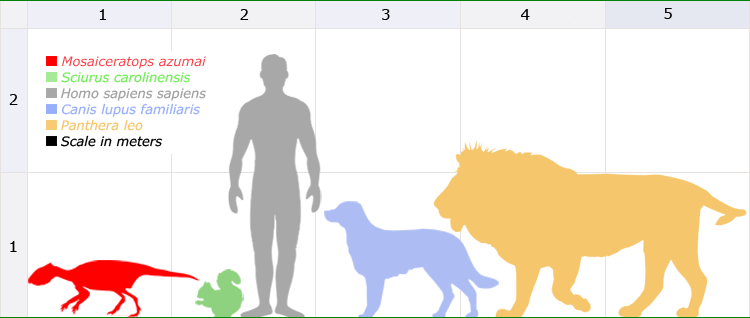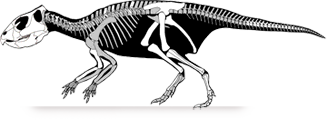
Pronunciation: mo-ZAY-yih-SEH-ruh-tops
Meaning: Mosaic horn face
Author/s: Zheng, Xu and Jin (2015)
Synonyms: None known
First Discovery: Henan, China
Acta Ordinal: #921
Mosaiceratops azumai
(Azuma's mosaic horn face)Etymology
Mosaiceratops is derived from the Latin "mosaicus" and the Greek "ceras" (horn) and "ops" (face), referring to its unique combination (or mosaic) of characters that were previously found only in basal ceratopsians, psittacosaurids, or basal neoceratopsians. The species epithet, azumai, honours Dr. Yoichi Azuma from Fukui Prefectural Dinosaur Museum who co-organized and participated in several dinosaur expeditions in China, one of which led to the discovery of Archaeoceratops.
In 2015, Mosaiceratops was one of eighteen dinosaurs from a total of thirty-five to be described in open access or free-to-read journals. This marks the first year that the majority of new dinosaur papers (51 percent) were freely readable and not hidden behind paywalls.
Discovery
The remains of Mosaiceratops were discovered in the Xiaguan Formation on the west bank of Tuanhe River, Xiaguan-Gaoqiu Basin, Neixiang County, southwestern Henan Province, China.
The holotype (ZMNH M8856, housed in the collections of the Zhejiang Museum of Natural History, Hangzhou, China) is a skull (15 cm long) and a partial skeleton, including three neck vertebrae, three back vertebrae, ribs, 18 tail vertebrae, chevrons, a partial tight arm (humerus and radius), hip bones (both ilia and the left ischium), both thighs, both shins, the left calf, the left ankle and heel, toe bones, and some unidentifiable fragments.
Preparators
Yiming Sheng and Chaohe Yu.