









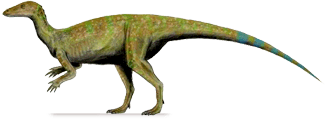
Pronunciation: BOO-jen-a-SOR-uh
Meaning: Large cheek lizard
Author/s: Galton (1995)
Synonyms: None known
First Discovery: South Dakota, USA
Acta Ordinal: #
Bugenasaura infernalis
Bugenasaura is a plant-eating dinosaur from the famous Hell Creek Formation of South Dakota and was big enough to cause quite a stir, despite being modestly sized. It was initially described as an "unidentified species of Thescelosaurus" (Thescelosaurus sp.) in 1976 by William Morris, who pointed out deeply inset tooth rows and interpreted heavy ridges on its jaws as large cheek attachment points, and those, plus a flared out beak, are what Peter Galton pounced on when he christened this specimen the "large-cheeked lizard" in 1995.
Clint Boyd revisited the now-named Buganasaura in 2009 and described it as wonderful. However, he was talking about Thescelosaurus — "the wonderful lizard" — and handed the fossils back to their rightful owner. Bugenasaura infernalis is now an unidentified species of Thescelosaurus, which is exactly what it used to be.
Clint Boyd revisited the now-named Buganasaura in 2009 and described it as wonderful. However, he was talking about Thescelosaurus — "the wonderful lizard" — and handed the fossils back to their rightful owner. Bugenasaura infernalis is now an unidentified species of Thescelosaurus, which is exactly what it used to be.
Etymology
Buganasaura is derived from the Latin "bu" (large) and "gena" (cheek), and the Greek "saura" (feminine form of lizard). The species epithet, infernalis, is derived from the Latin "infernus" (the lower regions, aka hell), which is a reference to its discovery in the Hell Creek Formation.
Discovery
The first fossils of Bugenasaura were discovered in the Hell Creek Formation of Harding County, South Dakota, USA, by Kenneth H. Oson and Arland Jacobson in 1972.
The holotype (SDSM 7210) is a partial skull, four back vertebrae, and two finger bones. Referred material includes YPM 8098 (a right dentary tooth collected by J. B.
Hatcher from the Lance Formation of Lusk, Wyoming, in 1889), MOR 979 (an almost complete skull and partial skeleton from the Hell Creek
Formation of Montana), and LACM 33542 (five neck and eleven
back vertebrae, and a partial left leg found by Harli Garbani in the Hell Creek formation of Garfield County, Montana) which was the holotype of ?Thescelosaurus garbanii. When Bugenasaura was sent back to Thescelosaurus from whence it came, all referred material went with it, apart from the holotype of ?Thescelosaurus garbanii, which was relieved of its troublesome question mark and became Thescelosaurus garbanii.


