






Pronunciation: way-way-cuh-NOW-tlus
Meaning: Ancient Duck
Author/s: Ramírez-Velasco (2012)
Synonyms: None known
First Discovery: Michoacán, Mexico
Acta Ordinal: #814
Huehuecanauhtlus tiquichensis
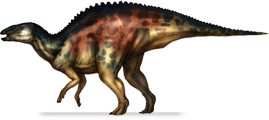
If you thought Huehuecanauhtlus was named after an Aztec God you would be wrong, though we can understand why you would jump to such a conclusion. Several Aztec deities were pre-fixed with "Huehue" (literally "old old" or commonly "ancient"): Huehuecoyotl was "Ancient Coyote", the old old trickster God of irrational fun, and Huehueteotle was just the old old God. Huehuecanauhtlus is an old old hadrosauroid, the southern-most diagnostic basal hadrosauroid from the Americas, no less, but it's teetering on the brink of Hadrosauridae proper.
Severe ouchies
The holotype of Huehuecanauhtlus tiquichensis shows three instances of damage in its spine and ribs. One vertebra is completely fused to a rib by a large, abnormal lump of bone caused by a spinal infection (osteomyelitis), which compressed the spinal nerve, likely causing direct neurological damage, chronic back pain, and possibly weakness or partial paralysis on the right side.
The same rib showed a second tumour-like growth, plus a broken end that had not fully healed, causing sharp pain and breathing difficulties, and risk of internal problems like a collapsed lung (pneumothorax) or bleeding into the chest cavity (haemothorax). A second rib also had a large infected mass with multiple cavities, showing another deep bone infection. All bones show thinning of the outer
layer. Though none of these injuries killed it outright, they would have have severely affected the dinosaur's life, making movement difficult, breathing painful, and daily survival far more challenging.
(Ancient Duck from Tiquicheo)Etymology
Huehuecanauhtlus is derived from the Nahuatl Aztecan "Huehue" (literally old old, very old, or plain ancient) and "canauhtli" (duck), in reference to its position as one of the oldest hadrosaurs or "duck-billed" dinosaurs. The species epithet, tiquichensis, honours the town of Tiquicheo, for the generosity and hospitality of its people during the fieldwork season. "-ensis" is a Latin suffix that means "from".
Discovery
The remains of Huehuecanauhtlus were collected from "the sixth spot" in the Barranca Los Bonetes locality, Tuzantla, Michoacán ("place of the fishermen") State, southwestern Mexico.
The holotype (IGM 6253) is a fragmentary skull and skeleton, including parts of the left upper and lower jaw, vertebrae from the neck, back and tail with associated ribs and spines, and some hip bones, while a neck bone, teeth and a piece of left lower jaw (IGM 6254), from a smaller individual found at "the third spot", represent the paratype.
Hadrosauroid fossils were first discovered at Barranca Los Bonetes by Mouloud Benammi et al. in May of 2003, and more have been discovered since. But a lack of diognostic features means none of them can be assigned to Huehuecanauhtlus, or any other critter for that matter.


