PHYLLODON
a small neornithischian dinosaur from the Late Jurassic of Portugal.
Pronunciation: FILL-o-don
Meaning: Leaf tooth
Author/s: Thulborn (
1973)
Synonyms: None known
First Discovery: Leiria, Portugal
Acta Ordinal: #239
Phyllodon henkeli
(Henkel's Leaf Tooth)Etymology
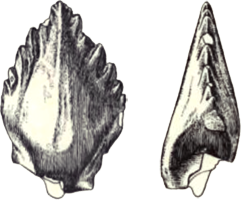
Phyllodon is derived from the Greek "phyllon" (leaf) and "odon" (tooth), in reference to the leaf-like shape of its cheek teeth.
Incidentally, the name is also in use for a genus of moss (
Phyllodon perplanicaulis, renowned for its ability to withstand desiccation during dry periods by entering a state of dormancy), which isn't considered an issue because the two organisms dwell in different kingdoms.
The
species epithet,
henkeli, honours Dr. Siegfried Henkel, who developed the "Henkel method" of collecting small vertebrate fossils, first used at the Guimarota site in 1962.
Discovery
The remains of
Phyllodon were discovered in the Camadas de Guimarota Formation at the Guimarota coal mine near Leiria, Portugal, between 1959 and 1961.
The
holotype (MGSP G5) is a tooth from the lower jaw. The paratype is a single upper jaw tooth crown (MGSP G2). Fifty-four teeth and fragments of teeth from the same site have also been referred to
Phyllodon. All specimens are preserved in the collection of the Lehrstuhl für Paläontologie at the Free University, Berlin.
Estimations
Timeline:
Era: Mesozoic
Epoch: Late Jurassic
Stage: Kimmeridgian
Age range: 155 mya
Stats:
Est. max. length: ?
Est. max. hip height: ?
Est. max. weight: ?
Diet: Herbivore
References
• Henkel S (1966) "
Methoden zur Prospektion und Gewinnung kleiner Wirbeltlerfossilien" [Methods for the prospection and extraction of small vertebrate fossils].
Neues Jahrbuch fuer Geologie und Palaeontologie Monatshefte, 3: 178-184.
• Kühne WG (1968) "
Contribuição para a fauna do Kimmeridgiano da Mina de Lignito Guimarota (Lelria, Portugal). 1. History of discovery, report on the work performed, procedure, technique and generalities".
Mémoria Serviços Geológicos de Portugal, 14(8): 1-20.
• Kühne W (1971) "Collecting Vertebrate Fossils by the Henkel Process".
Curator: the Museum Journal, 14(3): 175-179.
• Thulborn RA (1973) "
Teeth of ornithischian dinosaurs from the Upper Jurassic of Portugal, with description of a hypsilophodontid (Phyllodon henkeli gen. et sp. nov.) from the Guimarota lignite".
Memória Serivoços Geológicos de Portugal, Nova Série, 22: 89–134.
• Sues H-D and Norman DB (1990) "Hypsilophodontidae,
Tenontosaurus, Dryosauridae". Page 498–509 in Weishampel, Dodson and Osmólska (eds.) "
The Dinosauria: First Edition".
• Norman DB, Sues H-D, Witmer LM and Coria RA (2004) "Basal Ornithopoda". Page 393–412 in Weishampel, Dodson and Osmólska (eds.) "
The Dinosauria: Second Edition".
• Mateus O (2006) "Late Jurassic dinosaurs from the Morrison Formation (USA), the Lourinhã and Alcobaça Formations (Portugal), and the Tendaguru Beds (Tanzania): a comparison". In Foster and Lucas (eds.) "Paleontology and Geology of the Upper Morrison Formation".
New Mexico Museum of Natural History and Science Bulletin, 36: 223–231.
Time stands still for no man, and research is ongoing. If you spot an error, or want to expand, edit or add a dinosaur, please use
this form. Go
here to contribute to our FAQ.
All dinos are GM free, and no herbivores were eaten during site construction!
To cite this page:
Atkinson, L.
"
PHYLLODON :: from DinoChecker's dinosaur archive".
‹
http://www.dinochecker.com/dinosaurs/PHYLLODON›. Web access: 18th Oct 2026.