









Pronunciation: SAY-eet-AWD
Meaning: Sand monster
Author/s: Sertich and Loewen (2010)
Synonyms: None known
First Discovery: Utah, USA
Acta Ordinal: #728
Seitaad ruessi
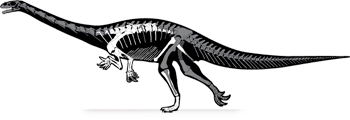
When paleontologists first clapped eyes on a photograph of Seitaad ruessi taken by Como Bluff artist Joe Pachak, they mistook a weathered hip bone for a portion of lower jaw and assumed it belonged to a pterosaur. With its containing block safely back at the UMNH, frenzied preparation work began, and it became apparent that what Joe Sertich and Mark Loewen had in hand was a theropod dinosaur. But nothing is certain in paleontology, and based on its hand what they actually had in hand was a thumb-clawed basal sauropodomorph (aka "prosauropod"), as of 2010 one of the few known from North America, and the most complete fossil ever discovered in the Navajo Sandstone Formation, with all of its known bones laying as they should be.
The only Seitaad specimen lacks a head, neck and tail, which has made its placement on the dinosaurian family tree a tad troublesome, but it may be a plateosaurid, or a massospondylid closely related to Adeopapposaurus and Massospondylus, or perhaps non-specialist plateosaurian closer to sauropods proper. Whatever it turns out to be, limb features suggest Seitaad was just as comfortable on four legs as it was on two, which just goes to show; four-leg drive is useless when the dune you're standing on collapses and buries you head first in sand, which is how palaeontologists suspect the Seitaad holotype met its end.
The only Seitaad specimen lacks a head, neck and tail, which has made its placement on the dinosaurian family tree a tad troublesome, but it may be a plateosaurid, or a massospondylid closely related to Adeopapposaurus and Massospondylus, or perhaps non-specialist plateosaurian closer to sauropods proper. Whatever it turns out to be, limb features suggest Seitaad was just as comfortable on four legs as it was on two, which just goes to show; four-leg drive is useless when the dune you're standing on collapses and buries you head first in sand, which is how palaeontologists suspect the Seitaad holotype met its end.
Etymology
Seitaad is named after Seit'aad; a mythical sand monster from the folklore of Navajo (specifically the Dineh peoples) who would bury its victims in dunes.
The species epithet, ruessi (ROO-ess-EYE), honors Everett Ruess who mysteriously disappeared while exploring southern Utah in 1934. ZooBank registry: urn:lsid:zoobank.org:act:03B8AA80-CBB1-459A-B1A3-233EADE343BF.
Discovery
The first remains of Seitaad was discovered by local artist Joe Pachak below the "Eagle's Nest" cliff dwelling (UMNH VP Locality 191, aka "Comb Ridge") in the Navajo Sandstone Formation (Glen Canyon Group), San Juan County, Utah, USA, in 2004.
The holotype (UMNH VP 18040) is a partial skull-less skeleton including 11 back vertebrae, 16 ribs, both shoulder girdles, a nearly complete left and partial right forelimb, a partial pelvis, a partial left hind limb and some belly ribs. Every bone was preserved in place which suggests Seitaad was still held together with soft tissue when it was buried. Unfortunately, the specimen was cracked in half during extraction, and due to the delicate preservation of the fossils and the articulated nature of the specimen, only the shin and pelvis were completely removed from the two blocks of matrix.
Preparators
J. Golden.


