









Pronunciation: da-sen-TROOR-us
Meaning: Very sharp tail
Author/s: Lucas (1902)
Synonyms: None known
First Discovery: Wiltshire, England
Acta Ordinal: #86
Dacentrurus armatus
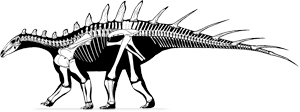
Dacentrurus—one of the biggest stegosaurs but unfathomably referred to as small in much of the literature—was the first stegosaur ever discovered, and it caused quite a stir. At around eight meters long and weighing close to three tons the likes of it had never been seen before, and Sir Richard Owen was so taken by its incredibly robust front legs that he initially named it Omosaurus—"the forelimb lizard". Perhaps even more unusual were the four pairs of spikes that adorned its tail, so it was quite a stroke of luck that an Omosaurus was already known, albeit a "crocodilian" (Omosaurus perplexus, Leidy, 1856). So, in 1902, Lucas coined Dacentrurus in honour of its striking (no pun intended) tail. That's a far better name anyway.
Despite being known from much of the western EU, with more remains turning up in England, France and Portugal, Dacentrurus remained a bit obscure until the discovery of the "sauropod mimic" Miaragaia in 2009. The pair have been found in the exact same time and place—the Late Jurassic Sobral Formation of Lourinha, Portugal—and because Dacentrurus is known mostly from its rear-end and Miragaia almost entirely from its front-end a theory began to gather steam in 2010 that they may have been one and the same type of critter. However, a review of stegosaurids in 2017, using enhanced data and advanced technology, concluded that Dacentrurus and Miragaia, and also Stegosaurus and Hesperosaurus, were very much separate entities. The 2019 description of a Mirigaia specimen (MG 4863) with both front and rear parts present, that had been loitering at the Alfragide campus of LNEG (Laboratório Nacional de Energia e Geologia) since its discovery at Atouguia da Baleia in Portugal way back in 1959, confirmed that review's findings.
Fossilised tridactyl (three-toed) footprints known as Deltapodus from Portugal, England and France have been attributed to meandering Dacentrurus.
Despite being known from much of the western EU, with more remains turning up in England, France and Portugal, Dacentrurus remained a bit obscure until the discovery of the "sauropod mimic" Miaragaia in 2009. The pair have been found in the exact same time and place—the Late Jurassic Sobral Formation of Lourinha, Portugal—and because Dacentrurus is known mostly from its rear-end and Miragaia almost entirely from its front-end a theory began to gather steam in 2010 that they may have been one and the same type of critter. However, a review of stegosaurids in 2017, using enhanced data and advanced technology, concluded that Dacentrurus and Miragaia, and also Stegosaurus and Hesperosaurus, were very much separate entities. The 2019 description of a Mirigaia specimen (MG 4863) with both front and rear parts present, that had been loitering at the Alfragide campus of LNEG (Laboratório Nacional de Energia e Geologia) since its discovery at Atouguia da Baleia in Portugal way back in 1959, confirmed that review's findings.
Fossilised tridactyl (three-toed) footprints known as Deltapodus from Portugal, England and France have been attributed to meandering Dacentrurus.
Etymology
Dacentrurus is derived from the Greek "da" (very), "kentron" (sharp point) and "oura" (tail), in reference to the "thagomizer" on its tail. The species epithet, armatus, means "equipped with armour" in Latin.
Discovery
The first remains of Dacentrurus were discovered at the "Swindon Brick and Tile Company" Quarry in the Kimmeridge Clay Formation of Wiltshire, England, by James Shopland on May 23rd, 1874. The holotype (BMNH 46013) is a partial skeleton including the pelvis, femur and some vertebrae, but no skull. "Dacentrurus" fossils have since been found at various other sites in England, France, Spain and Portugal. But most of them are fragmentary and considered not worth the bother by most palaeontologists.


