





Pronunciation: san-SOH-ree-OP-tuh-riks
Meaning: Climbing wing
Author/s: Czerkas and Yuan (2002)
Synonyms: Epidendrosaurus? (Zhang, 2002)
First Discovery: Liaoning, China
Acta Ordinal: #515
Scansoriopteryx heilmanni
The holotype of Scansoriopteryx is a mere hatchling the size of a sparrow, so strictly speaking, it wasn't strong enough to carry its own name, taxonomically or otherwise. Nor was the only slightly older fellow scansoriopterygid Epidendrosaurus (EH-pih-DEN-dro-SOR-us, "Top branch lizard", holotype V12653), which is so closely related that the pair actually represent the same species! Funnily enough, the latter was named first, so it should have precedence. But its name appeared online before the ICZN had embraced modern technology, and the former beat it onto ink and paper, which was, at the time, still the only valid scientific medium for officially naming critters.
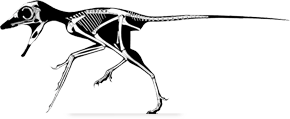
Scansoriopteryx, like all scansoriopterygids, was a weirdy. For starters, its arms are longer than its legs, and the outermost finger of its three-fingered hands is almost twice as long as the next longest, which is unusual among theropods. Typically of maniraptorans, it had a half-moon-shaped bone in each wrist (semilunate carpal) that allowed for a bird-like folding motion in the hands. And it was feathered but incapable of powered flight, even as an adult. Contrary to its most bird-like features, its tail was a half dozen times the length of its thighs and ended in a fan of feathers, while its pelvis is remarkably primitive and, in some ways, not even dinosaur-like. Scansoriopteryx is a lesson in contradictions. Heck, even its age is hotly contested.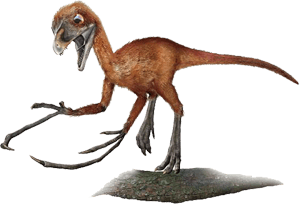
Because farmers are notoriously absent-minded about things like logging provenance data, the age of Scanceriopterx is uncertain. Czerkas and Yuan initially thought it hailed from the Early Cretaceous Yixian Formation, but Wang and colleagues reckon it's from the Daohugou beds (aka the Jiulongshan Formation), and the potential age discrepancy between the two is monumental. If carbon dating of the latter area is anything like reliable, it would push the age of the flightless Scansoriopteryx way back into the Middle Jurassic, meaning it was closer to the ancestor of all birds than Archaeopteryx - aka Urvogel - which literally means "first bird". In 2014, Czerkas and Feduccia went further, claiming Scansoriopteryx wasn't a dinosaur at all and opined that, despite millions of years of fossil evidence to the contrary, all dinosaurs evolved from flightless birds rather than vice versa.
Given its unusual proportions, most palaeontologists agree that Scansoriopteryx was arboreal (it lived in trees) and used its long forelimbs with strongly curved claws and scaley feet with an unusually large, backwards pointing hallux (the "thumb" of the foot, if you like) for grip. Its long first finger might have been a tool for poking crevices in search of grubs, but Yi Qi showed an alternate function, as its long digits (and thus, perhaps, those of all scansoriopterygids) supported sheets of membranous tissue akin to bat wings, which it used to glide from tree to tree.
Scansoriopteryx, like all scansoriopterygids, was a weirdy. For starters, its arms are longer than its legs, and the outermost finger of its three-fingered hands is almost twice as long as the next longest, which is unusual among theropods. Typically of maniraptorans, it had a half-moon-shaped bone in each wrist (semilunate carpal) that allowed for a bird-like folding motion in the hands. And it was feathered but incapable of powered flight, even as an adult. Contrary to its most bird-like features, its tail was a half dozen times the length of its thighs and ended in a fan of feathers, while its pelvis is remarkably primitive and, in some ways, not even dinosaur-like. Scansoriopteryx is a lesson in contradictions. Heck, even its age is hotly contested.
Because farmers are notoriously absent-minded about things like logging provenance data, the age of Scanceriopterx is uncertain. Czerkas and Yuan initially thought it hailed from the Early Cretaceous Yixian Formation, but Wang and colleagues reckon it's from the Daohugou beds (aka the Jiulongshan Formation), and the potential age discrepancy between the two is monumental. If carbon dating of the latter area is anything like reliable, it would push the age of the flightless Scansoriopteryx way back into the Middle Jurassic, meaning it was closer to the ancestor of all birds than Archaeopteryx - aka Urvogel - which literally means "first bird". In 2014, Czerkas and Feduccia went further, claiming Scansoriopteryx wasn't a dinosaur at all and opined that, despite millions of years of fossil evidence to the contrary, all dinosaurs evolved from flightless birds rather than vice versa.
Given its unusual proportions, most palaeontologists agree that Scansoriopteryx was arboreal (it lived in trees) and used its long forelimbs with strongly curved claws and scaley feet with an unusually large, backwards pointing hallux (the "thumb" of the foot, if you like) for grip. Its long first finger might have been a tool for poking crevices in search of grubs, but Yi Qi showed an alternate function, as its long digits (and thus, perhaps, those of all scansoriopterygids) supported sheets of membranous tissue akin to bat wings, which it used to glide from tree to tree.
(Heilman's climbing wing)Etymology
Scansoriopteryx is derived from the Latin "scandere" (climb) and the Greek "pteryx"' (wing).The species epithet, heilmanni, honors Gerhard Heilmann, a pioneer of avian paleontological studies.
Discovery
The provenance of Scansoriopteryx is uncertain as it was obtained from private fossil dealers, allegedly via a local farmer, who failed to record its geologic data. Czerkas and Yuan reckon it was probably found in China's Early Cretaceous-aged Yixian Formation, though later studies suggest it hailed from the possibly-Middle Jurassic-aged Daohugou fossil beds and is thus synonymous with the same area's Epidendrosaurus.
 • Padian K (2004) "Basal Avialae" in "


