









Pronunciation: NEE-oh-VEN-uh-tuh
Meaning: New hunter
Author/s: Hutt et al. (1996)
Synonyms: None known
First Discovery: Isle of Wight, UK
Acta Ordinal: #417
Neovenator salerii
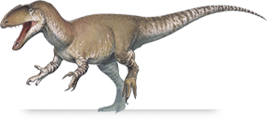
When the Henwood Family dug the first fossils of Neovenator salerii from a storm-caused cliff landslide on the Isle of Wight in 1978, palaeontologists assumed they were the remnants of a Megalosaurus relative, and why wouldn't they be? They were large, English and belonged to a carnivorous dinosaur, and Megalosaurus used to be the first stop for most large, English, carnivorous dinosaurs. However, after 18 years of MacGuyver-like missions by an army of volunteers and with 70% of its skeleton now known thanks to contributions from three separate specimens, Neovenator is pretty well understood. Well, more so than it used to be.
Neovenator was officially named during its first scientific description in 1996 by Steve Hutt, who identified it as an allosaurid. Then later, Darren Naish noted some similarities to the shark-toothed carcharodontosaurids. As it turns out, Neovenator (meaning "new hunter") was just that, an all-new species of carnivorous dinosaur which has since gone on to anchor its own family of previously problematic cosmopolitan carnivores: a bunch of moderately-sized, sleek and fleet of foot theropods known as neovenatorids, that are related to both the allosaurids and carcharodontosaurids, though they're closer to the latter than to the former.
Neovenator was officially named during its first scientific description in 1996 by Steve Hutt, who identified it as an allosaurid. Then later, Darren Naish noted some similarities to the shark-toothed carcharodontosaurids. As it turns out, Neovenator (meaning "new hunter") was just that, an all-new species of carnivorous dinosaur which has since gone on to anchor its own family of previously problematic cosmopolitan carnivores: a bunch of moderately-sized, sleek and fleet of foot theropods known as neovenatorids, that are related to both the allosaurids and carcharodontosaurids, though they're closer to the latter than to the former.
(Salero's New Hunter)Etymology
Neovenator is derived from the Greek "neos" (new) and the Latin "venator" (hunter), in reference to its status as a previously unknown species of carnivorous dinosaur.
The species epithet,
salerii, honors the Salero family, the owners of the land on which Neovenator was discovered.
Discovery
The remains of Neovenator were first discovered in plant debris bed L9 of the Wessex Formation, after a storm-caused cliff fall from Grange Chine onto the beach of Brighstone Bay, Isle of Wight, England, by the Henwood Family, who were on holiday from Basingstoke, in 1978.
The holotype (MIWG 6348, housed at the Museum of Isle of Wight Geology) is a partial skeleton.


