









Pronunciation: an-TEE-toh-NIGH-trus
Meaning: Before the thunder
Author/s: Yates and Kitching (2003)
Synonyms: None known
First Discovery: Free State, South Africa
Acta Ordinal: #541
Antetonitrus ingenipes
The critter we now know as Antetonitrus was discovered by James Kitching in the Free State of South Africa in 1981, then lay gathering dust on the shelves of Witwatersrand University's Bernard Price Institute in Johannesburg after being misidentified as a specimen of the "prosauropod"
Euskelosaurus. Its fossils were rediscovered two decades later by Adam Yates, who recognized them as distinct. Then he set about making sense of their weird features before publishing his findings in cahoots with Kitching in 2002.|1|
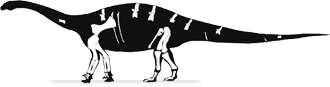
Antetonitrus, meaning "before the thunder", is one of the earliest sauropods but appears to retain some of the features of its earlier, primarily bipedal, mostly lightweight relatives; the non-sauropod sauropodomorphs (aka "prosauropods"). It was moderately sized but already rotund, with long and strong forelimbs, thickened wrists and short, robust hands that are all adaptations for weight-bearing, but its thumbs remained flexible, which suggests it was still able to grasp and manipulate food. In the coming millions of years, Antetonitrus' relatives would evolve even longer thicker "arm" bones and stronger muscles to lock the wrists for permanent four-leg-drive, the super-sizing would begin, and the thunder would arrive with the ground-shaking sauropods, known colloquially as "thunder lizards" (including Brontosaurus—the OG "thunder lizard"), which are the biggest and heaviest animals that have ever walked the earth.
Antetonitrus, meaning "before the thunder", is one of the earliest sauropods but appears to retain some of the features of its earlier, primarily bipedal, mostly lightweight relatives; the non-sauropod sauropodomorphs (aka "prosauropods"). It was moderately sized but already rotund, with long and strong forelimbs, thickened wrists and short, robust hands that are all adaptations for weight-bearing, but its thumbs remained flexible, which suggests it was still able to grasp and manipulate food. In the coming millions of years, Antetonitrus' relatives would evolve even longer thicker "arm" bones and stronger muscles to lock the wrists for permanent four-leg-drive, the super-sizing would begin, and the thunder would arrive with the ground-shaking sauropods, known colloquially as "thunder lizards" (including Brontosaurus—the OG "thunder lizard"), which are the biggest and heaviest animals that have ever walked the earth.
Etymology
Antetonitrus is derived from the Latin "ante" (before) and "tonitrus" (thunder) which is a reference to its existence before Brontosaurus (meaning "Thunder Lizard" in Greek). This was an amazing instance of foresight, as Brontosaurus had been sunk as a synonym of Apatosaurus by Elmer Riggs in 1903, but came thundering back as a valid critter courtesy of Tschopp, Mateus and Benson in 2015.|2|
The species epithet, ingenipes, is derived from the Latin "ingens" (massive) and "pes" ("paw" or "foot"), in reference to its robust hands and feet.
Discovery
Veteran fossil hunter James W. Kitching discovered Antetonitrus on farmland in the Lower Elliot Formation, Ladybrand District, Orange Free State, South Africa in 1981.
The holotype (BP/1/4952) consists of several types of vertebrae and numerous bones from both forelimb and hind limb. A smaller referred specimen (BP/1/4952b), including a right shoulder blade, a right humerus (one of two forearm bones), a left
ulna (the other forearm bone), a left shinbone and a right metatarsal II, was found at the same site as the holotype.
Back when Antetonitrus and its Norian-aged Elliot Formaton brethren (Melanorosaurus and Blikanasaurus) were still thought to be prosauropods, the oldest known sauropod was Isanosaurus from the slightly-younger Late Norian-Early Rhaetian-aged Nam Phong Formation of Thailand.|3| Yates' identification of the South African forms as sauropods themselves may have knocked Isanosaurus off its perch, date-wise, but it's still the earliest example of a true sauropod that walked permanently on four legs.


