




Pronunciation: jin-feng-OP-tuh-rix
Meaning: Golden Phoenix Feather
Author/s: Ji (2005)
Synonyms: None known
First Discovery: Hebei Province, China
Acta Ordinal: #575
Jinfengopteryx elegans
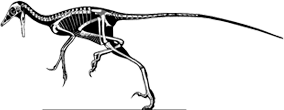
Jinfengopteryx — the "Golden Phoenix Feather" — was initially identified as a member of Archaeopterygidae and later compared to Archaeopteryx, but Ji's attempts to pass it off as the most basal bird were a little optimistic. An enlarged claw on its short second toe, a short rounded snout, and high tooth count were amongst many dinosaurian features highlighted by Chiappe, Xu and others, and Turner hammered the last nail into the coffin of this want-to-be bird by placing it squarely amongst the troodontids after an in-depth study of early birds, bird-like dinosaurs, and early dinosaurs that were once confused with birds.
Fortunately, Jinfengopteryx became more remarkable after its family shift and is the first troodontid discovered with contour feather impressions. Furthermore, tiny reddish-yellow "pearls" in its body cavity have been interpreted as remains of its last grain-based meal which is the first real evidence to back up early theories that troodontids weren't, in fact, purely carnivorous.
Fortunately, Jinfengopteryx became more remarkable after its family shift and is the first troodontid discovered with contour feather impressions. Furthermore, tiny reddish-yellow "pearls" in its body cavity have been interpreted as remains of its last grain-based meal which is the first real evidence to back up early theories that troodontids weren't, in fact, purely carnivorous.
Etymology
Jinfengopteryx takes it name from "Jinfeng" (Golden Phoenix - the Queen of birds in Chinese folklore) and the Greek "pteryx" (feather or wing). The species epithet, elegans, means elegant, fine or handsome in Latin.
Discovery
The remains of Jinfengopteryx were discovered at Longfengshan Hill in the Qiaotou member of the Huajiying Formation, Hebei Province, China. The holotype (CAGS-IG-04-0801) is a nearly complete, two feet long, articulated skeleton with fossilized non-flight feather impressions.


