






Pronunciation: koo-lin-dap-tuh-rix
Meaning: Kulinda wing
Author/s: Alifanov and Saveliev (2014)
Synonyms: None known
First Discovery: Transbaikal, Siberia
Acta Ordinal: #
Kulindapteryx ukureica
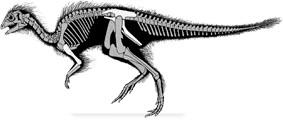
Having waited what felt like an eternity for the official unveiling of a rumoured-to-be-feathered ornithopod from Kulinda—initially nicknamed "Kulindosaurus" and later referred to as "Kulindodromeus"—that was supposed to be described by Pascal Godefroit, the community was blindsided in 2014 when Alifanov and Saveliev suddenly named a "feathered" ornithopod from the same locality Kulindapteryx.
Fossilised in volcanic ash, the material preserved patches of skin showing that the lower legs, feet, and tail underside were scaled, while the rest of the body bore "feather-like structures". That would push the origin of feathers closer to the base of the dinosaurian family tree rather than confining them to the theropod lineage, where the evidence has always pointed. However, despite the "pteryx" of its name meaning "wing", the supposed feathers appear to be nothing more than bristly filaments, which is old news, as such structures have already been found on other ornithischians such as Tianyulong and Psittacosaurus.
Because the anticipated presentation of "Kulindodromeus" at SVP in 2013 was pulled at the last minute due to health issues, it was unclear whether Kulindapteryx was based on the same Kulinda remains or not. Perhaps it was an entirely different species, of the same family, with similar features, from the exact same area. But our suspicious minds kept telling us that the delay opened a window of opportunity for taxonomic claim-jumpers, and we feared that Godefroit had been well and truly scooped. Allegedly, the situation was far worse than that.
A note from Godefroit:
"Please forget about those names (Kulindapteryx ukureica and Daurosaurus olovus). These are based on specimens that Alifanov stole in Chita and that are illegally housed in PIN in Moscow but belong, in fact, to the Institute of Natural Resources Ecology and Cryology (Chita). Moreover, there is a single taxon. And it is not a hypsilophont but a basal ornithischian. This paper is a true paleontological scandal! The official paper implying the original discoverers of the specimens... and based on the legal INREC material in Chita... will be published in July in one of the highest-ranked scientific journals!"
And so it came to pass. Godefroit's paper duly arrived via "Science" and is now free to view, despite being initially hidden behind a pay-wall, but there's no mention of stolen specimens. Alifanov's paper disappeared from the interweb soon after. An admission of guilt, perhaps?
Because the anticipated presentation of "Kulindodromeus" at SVP in 2013 was pulled at the last minute due to health issues, it was unclear whether Kulindapteryx was based on the same Kulinda remains or not. Perhaps it was an entirely different species, of the same family, with similar features, from the exact same area. But our suspicious minds kept telling us that the delay opened a window of opportunity for taxonomic claim-jumpers, and we feared that Godefroit had been well and truly scooped. Allegedly, the situation was far worse than that.
A note from Godefroit:
"Please forget about those names (Kulindapteryx ukureica and Daurosaurus olovus). These are based on specimens that Alifanov stole in Chita and that are illegally housed in PIN in Moscow but belong, in fact, to the Institute of Natural Resources Ecology and Cryology (Chita). Moreover, there is a single taxon. And it is not a hypsilophont but a basal ornithischian. This paper is a true paleontological scandal! The official paper implying the original discoverers of the specimens... and based on the legal INREC material in Chita... will be published in July in one of the highest-ranked scientific journals!"
And so it came to pass. Godefroit's paper duly arrived via "Science" and is now free to view, despite being initially hidden behind a pay-wall, but there's no mention of stolen specimens. Alifanov's paper disappeared from the interweb soon after. An admission of guilt, perhaps?
(Kulinda Wing from Ukureisk)Etymology
Kulindapteryx is derived from "Kulinda" (for the area in which it was discovered) and the Latin "pteryx" (wing).
The species epithet, ukureica, is derived from "Ukureisk" (for the Ukureisk Formation).
Discovery
The remains of "Kulindapteryx" hail from the Ukureisk formation at the Kulinda locality, within the Olov Depression, Chernyshevsky District, near Chernyshevsk Village, 220 km to the east of Chita city in what is now Zabaykalsky Krai (formerly Chitinskaya Oblast or Chita Region), Transbaikal region, southeastern Siberia, Russia. The locality was found by Sofia M. Sinitsa, during an Institute of Natural Resources, Ecology and Cryology, Siberian Branch of the Russian Academy of Sciences (INREC) expedition in 2010.


