









Pronunciation: ling·wu-long
Meaning: Lingwu dragon
Author/s: Xu et al. (2018)
Synonyms: None known
First Discovery: Ningxia Hui, China
Acta Ordinal: #1008
Lingwulong shenqi
(The amazing dragon of Lingwu)Etymology
Lingwulong is derived from "Lingwu" (for the geopark and city where the specimens were found) and the Mandarin Chinese "long" (dragon).
The species epithet, shenqi, means "amazing" in Mandarin Chinese, reflecting the unexpected discovery of a dicraeosaurid in the Middle Jurassic of China.
Discovery
The remains of Lingwulong were discovered in the Yanan Formation at Lingwu Geopark, near Ciyaopu, Yinchuan, Ningxia Hui Autonomous Region, China, by sheep herder Ma Yun in 2004.
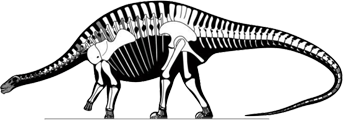
The holotype (LM V001a) is a partial skull. The paratype (LGP V001b) is a semi-articulated partial skeleton including a series of back vertebrae, complete sacrum (fused hip vertebrae), a tail vertebra, partial pelvis, and an incomplete right hind limb.
Referred specimens: IVPP V23704 (29 dentary teeth preserved in a 'U'-shaped arc), LGP V002 (a partial skeleton including several back and tail vertebrae, both shoulder blades, partial forelimbs, and partial pelvis), LGP V003 (a partial skeleton including a nearly complete series of back and hip vertebrae, both ilia [hip bones], and two tail vertebrae), LGP V004 (a small individual represented by a neck vertebra, a back vertebra, and right shin), LGP V005 (a partial skeleton preserving the sacrum, pelvis, and a semi-articulated series of 25 tail vertebrae) and LGP V006 (a partial skeleton preserving several neck vertebrae, partial shoulder girdle, and partial forelimb, plus numerous disassociated elements).
Preparators
Wang Haijun, Xiang Lishi, He Sicai, Cao Renfang, Tang Zhilu and Tao Yu.


