Pronunciation: DIP-luh-doh-COY-dee-uh
Author: Othniel Charles Marsh
Year: 1884
Meaning: Double beam-like (see etymology)
Locomotion: Quadrupedal (four legs)
Synonyms: Diplodocoidae (Hunt et al., 1994)—mispelling
Diplodocoidae (Upchurch, 1999)—mispelling
Rebbachisauroidea (Apesteguía, 2007)
Rebbachisauroidea (Apesteguía, 2007)
[Upchurch, 1995]Definition
All neosauropods more closely related to Diplodocus longus than Saltasaurus loricatus.
About
Diplodocoidea emerged in the Middle Jurassic as one of the two great branches of Neosauropoda, a lineage that begins to pull the sauropod body plan in striking new directions. Where their macronarian counterparts would push toward more vertical necks and high browsing, early diplodocoids experiment with a different suite of anatomical shifts—long, horizontally inclined necks, equally elongated tails, and a posture tuned to low-to-mid browsing and grazing. From their first appearances in the fossil record of the Americas, Africa, and Europe, they diversify into a triad of forms that stretch, shorten, or otherwise re-engineer the neosauropod blueprint, setting the stage for one of the most distinctive radiations in dinosaur evolution.
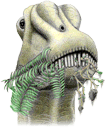
For all their later diversity, diplodocoids carry a shared heritage that shows most clearly in the cranial architecture: Long skulls with slender peg-like teeth clustered at the very front of a squared-off snout. These teeth were not designed for chewing, but for raking and stripping vegetation in large swaths, wearing down quickly and being replaced just as fast. Beyond the skull, however, their paths diverge dramatically. Rebbachisaurids refined the jaws into gnawing machines with the sauropod equivalent of "dental batteries", and lightened the skeleton until their bodies were almost as much air as bone. Huge diplodocids stretched the diplodocoid bauplan to almost absurd proportions with some of the longest necks in Sauropoda, and extremely long whip-like tails likely capable of subsonic if not sonic-boom speeds. Dicraeosaurids, meanwhile, took the opposite approach and shrank the entire frame, shortening the neck vertebrae and thus the neck itself while erupting tall, Y-shaped neural spines over a compact, robust body. In these sharp contrasts, the clade finds the innovations behind its greatest flourishing, a rise that carries Diplodocoidea to its apex even as the first hints of its eventual unravelling begin to take shape.
Diplodocoidea reaches its peak in the Late Jurassic as a suite of high-performance eating machines tuned to their world. But the very specialisations that once fueled their success became liabilities that began to limit their options as the Cretaceous reshaped around them. Their pencil-toothed, low-browsing strategy—so effective in earlier ecosystems—offered little flexibility in landscapes where plant communities began to shift, competitors diversified, and macronarians—especially the titanosaurs—began to dominate. By the turn of the middle Cretaceous the last diplodocoids were already the specialists among specialists, exquisitely adapted to a world that was slipping away, and in this narrowing evolutionary corridor, the lineage ultimately breathed its last breath.
Click here to view Dinochecker's A-Z list of diplodocoids.
Etymology
Diplodocoidea is derived from the Greek "diploos" (double) and "dokos" (beam), and the Latin "-oidea" (likeness, form, resemblance), in reference to the double-beamed bones (chevrons) on the underside of their tail vertebrae, and their relationship to Diplodocus. In the oudtated Linnaean system of classification,"-oidea" held the rank of "superfamily".
Relationships
References
• Upchurch P, Barrett PM and Dodson P (2004) "Sauropoda". Page 259-322 in Weishampel, Dodson and Osmolska (eds.) "The Dinosauria: Second Edition".
• Harris JD and Dodson P (2004) "A new diplodocoid sauropod dinosaur from the Upper Jurassic Morrison Formation of Montana, USA". Acta Palaeontologica Polonica, 49(2): 197-210.
• Wilson JA 2005) "Overview of sauropod phylogeny and evolution". In Curry Rogers and Wilson (eds.) "The sauropods: evolution and paleobiology".
• Taylor MP and Naish D (2005) "The phylogenetic taxonomy of Diplodocoidea (Dinosauria: Sauropoda)". PaleoBios, 25(2): 1-7.
• Sereno PC and Wilson JA (2005) "Structure and evolution of a sauropod tooth battery". Page 157–177 in Curry Rogers and Wilson (eds.) "The sauropods: evolution and paleobiology".
• Carpenter K and Tidswell V (2005) "Thunder Lizards: The Sauropodomorph Dinosaurs".
• Whitlock JA (2011) "Inferences of Diplodocoid (Sauropoda: Dinosauria) Feeding Behavior from Snout Shape and Microwear Analyses".  PLoS ONE, 6(4): e18304. DOI: 10.1371/journal.pone.0018304.
• Whitlock JA (2011) "A phylogenetic analysis of Diplodocoidea (Saurischia: Sauropoda)". Zoological Journal of the Linnean Society, 161; 872–915.
• Bajpai S, Datta D, Pandey P, Ghosh T, Kumar K and Bhattacharya D (2023) "Fossils of the oldest diplodocoid dinosaur suggest India was a major centre for neosauropod radiation". Scientific Reports, 13: 12680. DOI: 10.1038/s41598-023-39759-2. [Tharosaurus indicus.]
• Mannion PD and Moore AJ (2025) "Critical reappraisal of a putative dicraeosaurid sauropod dinosaur from the Middle Jurassic of Gondwana and a revised view of diplodocoid evolutionary relationships and biogeography". Journal of Systematic Palaeontology, 23(1): 2550760. DOI: 10.1080/14772019.2025.2550760. [Tharosaurus indicus is an indeterminate eusauropod that lacks
diplodocoid synapomorphies.]
• van der Linden TTP, Taylor MP, Campbell A, Curtice BD, Dederichs R, Lerzo LN,
Whitlock JA, Woodruff DC, and Tschopp E (2025) "Introduction to Diplodocoidea".
Palaeontologia Electronica, 28(2): a27. DOI: 10.26879/1518.
• Órfão J, de Celis A, Dunne EM, Ortega F and Mocho P (2026) "Everything, everywhere, all at once? Trends in Diplodocoidea diversity during the Jurassic/Cretaceous transition".
Fossil Record, 29(2): 707-730.
DOI: 10.3897/fr.29.189225.
PLoS ONE, 6(4): e18304. DOI: 10.1371/journal.pone.0018304.
• Whitlock JA (2011) "A phylogenetic analysis of Diplodocoidea (Saurischia: Sauropoda)". Zoological Journal of the Linnean Society, 161; 872–915.
• Bajpai S, Datta D, Pandey P, Ghosh T, Kumar K and Bhattacharya D (2023) "Fossils of the oldest diplodocoid dinosaur suggest India was a major centre for neosauropod radiation". Scientific Reports, 13: 12680. DOI: 10.1038/s41598-023-39759-2. [Tharosaurus indicus.]
• Mannion PD and Moore AJ (2025) "Critical reappraisal of a putative dicraeosaurid sauropod dinosaur from the Middle Jurassic of Gondwana and a revised view of diplodocoid evolutionary relationships and biogeography". Journal of Systematic Palaeontology, 23(1): 2550760. DOI: 10.1080/14772019.2025.2550760. [Tharosaurus indicus is an indeterminate eusauropod that lacks
diplodocoid synapomorphies.]
• van der Linden TTP, Taylor MP, Campbell A, Curtice BD, Dederichs R, Lerzo LN,
Whitlock JA, Woodruff DC, and Tschopp E (2025) "Introduction to Diplodocoidea".
Palaeontologia Electronica, 28(2): a27. DOI: 10.26879/1518.
• Órfão J, de Celis A, Dunne EM, Ortega F and Mocho P (2026) "Everything, everywhere, all at once? Trends in Diplodocoidea diversity during the Jurassic/Cretaceous transition".
Fossil Record, 29(2): 707-730.
DOI: 10.3897/fr.29.189225.
PLoS ONE, 6(4): e18304. DOI: 10.1371/journal.pone.0018304.
• Whitlock JA (2011) "A phylogenetic analysis of Diplodocoidea (Saurischia: Sauropoda)". Zoological Journal of the Linnean Society, 161; 872–915.
• Bajpai S, Datta D, Pandey P, Ghosh T, Kumar K and Bhattacharya D (2023) "Fossils of the oldest diplodocoid dinosaur suggest India was a major centre for neosauropod radiation". Scientific Reports, 13: 12680. DOI: 10.1038/s41598-023-39759-2. [Tharosaurus indicus.]
• Mannion PD and Moore AJ (2025) "Critical reappraisal of a putative dicraeosaurid sauropod dinosaur from the Middle Jurassic of Gondwana and a revised view of diplodocoid evolutionary relationships and biogeography". Journal of Systematic Palaeontology, 23(1): 2550760. DOI: 10.1080/14772019.2025.2550760. [Tharosaurus indicus is an indeterminate eusauropod that lacks
diplodocoid synapomorphies.]
• van der Linden TTP, Taylor MP, Campbell A, Curtice BD, Dederichs R, Lerzo LN,
Whitlock JA, Woodruff DC, and Tschopp E (2025) "Introduction to Diplodocoidea".
Palaeontologia Electronica, 28(2): a27. DOI: 10.26879/1518.
• Órfão J, de Celis A, Dunne EM, Ortega F and Mocho P (2026) "Everything, everywhere, all at once? Trends in Diplodocoidea diversity during the Jurassic/Cretaceous transition".
Fossil Record, 29(2): 707-730.
DOI: 10.3897/fr.29.189225.