Pronunciation: a-PAT-oh-SOR-uh-nay
Author: Friedrich von Huene
Year: 1927
Meaning: Deceptive lizards (see etymology)
Locomotion: Quadrupedal (four legs)
Synonyms: Atlantosaurinae (Steel, 1970)
[Taylor and Naish, 2005]Definition
All taxa more closely related to Apatosaurus than Diplodocus.
About
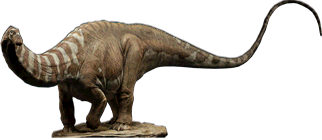
Apatosaurinae is the robust, power-built branch of Diplodocidae, represented chiefly by Apatosaurus and Brontosaurus from the Late Jurassic Morrison Formation of western North America. Their cervical vertebrae were massively thickened, with enlarged muscle attachment sites that gave the neck a deep, muscular profile distinct from the slender diplodocines. The torso was barrel-chested, supported by stout limb bones—especially the humerus and femur—which reflect a heavier, force-oriented build.
The tail remained long but broadened at the base before tapering into a diplodocid-style distal whip. Skull material shows a low, elongate snout with anteriorly concentrated, peg-like teeth suited for cropping vegetation. The reinforced neck and powerful forequarters indicate animals capable of generating substantial mechanical force, whether bracing against resistant vegetation or engaging in intraspecific shoving or neck-wrestling.
Apatosaurines represent the heavy-duty end of diplodocid evolution: compact, muscular sauropods engineered for strength rather than reach.
Click here to view Dinochecker's A-Z list of apatosaurines.
Etymology
Apatosaurinae is derived from the Greek "apate" (deception/deceptive) and "sauros" (lizard), and the Latin "-inae" (sub family). The name is based on group anchor Apatosaurus—the deceptive lizard, so named by Othniel Charles Marsh because he thought its chevron bones were deceptively similar to those of some sea-dwelling mosasaurs.
Although attributed to Friedrich von Huene in 1927 under the ICZN's principle of coordination (he actually coined the family Apatosauridae, but that includes all subranks as standard), Werner Janensch is often wrongly credited as author of the name, though he was the first to explicitly use it as a subfamily in 1929.
Relationships
References
• Marsh OC (1877) "Notice of New Dinosaurian Reptiles from the Jurassic formation".  American Journal of Science, 14(84): 514-516. DOI: 10.2475/ajs.s3-14.84.514.
• Riggs ES (August 1903) "Structure and Relationships of Opisthocoelian Dinosaurs. Part I, Apatosaurus Marsh". Publications of the Field Columbian Museum Geology, 2: 165-196.
• Huene Fv (1927) "Short review of the present knowledge of the Sauropoda". Memoirs of the Queensland Museum, 9(1): 121-126.
• Janensch W (1st January 1929) "Material und Formengehalt der Sauropoden in der Ausbeute der Tendaguru-Expedition". Palaeontographica - Supplementbände: 1-34.
• Gilmore CW (February 1936) "Osteology of Apatosaurus, with special references to specimens in the Carnegie Museum". Memoirs of the Carnegie Museum, 11(4): 175-300. DOI: 10.5962/p.234849.
• Taylor MP and Naish D (2005) "The phylogenetic taxonomy of Diplodocoidea (Dinosauria: Sauropoda)". PaleoBios, 25(2): 1-7.
• Tschopp E, Mateus OV and Benson RBJ (2015) "A specimen-level phylogenetic analysis and taxonomic revision of Diplodocidae (Dinosauria, Sauropoda)". PeerJ, 3(5): e857. DOI: 10.7717/peerj.857
American Journal of Science, 14(84): 514-516. DOI: 10.2475/ajs.s3-14.84.514.
• Riggs ES (August 1903) "Structure and Relationships of Opisthocoelian Dinosaurs. Part I, Apatosaurus Marsh". Publications of the Field Columbian Museum Geology, 2: 165-196.
• Huene Fv (1927) "Short review of the present knowledge of the Sauropoda". Memoirs of the Queensland Museum, 9(1): 121-126.
• Janensch W (1st January 1929) "Material und Formengehalt der Sauropoden in der Ausbeute der Tendaguru-Expedition". Palaeontographica - Supplementbände: 1-34.
• Gilmore CW (February 1936) "Osteology of Apatosaurus, with special references to specimens in the Carnegie Museum". Memoirs of the Carnegie Museum, 11(4): 175-300. DOI: 10.5962/p.234849.
• Taylor MP and Naish D (2005) "The phylogenetic taxonomy of Diplodocoidea (Dinosauria: Sauropoda)". PaleoBios, 25(2): 1-7.
• Tschopp E, Mateus OV and Benson RBJ (2015) "A specimen-level phylogenetic analysis and taxonomic revision of Diplodocidae (Dinosauria, Sauropoda)". PeerJ, 3(5): e857. DOI: 10.7717/peerj.857
American Journal of Science, 14(84): 514-516. DOI: 10.2475/ajs.s3-14.84.514.
• Riggs ES (August 1903) "Structure and Relationships of Opisthocoelian Dinosaurs. Part I, Apatosaurus Marsh". Publications of the Field Columbian Museum Geology, 2: 165-196.
• Huene Fv (1927) "Short review of the present knowledge of the Sauropoda". Memoirs of the Queensland Museum, 9(1): 121-126.
• Janensch W (1st January 1929) "Material und Formengehalt der Sauropoden in der Ausbeute der Tendaguru-Expedition". Palaeontographica - Supplementbände: 1-34.
• Gilmore CW (February 1936) "Osteology of Apatosaurus, with special references to specimens in the Carnegie Museum". Memoirs of the Carnegie Museum, 11(4): 175-300. DOI: 10.5962/p.234849.
• Taylor MP and Naish D (2005) "The phylogenetic taxonomy of Diplodocoidea (Dinosauria: Sauropoda)". PaleoBios, 25(2): 1-7.
• Tschopp E, Mateus OV and Benson RBJ (2015) "A specimen-level phylogenetic analysis and taxonomic revision of Diplodocidae (Dinosauria, Sauropoda)". PeerJ, 3(5): e857. DOI: 10.7717/peerj.857