









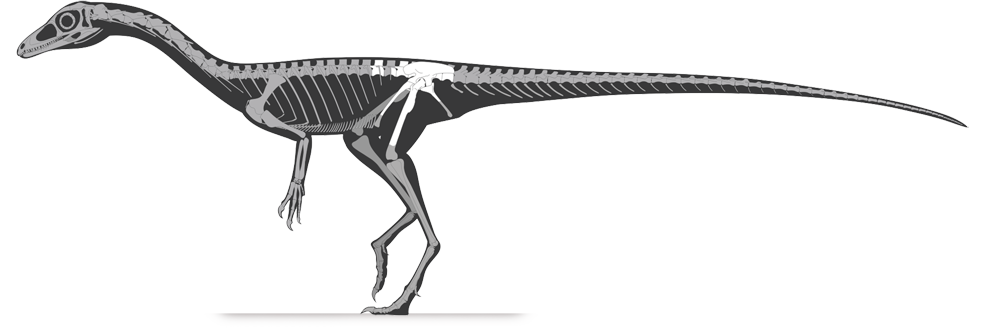
Pronunciation: pen-dry-guh
Meaning: Chief dragon
Author/s: Spiekman et al. (2021)
Synonyms: None known
First Discovery: Glamorgan, South Wales
Acta Ordinal: #1073
Pendraig milnerae
(Milner's Chief Dragon)Etymology
Pendraig is derived from the Welsh "Pen" (chief, head, or top) and "Draig" (dragon), which also means "chief warrior" when used in a figurative sense in Medieval Welsh. The anglicized form, Pendragon, was the surname of Uther, the father of the legendary King Arthur.
The species epithet, milnerae, honours Dr Angela C. Milner (1947-2021), one of the leading experts on British theropod dinosaurs, in recognition of her major contributions to vertebrate palaeontology and for relocating the "lost" holotype at the Natural History Museum, London. Pendraig milnerae was the second dinosaur named in honour of Milner in the space of 8 days, after the spinosaurid Riparovenator milnerae. ZooBank registry: urn:lsid:zoobank.org:act:724C0C8A-491D-4028-B692-FA921FB1273F.
Discovery
The remains of Pendraig were discovered in the Fissure fills of Pant-y-ffynnon Quarry near the village of Bonvilston, around 3 kilometers east of Cowbridge Town in the Vale of Glamorgan, South Wales, by Kenneth Alexander Kermack and Pamela Lamplugh Robinson in 1952, along with the holotypes of Pantydraco and Terrestrisuchus. The holotype (NHMUK PV R 3759) consists of a mostly complete pelvic girdle with an articulated series of two back and four hip vertebrae, and an associated left thigh that was found in the same rock block.
All remains were thought lost in the labyrinthine storage at the Natural History Museum, London, but were rediscovered by Angela Milner, loitering in a drawer of crocodile bones.
Referred material includes NHMUK PV R 37596 (field number P83/1), a complete back vertebra, and NHMUK PV R 37597 (field number P65/66b), a partial left ischium (hip bone). A counterslab to the latter specimen (field number P65/66a), along with four hand or foot bones (field numbers P65/30, P65/49, P65/23, and P65/45), were described and figured in the unpublished PhD thesis of Warrener in 1983. However, there is no record of these specimens in the collections of the Natural History Museum, London. A nearly complete thigh (BRSUG 28403) from the Tytherington fissures of Bristol might belong to Pandraig, or another coelophysoid entirely.


