









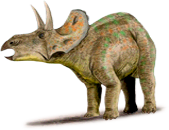
Pronunciation: ned-o-SEH-ruh-tops
Meaning: Insufficient horn face
Author/s: Ukrainsky (2007)
Synonyms: Diceratus hatcheri (Mateus, 2008)
First Discovery: Wyoming, USA
Acta Ordinal: #653
Nedoceratops hatcheri
Nedoceratops is often interpreted as a derogatory name because the "nedo", which prefixes the Greek "ceras" (horn) and "ops" (face), is a Russian slang term meaning poor or insufficient. Whilst not explicitly stated, perhaps the author had the latest-living ceratopsian in mind when he picked the name and intended it to mean "not quite at the Triceratops stage of evolution", referring to its pitiful nose horn. Nedoceratops is no stranger to confusion.
Nedoceratops was originally known as Diceratops, and apart from having just the two horns on its face (Di), it was remarkably similar to a dinosaur with three horns on its face (Tri). In fact, Diceratops was so Triceratops-like that when the first and only specimen was discovered in Wyoming in 1891, its missing nose-horn and punctured frill were brushed off as disease and/or severe battle damage, and it ended up as Triceratops (Diceratus) hatcheri (Lull, 1933), after killing off two of the palaeontologists who had previously tried to make sense of it.
Close scrutiny of the type-skull with its almost vertically pointing brow horns, window (fenestrae)-lacking frill, and shorter face convinced Forster that this was a stand-alone species. Furthermore, she realised there was already a Diceratops, albeit a Hymenoptera (think stingy-bitey insects), that was named by the spookily similar Foerster in 1868. Mateus came up with Diceratus as a replacement name in early March 2008, blissfully unaware that Ukrainsky had already coined Nedoceratops in a Russian journal in late December of the previous year, and following the letter of the ICZN "first name stands" law Nedoceratops wins.
Most herbivores don't get this much excitement during their entire life, never mind death, but it's not over yet. In 2010, Nick Longrich suggested Nedoceratops may be nothing more than a growth stage of Triceratops afterall, and Jack Horner agreed. However, like an armour-clad knight atop a fiery ceratopsian, Andy Farke rode to the rescue in 2011 and not only found Nedoceratops to be a valid critter with many unique features but also fought for the honour of Torosaurus, plunging his mighty lance into the heart of Horner's theory that it was merely a growth stage of Triceratops too. Take that, Popinjay!
Nedoceratops was originally known as Diceratops, and apart from having just the two horns on its face (Di), it was remarkably similar to a dinosaur with three horns on its face (Tri). In fact, Diceratops was so Triceratops-like that when the first and only specimen was discovered in Wyoming in 1891, its missing nose-horn and punctured frill were brushed off as disease and/or severe battle damage, and it ended up as Triceratops (Diceratus) hatcheri (Lull, 1933), after killing off two of the palaeontologists who had previously tried to make sense of it.
Close scrutiny of the type-skull with its almost vertically pointing brow horns, window (fenestrae)-lacking frill, and shorter face convinced Forster that this was a stand-alone species. Furthermore, she realised there was already a Diceratops, albeit a Hymenoptera (think stingy-bitey insects), that was named by the spookily similar Foerster in 1868. Mateus came up with Diceratus as a replacement name in early March 2008, blissfully unaware that Ukrainsky had already coined Nedoceratops in a Russian journal in late December of the previous year, and following the letter of the ICZN "first name stands" law Nedoceratops wins.
Most herbivores don't get this much excitement during their entire life, never mind death, but it's not over yet. In 2010, Nick Longrich suggested Nedoceratops may be nothing more than a growth stage of Triceratops afterall, and Jack Horner agreed. However, like an armour-clad knight atop a fiery ceratopsian, Andy Farke rode to the rescue in 2011 and not only found Nedoceratops to be a valid critter with many unique features but also fought for the honour of Torosaurus, plunging his mighty lance into the heart of Horner's theory that it was merely a growth stage of Triceratops too. Take that, Popinjay!
Etymology
Nedoceratops (insufficient horned face) is derived from the Russian prefix "nedo" which denotes poor or insufficient, and the Greek "ceras" (horn) and "ops" (face).
The specific epithet, hatcheri, honours John Bell Hatcher who made the discovery.
Synonyms
Diceratops hatcheri (Lull, 1905)
Diceratus hatcheri (Mateus, 2008)
Discovery
The only confirmed remains of Nedoceratops were discovered in the Lance Formation near Lightning Creek, Niobrara County, Wyoming, USA, by John Bell Hatcher in 1891.
The Holotype (USNM 2412) is a skull.


