









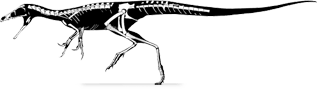
Pronunciation: COMP-sog-NAY-thus
Meaning: Delicate jaw
Author/s: Wagner (1859)
Synonyms: Compsognathus corallestris?
First Discovery: Solnhofen, Germany
Acta Ordinal: #18
Compsognathus longipes
For one hundred and thirteen years, Compsognathus was known only from juvenile remains that were found in Bavaria in 1859 and described in detail by Johann A. Wagner two years later. But even though an actual adult specimen was discovered in 1972 in Louis Ghirardi's quarry at Canjuers near Nice'¹', it's still referred to as a chicken-sized-dinosaur.
In actual fact, Compsognathus was more of a turkey-sized dinosaur. It's still not huge by any means, but in the late Jurassic, this difference in size was monumental and could dictate your standing in the food chain. And besides, the up-sizing meant it lost its crown as "the smallest ever dinosaur" as smaller ones have come thick and fast since the 1980s.
Compsognathus is one of the few dinosaurs whose diet is known with certainty, as the remains of small lizards were preserved in the stomach of both of the only known specimens. "Dermal ossifications" (armour) that von Huene identified in 1901 were later re-interpreted as putrefaction-caused gas bubbles by German geologist Karl Werner Barthel in 1964'²' and later still as eggs by Peter Griffiths in 2001'³'. But it's hard to tell what they really are.
In Wagner's brief initial description in 1859, he described Compsognathus as one of the "most curious forms among the lizards", then nine years passed before Thomas Huxley recognised its close relationship to dinosaurs. Edward Drinker Cope coined Compsognathidae with Compsognathus as the anchor in 1871, but his sneaky nemesis Othniel Charles Marsh tried to claim the naming glory for this (and other) family names himself in his "Classification of the Dinosauria" that was published over a decade later.
In actual fact, Compsognathus was more of a turkey-sized dinosaur. It's still not huge by any means, but in the late Jurassic, this difference in size was monumental and could dictate your standing in the food chain. And besides, the up-sizing meant it lost its crown as "the smallest ever dinosaur" as smaller ones have come thick and fast since the 1980s.
Compsognathus is one of the few dinosaurs whose diet is known with certainty, as the remains of small lizards were preserved in the stomach of both of the only known specimens. "Dermal ossifications" (armour) that von Huene identified in 1901 were later re-interpreted as putrefaction-caused gas bubbles by German geologist Karl Werner Barthel in 1964'²' and later still as eggs by Peter Griffiths in 2001'³'. But it's hard to tell what they really are.
In Wagner's brief initial description in 1859, he described Compsognathus as one of the "most curious forms among the lizards", then nine years passed before Thomas Huxley recognised its close relationship to dinosaurs. Edward Drinker Cope coined Compsognathidae with Compsognathus as the anchor in 1871, but his sneaky nemesis Othniel Charles Marsh tried to claim the naming glory for this (and other) family names himself in his "Classification of the Dinosauria" that was published over a decade later.
Etymology
Compsognathus is derived from the Greek "kompsos" (elegant) and "gnathos" (jaw). The species epithet, longipes (LON-jih-pees), means "long-legged" in Latin.
Discovery
The first remains of Compsognathus were discovered in the Solnhofen limestone deposits of the Riedenburg-Kelheim region of Bavaria, Germany, by Joseph Oberndorfer in 1859. The holotype (BSP AS I 563) is a beautiful, virtually complete skeleton.
This is the same area that yielded Archaeopteryx.
Need for speed
In 2007, Sellers and Manning of the University of Manchester tapped into the NW-Grid and hammered its network of resources to squeeze what would've been almost a fifth of a million hours of single computer analyses into a mere two months, as they ran test after test to calculate the likeliest top speed of several dinosaurs using a program called GaitSym. To test their system, they added a handful of modern animals for which top speeds are known, with surprisingly accurate results. And while factors such as weight, muscle mass, posture, bone strength, joint constraints and tendon recoil of the extinct critters tested were pure guestimates, the computer-generated Compsognathus could run up to 64 kilometres per hour without falling flat on its face. That's slightly faster than a racing Greyhound!


