









Pronunciation: ma-ha-KAH-luh
Meaning: for Mahakala
Author/s: Turner et al. (2007) (2007)
Synonyms: None known
First Discovery: Ömnögovi, Mongolia
Acta Ordinal: #629
Mahakala omnogovae
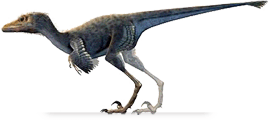
Although fully grown, Mahakala is teeny. It's around the size of the "first bird" Archaeopteryx and the troodontid Mei long, and sports many features in common with birds and troodontids. But it's actually a dromaeosaurid—the sickle-clawed carnivorous critters that are affectionately known as "raptors", some of which are huge—and despite its late appearance is one of the most basal.
(Mahakala from the southern Gobi)Etymology
Mahakala is named after one of the eight protector deities of Tibetan Buddhism or "Dharmapalas"... the one known as "Mahakala", funnily enough. You can't miss him: he's black in colour with a crown of five human skulls!
The species epithet, omnogovae, refers to its discovery in Ömnögovi ("South Gobi"), Mongolia's largest Aimag ("Province") that lies within the Southern Gobi Desert in the south of the country.
Discovery
The first remains of Mahakala were discovered in the Tugrugyin Member of the Djadokhta Formation, Tugrugyin Shireh, Ömnögovi, Mongolia, in 1992, during the joint American Museum of Natural History–Mongolian Academy of Sciences expeditions, led by M.A. Norell.
The holotype (IGM 100/1033) is the partial skeleton of a young or near adult specimen including skull bones, neck vertebrae, bones from both hindlimbs, forelimbs and feet, one second toe "raptor" claw, and portions of the pelvis and shoulder girdles.
Preparators
Amy Davidson (AMNH), with additional preparation carried out by William Amaral (Harvard, MCZ) and Ana Balcarcel (AMNH).


