




Pronunciation: peg-o-mas-tahks
Meaning: Strong jaw
Author/s: Sereno (2012)
Synonyms: None known
First Discovery: Cape Province, South Africa
Acta Ordinal: #833
Pegomastax africana
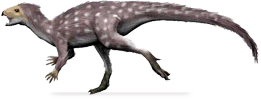
Some extinct critters are weird, others are weirder still, and others are the weirdest. Pegomastax, for example, had a beak, fangs, and possibly quills, but it wasn't a bird, carnivore or porcupine. It wasn't a dwarf as widely reported either, but a fully grown ornithischian dinosaur, though far from the biggest with an estimated total length of less than two feet.
If rumours are to be believed, the remains that would become Pegomastax were singled out as weird in the 1980s by Paul Sereno while a student under Professor "Fuzz" Crompton. But he managed to keep them under his hat, metaphorically, for the best part of three decades. Pegomastax may have been a bit fuzzy itself, though this is merely an assumption based on its bristle-covered relatives such as Tianyulong. And while it was two-legged, possibly fleet-footed, and probably had grasping hands, its most studied features are its teeth because it's known almost entirely from lower jaws.
Unusually for an herbivore but perfectly normal amongst heterodontosaurids, Pegomastax had a pair of large, sharp-edged canine teeth or "fangs" in its lower jaws and a significant diastema (fang-housing slot) behind each, which suggests impressive fangs (and presumably slots) were present in the missing upper jaws too. Working backwards, the next tooth in each relatively short and robust lower jawbone was "discordantly small" and of unknown purpose, then nine scalloped teeth were arranged overlapping to form one continuous chewing surface. An unusually thick, wedge-shaped bone (predentary) at the tip of the lower jaws bore no teeth, but it, and a corresponding bone (premaxilla) at the tip of the upper jaws, would have anchored a keratin "beak" for cropping vegetation.
If rumours are to be believed, the remains that would become Pegomastax were singled out as weird in the 1980s by Paul Sereno while a student under Professor "Fuzz" Crompton. But he managed to keep them under his hat, metaphorically, for the best part of three decades. Pegomastax may have been a bit fuzzy itself, though this is merely an assumption based on its bristle-covered relatives such as Tianyulong. And while it was two-legged, possibly fleet-footed, and probably had grasping hands, its most studied features are its teeth because it's known almost entirely from lower jaws.
Unusually for an herbivore but perfectly normal amongst heterodontosaurids, Pegomastax had a pair of large, sharp-edged canine teeth or "fangs" in its lower jaws and a significant diastema (fang-housing slot) behind each, which suggests impressive fangs (and presumably slots) were present in the missing upper jaws too. Working backwards, the next tooth in each relatively short and robust lower jawbone was "discordantly small" and of unknown purpose, then nine scalloped teeth were arranged overlapping to form one continuous chewing surface. An unusually thick, wedge-shaped bone (predentary) at the tip of the lower jaws bore no teeth, but it, and a corresponding bone (premaxilla) at the tip of the upper jaws, would have anchored a keratin "beak" for cropping vegetation.
(Strong jaw from Africa)
Etymology
Pegomastax is derived from the Greek "pegos" (strong) and "mastax" (jaw).
The species epithet, africana, means "pertaining to Africa" in Latin. Initially published as "africanus" which means exactly the same thing, it was changed to correct a gender mismatch ("mastax" is feminine, but "Africanus" is masculine) in accordance with the ICZN naming-regulations soon after (see reference 2). ZooBank registry: urn:lsid:zoobank.org:act:11E67968-C4E9-40EA-B7F5-D05D6023DF5C.
Discovery
The remains of Pegomastax were discovered in the upper Elliot Formation (Stormberg Group) at Krommespruit, Voyizane (Voisana), Transkei (Herschel) District, Cape Province, South Africa, way back in 1966-1967 by Alfred "Fuzz" Crompton, near sites that yielded the best-preserved specimens of Heterodontosaurus tucki.
The holotype (SAM-PK-K10488) is a fragmentary skull with lower jaws.


