









Pronunciation: foat-NAH
Meaning: The Origin
Author/s: Avrahami et al. (2024)
Synonyms: None known
First Discovery: Utah, USA
Acta Ordinal: #1173
Fona herzogae
(Herzog's Origin)Etymology
Fona, literally meaning "the origin" in the Austronesian language of Chamorro, refers to a figure of the same name (Fo'na) in Chamorro culture. Fo'na and her brother Pontan (literally meaning "a ripe coconut"), were the ancestral Maga’håga and Maga’låhi—a clan's first-born female and male—of the Chamorro people. According to oral tradition, when Pontan's spirit began to die, Fo'na used his bits to create the universe, with his back becoming the earth, and she was so distraught at the loss that she threw herself into the ground, turned to stone, and the first humans sprang forth from her fossilised body. The name Fona was chosen by the authors because of two specimens found side by side at the "Mini Troll locality" which may have been male and female, perhaps siblings, mirroring the ancestral story of the Chamorro, to a degree.
The species epithet, herzogae, honours Lisa Herzog who discovered the "Mini Troll Locality".
Discovery
The remains of Fona were discovered in the Mussentuchit Member of the Cedar Mountain Formation, Emery County, Utah, USA.
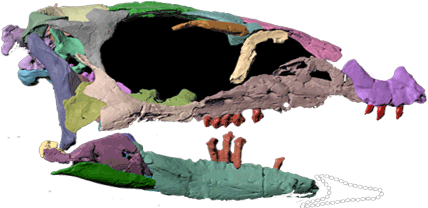
The holotype (NCSM 33548), found at the "Karmic Orodromine locality", is a single partially articulated, nearly complete skeleton.
Several other specimens from various localities across the Mussentuchit Member were assigned to Fona, based solely on skeletal similarities. They include FMNH PR 4581 (most of a skeleton lacking parts of the skull, the whole pelvic girdle, and some foot bones), found by F. Gallastegui at the slightly younger "Manolo site", and two similar-sized sub-adult specimens plus some juvenile bones, found by L. Herzog at the even younger "Mini Troll locality".
Preparators
A. Knowles (the holotype from the Karmic Orodromine locality), A. Giterman (specimens from the Last Chance Theropod, Magic Man, and Karmic localities),
A. Giterman and E. Lund (specimens from the Mini Troll locality),
A. Shinya (specimens from the Manolo locality).


