









Pronunciation: ROO-bee-o-SOR-us
Meaning: Thornbush (bramble) lizard
Author/s: McDonald and Horner (2010)
Synonyms: Styracosaurus ovatus?
First Discovery: Montana, USA
Acta Ordinal: #727
Rubeosaurus ovatus
(Ovate thornbush lizard)
Etymology
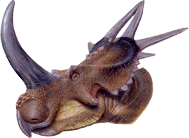
Rubeosaurus is derived from the Latin "rubeus" (thornbush or bramble, aka blackberry bush) and the Greek "sauros" (lizard), named for the array of spikes adorning its frill.
The species epithet, ovatus, means "egg-shaped" in Latin. The name was coined by American paleontologist and Herman Munster look-a-like Charles Whitney Gilmore in 1930 for the shape of its frill.
Discovery
The remains of Rubeosaurus were discovered on a Blackfoot Indian Reservation in the upper Two Medicine Formation at Milk River, Glacier
County, Montana, by George F. Sternberg in 1928.
The holotype (USNM 11869) is a partial frill (parietal) which Gilmore named as a second species of Styracosaurus, Styracosaurus ovatus, and for years it caused problems, coasting between valid and not so from palaeontologist to palaeontologist. The discovery of a partial skull (MOR 492) in 1986 convinced McDonald and Horner that Styracosaurus ovatus was valid, but it was also distinct, and closer to Einiosaurus than to Styracosaurus. And so they renamed it Rubeosaurus. However, in 2020, Wilson, Ryan and Evans moved the holotype of Styracosaurus ovatus back from whence it came, snaffled MOR 492 (along with subsequently described specimens referred to Rubeosaurus) and renamed it Stellasaurus ancellae.


