





Pronunciation: gwah-LEE-cho
Meaning: Evil spirit
Author/s: Apesteguía, et al. (2016)
Synonyms: 'Nototyrannus violantei'
First Discovery: Río Negro, Argentina
Acta Ordinal: #945
Gualicho shinyae
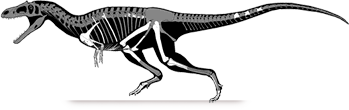
Everyone and everything outside of the Late Cretaceous eco-systems of western North America pokes fun at Tyrannosaurus rex and their puny arms and tiny two-fingered hands, which is a bit unfair. There are other carnivorous dinosaurs from the same period of elsewhere that were equally short-changed in the front limb department, and more so in abelisaurids like Carnotaurus, whose forearms had shrunk to nothing more than wrists with fingers that were merely fused, clawless nubbins of bone. While not quite to the latter degree, Gualicho had also undergone arm shrinkage and a reduction in the number of its digits, with only two functional fingers and a splint of bone that represents a third.
The three genera mentioned thus far all represent different branches of a dinosaurian group called Theropoda, the common ancestor of which had long arms and five-fingered hands. And they all have close relatives with longer arms and three "proper" fingers, meaning their two-fingered-baby-sized-armed-ness must have evolved via something called convergent evolution. Convergent evolution refers to the acquisition of similar environment-suiting features in critters that aren't closely related, such as bees, birds and bats, who belong to different lineages but have all evolved the ability to fly. With these distantly related theropod dinosaurs, however, reduced arms weren't so much an aquired trait as a side effect; they had all "converged" on a large skull with powerful jaws which was so efficient at capturing and despaching prey that their arms became surpluss to requirements and shrank. In turn, this made room for more neck muscles to anchor their primary hunting tools, making them even more efficient, and if not for a bloomin' extinction they may have lost their arms altogether, becoming more efficient hunters still.
Gualicho was trouble from the get go, which is why Sebastián ApesteguÃa and colleagues named it after a local demon and would often "thank" the curse of Gualicho for the many mishaps that occurred in and around camp. The calamities continued after its remains were extracted, wrapped in plaster, and loaded for transport, only for the truck to break down. Then a group of opportunistic "experts" from a Brazilian museum turned up at the site and nicked the neatly-jacketed specimen while no-one was around. Allegedly. After a brief description and a stint as the first and only South American tyrannosauroid under the informal title "Nototyrannus violantei" the specimen was reclaimed and reidentified as a neovenatorid abelisauroid (the first from the Huincul Formation) with an unusual mosaic of ceratosaurian and tetanuran features throughout the skeleton. But we have a feeling that Gualicho's curse hasn't been lifted yet. Several palaeontologists have opined that Gualicho has been misidentified once again, and that it may be a specimen of Aoniraptor—a close relative of Niger's Deltadromeus—from exactly the same area that Motta et al described just a few months earlier.
The three genera mentioned thus far all represent different branches of a dinosaurian group called Theropoda, the common ancestor of which had long arms and five-fingered hands. And they all have close relatives with longer arms and three "proper" fingers, meaning their two-fingered-baby-sized-armed-ness must have evolved via something called convergent evolution. Convergent evolution refers to the acquisition of similar environment-suiting features in critters that aren't closely related, such as bees, birds and bats, who belong to different lineages but have all evolved the ability to fly. With these distantly related theropod dinosaurs, however, reduced arms weren't so much an aquired trait as a side effect; they had all "converged" on a large skull with powerful jaws which was so efficient at capturing and despaching prey that their arms became surpluss to requirements and shrank. In turn, this made room for more neck muscles to anchor their primary hunting tools, making them even more efficient, and if not for a bloomin' extinction they may have lost their arms altogether, becoming more efficient hunters still.
Gualicho was trouble from the get go, which is why Sebastián ApesteguÃa and colleagues named it after a local demon and would often "thank" the curse of Gualicho for the many mishaps that occurred in and around camp. The calamities continued after its remains were extracted, wrapped in plaster, and loaded for transport, only for the truck to break down. Then a group of opportunistic "experts" from a Brazilian museum turned up at the site and nicked the neatly-jacketed specimen while no-one was around. Allegedly. After a brief description and a stint as the first and only South American tyrannosauroid under the informal title "Nototyrannus violantei" the specimen was reclaimed and reidentified as a neovenatorid abelisauroid (the first from the Huincul Formation) with an unusual mosaic of ceratosaurian and tetanuran features throughout the skeleton. But we have a feeling that Gualicho's curse hasn't been lifted yet. Several palaeontologists have opined that Gualicho has been misidentified once again, and that it may be a specimen of Aoniraptor—a close relative of Niger's Deltadromeus—from exactly the same area that Motta et al described just a few months earlier.
(for Gualichu and Akiko Shinya)Etymology
Gualicho is named after a cave-dwelling Mapuche evil spirit in native South American folklore who was the cause of all evils, calamities and misfortunes. Over time, the name has become synonymous in the mythology of Argentina with "casting an evil spell", so the name was chosen to reflect the mishaps the team encountered during their fieldwork and the specimens' contentious history following excavation.The species epithet, shinyae, honours Akiko Shinya; chief fossil preparator of the Field Museum in Chicago, who discovered the holotype. ZooBank registry: urn:lsid:zoobank.org:act:94AE3F8D-9485-443C-A945-0DDD107FE3D8.
Discovery
The remains of Gualicho were discovered at "Violante's field" in the Huincul Formation, along the northern flank of Meseta de la Rentería, Río Negro Province, Argentina, by Akiko Shinya on the very last day of the expedition (February 13th, 2007).
The holotype (MPCN PV 0001) includes four partial back vertebrae, belly ribs, a section of the tail, the left shoulder girdle and forelimb, the ends of both pubes, and parts of both hind limbs and feet.


