









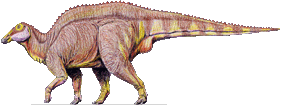
Pronunciation: bahrs-BOHL-dee-uh
Meaning: for Barsbold
Author/s: Maryanska and Osmólska (1981)
Synonyms: None known
First Discovery: Ömnögovi, Mongolia
Acta Ordinal: #292
Barsboldia sicinskii
Upon discovery, the remains that would become Barsboldia were thought to belong to the colossal, common as muck Nemegt Formation duck-billed saurolophine hadrosaurid known as Saurolophus angustirostris. Later study convinced Maryanska and Osmólska that it was distinct from Saurolophus, mainly because of the "spines" on its vertebrae that were longest over its hips and distinctly club-shaped at the base of its tail, and Barsboldia was announced as "the first Lambeosaurine known from the Nemegt" in 1981. But a study published in 2012 found Barsboldia to be a saurolophine after all.
Etymology
Barsboldia is named after the eminent Mongolian palaeontologist Dr. Rinchen Barsbold. The species epithet, sicinskii, honours Mr. Wojciech Sicinski, technical assistant at the Institute of Paleobiology, Polish Academy of Sciences, Warsaw.
Discovery
The remains of Barsboldia were discovered in the Nemegt Formation of Northern Sayr, Nemegt Basin, Ömnögovi (South Gobi) Aimag (Province), Mongolian
People's Republic (previously known as "outer Mongolia"), during a Kielan-Jaworowska and Barsbold-led Polish-Mongolian Paleontological Expedition in 1970.
The holotype (ZPAL MgD-1/110) is a partial skeleton, including a series of nine back vertebrae, a block of nine hip vertebrae, fifteen tail vertebrae, hip bones (an ilium, and fragments of left and right pubis), half a dozen ribs, shin and calf fragments, two metatarsals, a toe bone and a claw, and fragments of ossified tendons.


