





Pronunciation: man-EYE-denz
Meaning: Hand tooth
Author/s: Pol et al. (2011)
Synonyms: None known
First Discovery: Chubut, Argentina
Acta Ordinal: #787
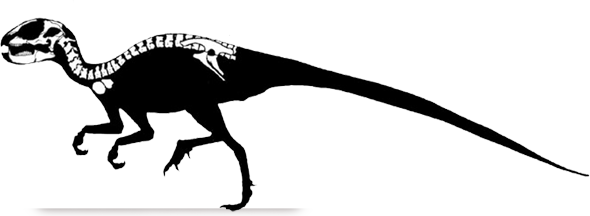
Manidens condorensis
Manidens owns the first diagnostic ornithischian fossils recovered from Jurassic-aged rocks in South America, and its holotype constitutes the most completely known southern heterodontosaurid from outside of Africa — even though all of its limbs and most of the tail are missing. Funnily enough, its name means "hand teeth", even though its hands are missing too. And it's the only known heterodontosaurid with more robust (and therefore stronger) jaws than Pegomastax — whose name means "strong jaws".
Additional heterodontosaurid remains from the Cañadón Asfalto Formation—including tail vertebrae and two complete metatarsals, along with long toe bones suggesting feet capable of grasping branches and perching like modern arboreal (tree-dwelling) birds—might belong to Manidens. It can't lay claim to them, though, because the holotype lacks like-for-like bones for direct comparison. Nevertheless, Becerra, Pol, Rauhut and Cerda tentatively attributed them to Manidens in 2016, based entirely on the laws of probability.
Additional heterodontosaurid remains from the Cañadón Asfalto Formation—including tail vertebrae and two complete metatarsals, along with long toe bones suggesting feet capable of grasping branches and perching like modern arboreal (tree-dwelling) birds—might belong to Manidens. It can't lay claim to them, though, because the holotype lacks like-for-like bones for direct comparison. Nevertheless, Becerra, Pol, Rauhut and Cerda tentatively attributed them to Manidens in 2016, based entirely on the laws of probability.
(Hand tooth from Cerror Condor)Etymology
Manidens is derived from Latin "manus" (hand) and "dens" (tooth), in reference to the hand-shaped form of the teeth in the back of its lower jaw.The species epithet, condorensis, means "from Cerro Condor" in Latin, in reference to the village of Cerro Cóndor, located near the Queso Rallado site where the specimen was found.
Discovery
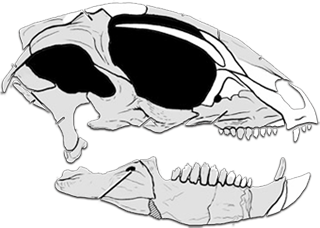 Manidens was discovered in the Cañadón Asfalto Formation at the Queso Rallado locality, 2.3 km west of the village of Cerro Cóndor, Chubut Province, Argentina, by zoologist Guillermo Rougier.
The holotype (MPEF-PV 3211) is a partial skeleton with skull and lower jaws, including the axial column except most of the tail, a left shoulder girdle, and an almost complete pelvis. The specimens MPEF-PV 1719, 1786, 1718, 3810, 3811, representing isolated teeth from the same area as the holotype, are also referred to Manidens.


