









Pronunciation: SIGH-oor-uh-MIEM-us
Meaning: Squirrel-mimic
Author/s: Rauhut et al. (2012)
Synonyms: None known
First Discovery: Painten, Germany
Acta Ordinal: #828
Sciurumimus albersdoerferi
Discovered in 2009 and informally tagged "Xaveropterus" two years later, the now-named Sciurumimus is the most complete predatory dinosaur specimen ever found in Europe. As we've come to expect from fossils discovered in Bavarian sandstone, its remains are beautifully preserved. And as well as giving us a rare glimpse of a juvenile dinosaur, it put the cat amongst the pigeons after a stint under ultraviolet light.
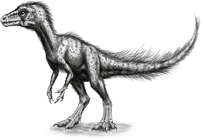
At first glance remarkably similar to Juravenator starki, the body of Sciurumimus is covered, at least partially, in bristly "proto-feathers" and had an exceptionally bushy tail, hence the name "squirrel mimic". Of course, feathered members of Theropoda are nothing new. They've been virtually leaping from the ground in recent years, but only those classified as coelurosaurs. However, Sciurumimus is a megalosauroid: a twig of far more primitive predatory dinosaurs sprouting from the carnosaurian branch on the evolutionary tree of theropods. In other words, Sciurumimus provides the first unequivocal evidence of feathered theropod dinosaurs that are not closely related to birds.
At first glance remarkably similar to Juravenator starki, the body of Sciurumimus is covered, at least partially, in bristly "proto-feathers" and had an exceptionally bushy tail, hence the name "squirrel mimic". Of course, feathered members of Theropoda are nothing new. They've been virtually leaping from the ground in recent years, but only those classified as coelurosaurs. However, Sciurumimus is a megalosauroid: a twig of far more primitive predatory dinosaurs sprouting from the carnosaurian branch on the evolutionary tree of theropods. In other words, Sciurumimus provides the first unequivocal evidence of feathered theropod dinosaurs that are not closely related to birds.
Etymology
Sciurumimus is derived from "Sciurus" (a species of squirrel) and the Latin "mimos" (mimic) because of its broad, "bushy" tail. Thank your lucky stars that the authors decided against "Oachkatzlschwoaf" ("squirrel's tail" in Bavarian), which even poses problems for non-Bavarian Germans!
The species epithet, albersdoerferi, honours Raimund Albersdoerfer, the private collector who made the fossil available for scientific study.
Discovery
The remains of Sciurumimus were discovered at Rygol Quarry in the Rögling Formation close to Painten, Lower Bavaria, Germany, in the mid-2000s.
The holotype (BMMS BK 11) is an exceptionally preserved, 98% complete juvenile skeleton, 719mm long.


