
ALBERTOSAURUS
a carnivorous albertosaurine tyrannosaurid dinosaur from the Late Cretaceous of Canada.
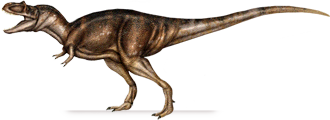
Pronunciation: al-BUHR-to-SOR-us
Meaning: Alberta Lizard
Author/s: Osborn (
1905)
Synonyms: See
below
First Discovery: Alberta, Canada
Acta Ordinal: #92
Albertosaurus sarcophagus
(Corpse-Eating Alberta Lizard)Etymology
Albertosaurus is derived from "Alberta" (its place of discovery; named after Princess Louise Caroline Alberta [1848-1939], the fourth daughter of Queen Victoria and Prince Albert) and the Greek "sauros" (lizard). The
species epithet,
sarcophagus, is derived from the Greek "sarx" (flesh) and "phagein" (to eat). Particularly popular with Egyptians and Romans, a sarcophagus is a stone coffin or funeral container which, when filled with lime, would "eat" the flesh from the (normally Royal) corpse within.
ZooBank registry:
urn:lsid:zoobank.org:act:2C1AA442-37FB-42C5-8EA1-55AF79E61C74.
Discovery
The first fossils of
Albertosaurus were discovered in the Horseshoe Canyon Formation alongside the Red Deer River near Drumheller, Alberta, Canada, by renowned geologist Joseph B. Tyrrell in 1884.
The
holotype (CMN 5600) is a partial skull that E.D. Cope originally assigned to
Laelaps incrassatus in 1892. Bizarrely,
Laelaps had been officially renamed
Dryptosaurus by O.C. Marsh 15 years earlier, but Cope refused to follow the work of his "bone wars" nemesis. Lawrence Lambe officially changed
Laelaps incrassatus to
Dryptosaurus incrassatus in 1904, and a year later, H.F. Osborne coined
Albertosaurus sarcophagus for CMN 5600 in the same AMNH bulletin that he described
Tyrannosaurus rex.
Estimations
Timeline:
Era: Mesozoic
Epoch: Late Cretaceous
Stage: Campanian-Maastrichtian
Age range: 73-67 mya
Stats:
Est. max. length: 8.6 meters
Est. max. hip height: 3 meters
Est. max. weight: 2.4 tons
Diet: Carnivore
Albertosaurus
sarcophagus
Other species?
Albertosaurus megagracilis was named by Greg Paul in 1988 for a small tyrannosaurid skeleton from Montana's Hell Creek Formation. It was renamed
Dinotyrannus megagracilis by George Olshevsky in 1995, but most likely represents a juvenile specimen of
Tyrannosaurus rex.
Albertosaurus arctunguis is based on a partial skeleton (ROM 807) discovered in the Edmonton Formation near the Red Deer River by Gus Lindblad and Ralph Hornell in 1928. In 1970, Dale Russell concluded that it is indistinguishable from
Albertosaurus sarcophagus.
Albertosaurus libratus was originally named
Gorgosaurus libratus by Lawrence Lambe in 1914, based on a partial skeleton discovered in the Dinosaur Park Formation by Charles H. Sternberg in 1913. Dale Russell declared
Gorgosaurus a junior synonym of
Albertosaurus in 1970. However, most palaeontologists follow Philip J. Currie's 2003 work and keep the two separate, as they are no more similar to each other than
Daspletosaurus is to
Tyrannosaurus.
Deinodon sarcophagus (Osborn, 1905)
Albertosaurus arctunguis (Parks, 1928)
Deinodon arctunguis (Parks, 1928)
References
• Osborn HF (1905) "
Tyrannosaurus and other Cretaceous carnivorous dinosaurs".
Bulletin of the AMNH, 21(14): 259-265.
• Russell DA (1970) "Tyrannosaurs from the Late Cretaceous of western Canada".
Ottawa National Museum of Natural Sciences, Publications in Palaeontology, 1: 1-34
• Holtz TR Jr. (2004) "Tyrannosauroidea". In Weishampel, Dodson and Osmólska "
The Dinosauria: Second Edition".
• Currie PJ (1998) "
Possible evidence of gregarious behavior in tyrannosaurids".
 GAIA, 15: 271-277.
• Parks WA (1928) "
Albertosaurus arctunguis, a new species of therapodous dinosaur from the Edmonton Formation of Alberta".
University of Toronto Studies, 26: 1-19.
• Currie PJ (2003) "Allometric growth in tyrannosaurids (Dinosauria: Theropoda) from the Upper Cretaceous of North America and Asia".
Canadian Journal of Earth Sciences, 40(4). DOI: 10.1139/e02-083
• Tanke DH and Kenneth Carpenter K (2001) "
Mesozoic Vertebrate Life".
• Bell PR and Currie PJ (2014) "
Albertosaurus (Dinosauria: Theropoda) material from an Edmontosaurus bonebed (Horseshoe Canyon Formation) near Edmonton: Clarification of palaeogeographic distribution".
Canadian Journal of Earth Sciences, 51(11): 1-6.
• Doyon JA, Brown CM, Therrien F and Currie PJ (2026) "Evidence for dromaeosaurid scavenging on
Albertosaurus (Dinosauria: Tyrannosauridae)".
Journal of Paleontology (advance online publication).
DOI: 10.1017/jpa.2026.10269.
Time stands still for no man, and research is ongoing. If you spot an error, or want to expand, edit or add a dinosaur, please use
this form. Go
here to contribute to our FAQ.
All dinos are GM free, and no herbivores were eaten during site construction!
To cite this page:
Atkinson, L.
"
ALBERTOSAURUS :: from DinoChecker's dinosaur archive".
‹
http://www.dinochecker.com/dinosaurs/ALBERTOSAURUS›. Web access: 21st Oct 2026.









