









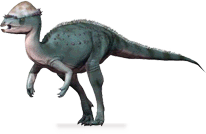
Pronunciation: ACK-rho-THO-luhs
Meaning: High dome
Author/s: Evans et al. (2013)
Synonyms: None known
First Discovery: Alberta, Canada
Acta Ordinal: #858
Acrotholus audeti
When University of Toronto postgraduate Caleb Brown passed palaeontologist David Evans a lump of fossilized bone about the size of a baked potato from the Santonian-age Milk River Formation in 2008, he knew he held in his hands a skull cap from the oldest known pachycephalosaur — or herbivorous "headbanger" — from Alberta, and at that point, the world. Fossils of critters less than 100kg or so are generally too small to survive the ravages of badland elements and Old Father Time. Heck, this bone only survived because it was a good two inches thick and rock solid. But the absence of any fossils that weren't used during machismo-driven head-butting contests for mating rights didn't curb the authors' enthusiasm and, using a like-for-like downscale based on larger and more complete family members, they reckon Acrotholus may have been about the size of a decent-sized dog.
(Roy Audet's high dome)
Etymology
Acrotholus is derived from the Greek "akros" (high) and "tholus" (dome).
The species epithet, audeti (aw-DET-eye), honors Canadian rancher Roy Audet, on whose land the holotype was found. ZooBank registry: urn:lsid:zoobank.org:act:D9254894-8009-487F-8490-F3090044EC9C.
Discovery
The holotype of Acrotholus (TMP 2008.045.0001: an unusually oval-shaped domed skull roof) was discovered in the Deadhorse Coulee Member of the Milk River Formation, 1.5 km east of
Writing-On-Stone Provincial Park in the badlands of Alberta, Canada, by Caleb Brown in 2008.
The front part of a second dome (ROM 2964) is a paratype, and an incomplete, poorly preserved third dome with clear pathologies (ROM 2962), described by Sullivan in 2006, might belong to Acrotholus based on its similar overall shape to the holotype. Both were found in the Milk River Formation, approximately 9.5 km east of Writing-On-Stone
Provincial Park.
Preparator
I. Morrison of the Royal Ontario Museum (holotype).


