









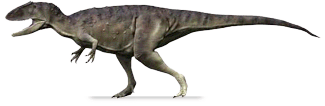
Pronunciation: EE-o-car-CAR-ee-uh
Meaning: Dawn shark
Author/s: Sereno and Brusatte (2008)
Synonyms: None known
First Discovery: Ténéré, Niger
Acta Ordinal: #664
Eocarcharia dinops
Eocarcharia means dawn shark, but not just any old shark. It's named after the Carcharodon brand of shark which includes the Great
White (Carcharodon carcharias) and possibly Megalodon (Carcharodon megalodon), though the latter is disputed.
Carcharodon lends its name to a whole group of theropod dinosaurs too — the carcharodontosaurids — the "shark-toothed lizards", predictably named for their jagged-edged, shark-like teeth, and this is the family to which Eocarcharia belongs.
The brow of Eocarcharia is swollen into a massive band of bone that gave it a menacing glare and prompted the species name dinops (fierce-eyed), and may have been used during bouts of head-banging for mating rights. However, we can't rule out a non contact display function, and it may simply be that the biggest, most gnarly forehead attracted the most desirable mates.
Closely related to Acrocanthosaurus, Eocarcharia was discovered along with Kryptops palaios during a Paul Sereno-led Sahara expedition in 2008, but unlike the smaller archaic abelisaur's scavenging teeth, the huge meat slicers of Eocarcharia were designed to rent prey asunder.
In 2025, Cau and Paterna questioned its validity, claiming the holotype is a chimera, made up of a spinosaurid skull roof and carcharodontosaurid snout bones, so Eocarcharia is currently on very shaky ground.
The brow of Eocarcharia is swollen into a massive band of bone that gave it a menacing glare and prompted the species name dinops (fierce-eyed), and may have been used during bouts of head-banging for mating rights. However, we can't rule out a non contact display function, and it may simply be that the biggest, most gnarly forehead attracted the most desirable mates.
Closely related to Acrocanthosaurus, Eocarcharia was discovered along with Kryptops palaios during a Paul Sereno-led Sahara expedition in 2008, but unlike the smaller archaic abelisaur's scavenging teeth, the huge meat slicers of Eocarcharia were designed to rent prey asunder.
In 2025, Cau and Paterna questioned its validity, claiming the holotype is a chimera, made up of a spinosaurid skull roof and carcharodontosaurid snout bones, so Eocarcharia is currently on very shaky ground.
(Fierce-Eyed Dawn Shark)Etymology
Eocarcharia is derived from the Greek "eos" (dawn) and "karcharias" (shark) in reference to its basal position amongst the shark-toothed lizards (Carcharodontosauridae).The species epithet, dinops, is also Greek and means "fierce-eyed."
Discovery
The remains of Eocarcharia were discovered by Paul Sereno in the Elrhaz Formation at Gadoufaoua (known in Touareg as "the place where camels fear to go"), on the western edge of the Ténéré Desert, Agadez, Niger. The holotype (MNN GAD2) consists of skull bones and isolated teeth.
Preparators
Andrew Gray, Ray Vodden, Hannah Moots, Sara Burch, and Caitlin Wylie (University of Chicago, USA).


