




Pronunciation: MAG-na-MAN-us
Meaning: Great hand
Author/s: Fuentes et al. (2016)
Synonyms: None known
First Discovery: Soria, Spain
Acta Ordinal: #952
Magnamanus soriaensis
Magnamanus is the most complete dinosaur known from the Early Cretaceous of Spain, and yet it's currently boxed up and in storage—along with other equally important and striking fossils—at the Numantino Museum in Soria, which only has room to display two percent of its historical holdings at any given time, and that space is taken up entirely by archaeological relics. Equally unusual is the fact that Magnamanus was being mentioned by Spanish media at the dawn of 2017 as if it were a newly named critter—coverage that would have made it the first dinosaur of that year. Alas, that title went instead to Yehuecauhceratops, not because Magnamanus was late, but because it was early. By a full digit.
Media, public and most of science itself were blissfully unaware that Magnamanus soriaensis had been named and described, in an obscure paleontological journal, apparently in 2016, because nothing had been announced, it's own website showed no trace of the article in 2016, and the only "evidence" of a 2016 publication date was the unpublished timestamp of the PDF version of the article that didn't actually appear online until 2017. Even the WorldCat listing that was cited as proof of a 2016 print edition that would satisfy the International Code of Zoological Nomenclature (ICZN) rules regarding date of nameage has since vanished. Still, the 2016 date has been universally accepted by palaeontologists, despite the documentary trail being thin, contradictory, and oddly dependent on trust rather than verifiable archival evidence, leaving Magnamanus in the peculiar position of being both officially named and as literarily untraceable as it is literally unviewable.
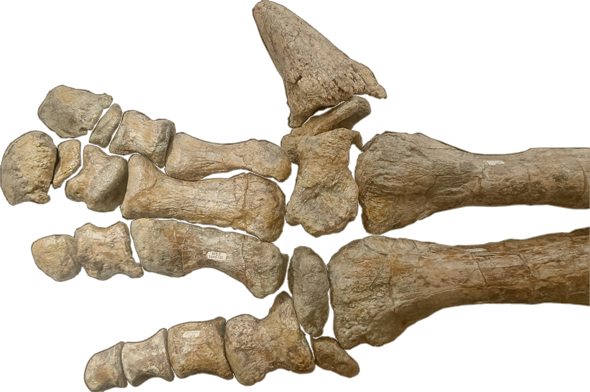
Anatomically, Magnamanus was a medium-sized styracosternan ornithopod in the mould of Iguanodon, but with forelimbs of extraordinary size and power. The shoulder blade to the finger tips are stupendously robust — far more heavily built than in most Early Cretaceous styracosternans — with the five-fingered hand itself (the middle three digits of which are so close as to be almost a single element) broad and stout enough to justify the name Magnamanus, "large hand". With forelimbs this massive and an estimated body mass exceeding three tons, Magnamanus likely walked on all fours, a conclusion perhaps supported by quadrupedal ornithopod tracks bearing handprints documented from the region. The holotype includes almost a hundred teeth, yet none are preserved in the jaws: they are all loose, shed elements from the dental battery, most of which are worn down to the point of uselessness, with only a single upper jaw tooth retaining anything like a functional crown. This particular herbivore, it seems, was a very old individual, whose plant-grinding apparatus had been pushed to its limits.
Media, public and most of science itself were blissfully unaware that Magnamanus soriaensis had been named and described, in an obscure paleontological journal, apparently in 2016, because nothing had been announced, it's own website showed no trace of the article in 2016, and the only "evidence" of a 2016 publication date was the unpublished timestamp of the PDF version of the article that didn't actually appear online until 2017. Even the WorldCat listing that was cited as proof of a 2016 print edition that would satisfy the International Code of Zoological Nomenclature (ICZN) rules regarding date of nameage has since vanished. Still, the 2016 date has been universally accepted by palaeontologists, despite the documentary trail being thin, contradictory, and oddly dependent on trust rather than verifiable archival evidence, leaving Magnamanus in the peculiar position of being both officially named and as literarily untraceable as it is literally unviewable.
Anatomically, Magnamanus was a medium-sized styracosternan ornithopod in the mould of Iguanodon, but with forelimbs of extraordinary size and power. The shoulder blade to the finger tips are stupendously robust — far more heavily built than in most Early Cretaceous styracosternans — with the five-fingered hand itself (the middle three digits of which are so close as to be almost a single element) broad and stout enough to justify the name Magnamanus, "large hand". With forelimbs this massive and an estimated body mass exceeding three tons, Magnamanus likely walked on all fours, a conclusion perhaps supported by quadrupedal ornithopod tracks bearing handprints documented from the region. The holotype includes almost a hundred teeth, yet none are preserved in the jaws: they are all loose, shed elements from the dental battery, most of which are worn down to the point of uselessness, with only a single upper jaw tooth retaining anything like a functional crown. This particular herbivore, it seems, was a very old individual, whose plant-grinding apparatus had been pushed to its limits.
(Great Hand of Soria)Etymology
Magnamanus is derived from the Latin "magnus" (great or large) and "manus" (hand). By the by, in early christian art Jesus is often depicted making a hand gesture known as the "magna manus" which he blatantly robbed from Buddhism—specifically from Amoghasiddhi, the Green Buddha of the North—where it is known as "adhaya-mudra". With the right hand raised to heart level and the palm facing out and fingers pointing up, this is a gesture of protection, meaning Buddha has your back.
The species epithet, soriaensis, means "from Soria" in Latin.
Discovery
Magnamanus was discovered in a 28m2 area at "Zorralbo I" in the Golmayo Formation, Soria Province, Spain, by husband and wife Manuel Meijide Calvo and Carolina Fuentes Vidarte, and their sons Federico and Manuel Meijide Fuentes, in 2000, and excavated across five consecutive field seasons between 2000 and 2004.
Spanish family names (aka surnames) are a bit unusual compared to, say, English family names, in that everyone has two of them and women rarely change theirs when they get married. Their offspring will have a two-part family name, with the first part (ie; "Meijide") being the father's first-of-two surnames (his father's family name) and the second part (ie; "Fuentes") being the mother's first-of-two surnames (her father's family name), so only father's family names are passed down through the generations.
The holotype, catalogued as MNS 2000/132, 2001/122, 2002/95, 2003/69, and 2004/54, is a partial skeleton comprising; a partial snout, and ninety-eight (sixty-two upper and thirty-six lower) loose and very worn teeth; a proatlas (an arch-shaped pair of bones that help stabilise the joint between the skull and the first neck vertebra); partial vertebrae (one neck, four back, thirty-two tail) and associated ribs and tendons; the right shoulder girdle and a left shoulder bone; both upper arms, and the right lower arm, wrist and hand; thirty-seven hip fragments and a partial pelvic girdle; fragment of the right thigh, shin, and two foot bones; and five chevrons.
The large hand of Magnamanus was displayed at the Numantino Museum of Soria as the "Piece of the Month"... three times... across July–September 2018.


