
MELANOROSAURUS
a melanorosaurid sauropodomorph dinosaur from the Late Triassic of South Africa and Lesotho.
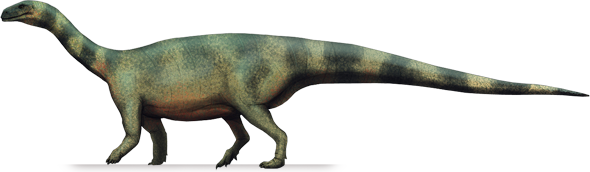
Pronunciation: me-LAN-or-o-SOR-us
Meaning: Black Mountain Lizard
Author/s: Haughton (
1924)
Synonyms: None known
First Discovery: Cape Province, South Africa
Acta Ordinal: #147
Melanorosaurus readi
Melanorosaurus was one of the earliest dinosaurs to experiment with the giant, four-legged body plan that later defined the great sauropods. Living in South Africa about 210 million years ago, it stood out among Late Triassic dinosaurs for its sheer size—up to 12 meters long—and for its unusually heavy, column-like limbs. Its pelvis carried four fused sacral vertebrae, one more than the typical "prosauropod" count, giving the hips extra strength for supporting a massive, quadrupedal frame. The reinforced sacrum, powerful legs, and deep, sturdy torso mark Melanorosaurus as one of the first sauropodomorphs to cross into sauropod-grade anatomy.
(Reid's Black Mountain Lizard)Etymology
Melanorosaurus is derived from the Greek "melas" (black), "oros" (mountain) and "sauros" (lizard), in reference to its discovery on "Thaba 'Nyama" (Black Mountain).
The
species epithet,
readi, honours Mr. B. Read, former Principal of the Bensonvale Training School, "of whose kindness, display of interest, and hospitality i have a lively recollection" (Haughton, 1924).
Discovery
The first fossils of
Melanorosaurus were discovered in the
Elliot Formation (Stormberg group, Karoo supergroup) on the north slope of Thaba 'Nyama ("Black Mountain"), between Josana's Hoek and Josana's Nek in the Herschel District of the former Transkei, eastern Cape Province, South Africa.
The
holotype originally consisted of two syntypes; (1)
SAM 3449 is a left tibia (shin), a left fibula (calf), a right ilium and left pubis (hip bones), metatarsals (foot bones), and "some vertebrae" from Haughton's original description that transmogrified into "a right ulna and both radii" for Galton
et al's reappraisal of its remains in 2005, and (2)
SAM 3450 which includes a right femur (thigh) and half of a right humerus (upper arm or "funny bone").
In 2024,
SAM-PK-3449 was designated as the lectotype by Barrett and Choiniere, who excluded
SAM-PK-3450 on the basis of anatomical differences.
Another, somewhat smaller specimen,
SAM 3532, discovered at Rooi Nek between Kromme Spruit and Majuba Nek and assigned to
Melanorosaurus by Haughton at the time of description, includes a scapula (shoulder blade) and humerus that Van Heerden erroneously referred to the holotype in 1979, plus a left ilium and metatarsal III. Truth be told, no-one seems to know if this belongs to
Melanorosaurus or not.
NM QR3314 (a juvenile specimen, including a skull) and
NM QR1551 (all four types of vertebrae and various limb bones belonging to two individuals) have also been assigned here.
Estimations
Timeline:
Era: Mesozoic
Epoch: Triassic
Stage: Norian-Simemurian
Age range: 221-201 mya
Stats:
Est. max. length: 12 meters
Est. max. hip height: 2 meters
Est. max. weight: 2 tons
Diet: Herbivore
Melanorosaurus thabanensis
Discovered near Thabana Morena village in Lesotho by François Ellenberger in 1959, the species long known as
Melanorosaurus thabanensis (Gauffre, 1993) is based on the holotype femur MNHN.F.LES351, a massive, powerfully built thigh bone that immediately set it apart from other sauropodomorphs of the Lower Elliot Formation. What set it apart even more, is that it doesn't belong to
Melanorosaurus.
Later study by Nair and Yates and others, showed that it was distinct enough to warrant its own name, yet the fossil still captures the same evolutionary moment: a lineage of Late Triassic dinosaurs pushing toward larger size, reinforced hindlimbs, and a more quadrupedal stance long before the first giants of the Jurassic appeared.
Melanorosaurus thabanensis—via an erroneous outing as
Thotobolosaurus (Ellenberger, 1970), and
Kholumolumosaurus ellenbergerorum (Gauffre, 1996) which is now
Kholumolumo (Peyre de Fabrègues and Allain, 2020)—was renamed
Meroktenos in 2016.
References
• Haughton SH (1924) "
The fauna and stratigraphy of the Stormberg Series".
Annals of the South African Museum. Volume XII. [coins
Melanorosaurus readi.]
• Costedoat D (1962) "Etude de quelques reptiles fossiles".
Master Thesis, Université de Paris.
• Ellenberger P (1970) "Les niveaux paléontologiques de première apparition des mammifères primoridaux en Afrique du Sud et leur ichnologie. Establissement de zones stratigraphiques detaillees dans le Stormberg du Lesotho (Afrique du Sud) (Trias Supérieur à Jurassique)" [The paleontological levels of the first appearance of primordial mammals in southern Africa and their ichnology. Establishment of detailed stratigraphic zones in the Stormberg of Lesotho (southern Africa) (Upper Triassic to Jurassic)]. Page 343–370 in Haughton (ed.) "Second Symposium on Gondwana Stratigraphy and Paleontology".
International Union of Geological Sciences. Council for Scientific and Industrial Research, Pretoria. [coins
Thotobolosaurus mabeatae.]
• Gauffre F-X (1993) "The most recent Melanorosauridae (Saurischia, prosauropoda) Lower Jurassic of Lesotho, with remarks on the prosauropod Phylogeny".
Neues Jahrbuch für Geologie und Paläontologie Monatshefte, 11: 648-654. [coins
Melanorosaurus thabanensis.]
• Gauffre F-X (1996) "Phylogénie des dinosaures prosauropodes et étude d'un nouveau prosauropode du Trias supérieur d'Afrique australe".
Ph.D. dissertation, Muséum National d'Histoire Naturelle, Paris, France: 1-156. [coins
Kholumolumosaurus ellenbergerorum.]
• Galton PM, Van Heerden J and Yates AM (2005) "Postcranial anatomy of referred specimens of
Melanorosaurus". Page 1-37 in Carpenter and Tidswell (eds.) "
Thunder-Lizards: The Sauropodomorph Dinosaurs".
Indiana University Press.
• Yates AM (2007) "The first complete skull of Triassic dinosaur
Melanorosaurus". Page 9–55 in Barrett and Batten (eds.) "
Special Papers in Palaeontology: Evolution and Palaeobiology of Early Sauropodomorph Dinosaurs".
Wiley-Blackwell; No 77 edition.
• Paul GS (2010) "
The Princeton Field Guide to Dinosaurs".
Princeton University Press.
• Yates AM (2010) "
A revision of the problematic sauropodomorph dinosaurs from Manchester, Connecticut and the status of Anchisaurus Marsh".
Palaeontology 53(4): 739-752
• Peyre de Fabrègues C and Allain R (2016) "
New material and revision of Melanorosaurus thabanensis, a basal sauropodomorph from the Upper Triassic of Lesotho".
PeerJ, 4: e1639. DOI: 10.7717/peerj.1639.
• Peyre de Fabrègues C and Allain R (2020) "
Kholumolumo ellenbergerorum, gen. et sp. nov., a new early sauropodomorph from the lower Elliot Formation (Upper Triassic) of Maphutseng, Lesotho".
Journal of Vertebrate Paleontology, 39(6): e1732996. DOI: 10.1080/02724634.2019.1732996.
• Barrett PM and Choiniere JN (2024) "
Melanorosaurus readi Haughton, 1924 (Dinosauria, Sauropodomorpha) from the Late Triassic of South Africa: osteology and designation of a lectotype".
Journal of Vertebrate Paleontology: e2337802.
Time stands still for no man, and research is ongoing. If you spot an error, or want to expand, edit or add a dinosaur, please use
this form. Go
here to contribute to our FAQ.
All dinos are GM free, and no herbivores were eaten during site construction!
To cite this page:
Atkinson, L.
"
MELANOROSAURUS :: from DinoChecker's dinosaur archive".
‹
http://www.dinochecker.com/dinosaurs/MELANOROSAURUS›. Web access: 25th Oct 2026.









