







Pronunciation: ih-GWAHN-uh-col-OSS-us
Meaning: Gigantic Iguana
Author/s: McDonald et al. (2010)
Synonyms: None known
First Discovery: Utah, USA
Acta Ordinal: #759
Iguanacolossus fortis
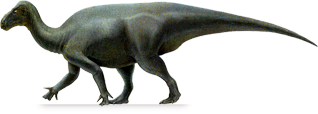
Iguanacolossus is a member of Styracosterna, which is (basically) Ankylopollexia minus Camptosaurus, and was discovered at "Dons Ridge" in the lower Yellow Cat Member of Utah's Cedar Mountain Formation. Based on known remains, it's a large, somewhat ponderous beast with robust limbs. Size-wise, it appears to fall in the same ballpark as the recently installed iguanodont name-bearer Iguanodon bernissartensis from a coal mine in Belgium's Sainte-Barbe Clays Formation.
"Andrew's Site" in the same area yielded the remains of Hippodraco, which McDonald described at the same time as Iguanacolossus, but it's smaller and rather gracile by comparison. In contrast, a stupendously large left shin and nine equally monstrous tail vertebrae (UMNH VP 20207) were hauled from the same quarry, but they don't share features with any other iguanodont from the Cedar Mountain Formation (including Iguanacolossus) and can't be assigned to Hippodraco because its holotype lacks those parts for comparison.
"Andrew's Site" in the same area yielded the remains of Hippodraco, which McDonald described at the same time as Iguanacolossus, but it's smaller and rather gracile by comparison. In contrast, a stupendously large left shin and nine equally monstrous tail vertebrae (UMNH VP 20207) were hauled from the same quarry, but they don't share features with any other iguanodont from the Cedar Mountain Formation (including Iguanacolossus) and can't be assigned to Hippodraco because its holotype lacks those parts for comparison.
(Mighty Gigantic Iguana)
Etymology
Iguanacolossus is a combination of "Iguana" (referring to Iguana lizards, whose teeth have been historically compared to those of iguanodonts such as this one) and the Latin "colossus" (of gigantic size).
The species epithet, fortis, means "mighty" in Latin.
ZooBank registry: urn:lsid:zoobank.org:act:737FED01-0B7E-450B-8586-DF2B212CD84B.
Discovery
The remains of Iguanacolossus were discovered at "Don's Ridge" (named after discoverer Don DeBlieux) within the Lower Yellow Cat member of the Cedar Mountain Formation, near Green River, Grand County, Utah.
The holotype (UMNH VP 20205) includes a partial skull, neck bone fragments, thirteen back vertebrae in various states of completeness, a right shoulder blade, a partial pelvic girdle, five tail vertebrae with chevrons, a left calf and two foot bones.


