






Pronunciation: SEH-ruh-SIN-ops
Meaning: Face of cherry
Author/s: Chinnery and Horner (2007)
Synonyms: None known
First Discovery: Montana, USA
Acta Ordinal: #636
Cerasinops hodgskissi
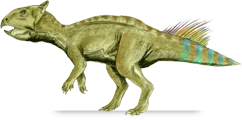
When Cerasinops was discovered in 1983, distinguishing characteristics weren't exactly screaming out at palaeontologists, so they referred to it simply as Cera (pronounced Sara). And so it remained for 24 years. Being bipedal and small is nothing new within Neoceratopsia, the group of "horn-faced" herbivores to which Cerasinops belongs as a basal member. Nor is the fact that the faces of basal "horn-faced" herbivores mostly lack horns. What did turn out to be new, however, is a suite of features combining those of Asian neoceratopsians (holes in the skull frill and extra teeth at the front of the upper jaws) previously unseen in North American ones with those of North American neoceratopsians (specialized tooth wear patterns) previously unseen in Asian ones, all wrapped up in a single critter.
(Hodgskiss's Face of Cherry)Etymology
Cerasinops is derived from the Latin "cerasinus" (of cherry) and the Greek "-ops" (face), referring to the red beds of
the type locality and the dark red tinge of colour on the specimen.
The name also incorporates "Cera" (Pron: Sarah), a nickname by which the holotype specimen has been known for many years.
The species epithet, hodgskissi, honours Mr. and Mrs. Wilson Hodgskiss who permitted the Museum of the Rockies to collect specimens on their land.
Discovery
The holotype of Cerasinops (MOR 300) is an almost 80% complete skeleton, discovered in the Two Medicine Formation at the Red Rocks Site (MOR TM-012), near Choteau, Teton County, Montana, by Jack Horner in 1983.
Referred material includes skull fragments and teeth, a partial hindlimb and forearm fragments (USNM 13863 and 13864) from the Two Medicine Formation at MOR Locality TM-067, Pondera County, Montana, that were previously referred to Leptoceratops sp. by Gilmore in 1939.
Preparator
Carrie Ancel.


