Pronunciation: ma-MEN-chi-SOR-ih-day
Authors: Young and Zhao
Year: 1972
Meaning: Mamenchi lizards (see etymology)
Locomotion: Quadrupedal (four legs)
Synonyms: Omeisauridae (Wilson, 2002)
Definition
No official definition
About
Mamenchisauridae emerges in the Late Jurassic as a distinctive eusauropod lineage, trailblazing a unique suite of skeletal specialisations that would evolve independently in some later neosauropods. Their earliest representatives appear in the floodplain ecosystems of China, and become one of the most recognisable sauropod radiations of their time.
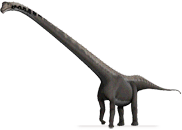
Mamenchisaurid anatomy pushed toward biomechanical extremes. Their necks could stretch to nearly half the animal’s total length, built from some of the longest vertebrae ever produced by a terrestrial vertebrate. The axial column is hollowed by an extensive air-sac system, turning much of the backbone into a lightweight but resilient truss capable of sustaining such extravagant proportions. Their neck ribs sweep back in long, overlapping shafts that span multiple vertebrae, acting both as extended lever arms for the major cervical muscles and as dynamic stabilisers that help tame the mechanical stresses of extreme elongation. The skull is small but deep, with a short snout and robust jaws; the limbs are columnar without being especially long; and the tail is a plain, functional counterbalance, stripped of ornament and built simply to do its job.
Mamenchisaurids reach their zenith in the Late Jurassic and persist into the Early Cretaceous of Asia, becoming one of the dominant sauropod groups in Chinese ecosystems. Their decline coincides with the rise of neosauropods, which spread across Asia and diversify into a broader range of ecological roles. Yet their legacy is unmistakable: they include the longest-necked dinosaurs ever discovered, exemplified by giants such as Xinjiangtitan and Mamenchisaurus sinocanadorum, and showcase the extraordinary malleability of the sauropod neck. Mamenchisauridae stands as a lineage that pushed sauropod morphology in a direction no other group explored so completely.
Click here to search Dinochecker for mamenchisaurids.
Etymology
Mamenchisauridae is derived from "Mamenchi"—[Chinese "ma" (horse), "men" (gate) and "xi" (brook)]—which is an accent-induced misinterpretation of Mamingxi—[Chinese "ma" (horse), "ming" (neighing) and "xi" (brook)]—where the type specimen was found, the Greek "sauros" (lizard), and the Latin "-idae" (family).
Relationships
References
• Young CC and Zhao X (1972) "Mamenchisaurus hochuanensis sp. nov.". Institute of Vertebrate Palaeontology and Palaeoanthropology Monographs, Series I, 8: 1-30.
• Russell DA and Zheng Z (1993) "A large mamenchisaurid from the Junggar Basin, Xinjiang, People's Republic of China". Canadian Journal of Earth Sciences, 30(10): 2082-2095. DOI: 10.1139/e93-180.
• Wu W-H, Zhou C-F, Wings O, SekihaT and Dong Z-M (2013) "A new gigantic sauropod dinosaur from the Middle Jurassic of Shanshan, Xinjiang". Global Geology, 32(3): 437-446.
• Paul GS (2016) "The Princeton Field Guide to Dinosaurs: Second Edition".