




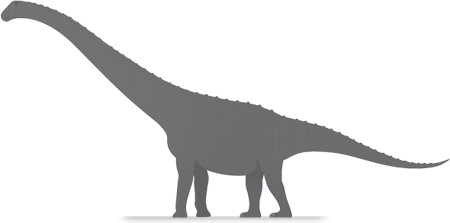
Pronunciation: dis-LOK-o-SOR-us
Meaning: Hard-to-place lizard
Author/s: McIntosh, Coombs, and Russell (1992)
Synonyms: Non known
First Discovery: Wyoming, USA
Acta Ordinal: #374
Dyslocosaurus polyonychius
(Hard-to-place Lizard, with Many Claws)Etymology
Dyslocosaurus is derived from the Greek "dys" (bad, poor), the Latin "locus" (place), and the Greek "sauros" (lizard), in reference to the lack of locality data attached to its fossils, which were simply labelled as "Lance Creek", which is a county in Wyoming. The species epithet, polyonychius, is derived from the Greek "polys" (many) and "onyx" (claw), referring to the foot claws which may (or may not) number four or maybe five, compared to your usual diplodocid claw count of three.
Discovery
The remains of Dyslocosaurus were discovered at "Lance Creek" in Wyoming, USA, by Frederic Brewster Loomis in 1902.
The holotype (AC 663—housed at the Amherst College Museum of Natural History) consists entirely of limb bones.


