PALUDOHADROS
a herbivorous hadrosauroid iguanodontian dinosaur from the Early Cretaceous of England.
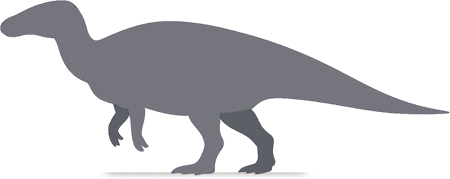
Pronunciation: pah-LOO-doe-HAD-ross
Meaning: Swamp hadrosauroid
Author/s: Sacamoto
et al. (
2026)
Synonyms: None known
First Discovery: Surrey, England
Acta Ordinal: #1260
Paludohadros proudlovii
(Proudlove's Swamp Hadrosauroid)Etymology
Paludohadros is derived from the Latin "palüs" (swamp) and the Greek "hadrós" (thick or bulky: specifically referring to Hadrosauroidea—the "bulky lizards"—of which
Paludohadros is a member). The name refers to both the swampy environment of its southern England home during the Early Cretaceous and the current muddy conditions of the fossil site.
The
species epithet,
proudlovii, honours William Proudlove, former factory manager of Ewhurst
Works, who died in 2000 at the age of 35, shortly before the excavation of the holotype fossils.
ZooBank registry:
Discovery
The remains of
Paludohadros were discovered in the Upper Member of the Weald Clay Formation at "Smokejacks Brickworks" (now known as Ewhurst Works), near the village of Ockley in Surrey, UK, by Geoff Toye during a field trip of the British Geologists' Association on July 22nd, 2001.
The
holotype (NHMUK PV R 16396) is a partial skull and skeleton that was initially identified as a juvenile
Iguanodon, and later as a specimen of
Mantellisaurus.
Referred material includes four upper arms and four shins from Smokejacks Pit, described by W. H. E. Rivett in 1953 and 1956, and an isolated partial surangular (part of the lower jaw) from a Wealden-age site on the Isle of Wight.
Estimations
Timeline:
Era: Mesozoic
Epoch: Early Cretaceous
Stage: Barremian
Age range: 126-121 mya
Stats:
Est. max. length: ?
Est. max. hip height: ?
Est. max. weight: ?
Diet: Herbivore
References
• Rivett WHE (1953) "Saurian remains from the Weald Clay at Ockley, Surrey".
South Eastern Naturalist and
Antiquary, 58: 36–37.
• Rivett WHE (1956) "On some reptilian bones from the Weald Clay of Surrey".
Proceedings of the Geologists' Association, 67(1540): 110-111.
• Austen P (2001) "
The day of the Iguanodon". Geologists' Association Circular, #948, page 13.
• Nye E, Feist-Burkhardt S, Horne DJ, Ross AJ and Whittaker JE (2008) "The palaeoenvironment associated with a partial
Iguanodon skeleton from the Upper Weald Clay (Barremian, Early Cretaceous) at Smokejacks Brickworks (Ockley, Surrey, UK), based on palynomorphs and ostracods".
Cretaceous Research, 29(3): 417-444. DOI: 10.1016/j.cretres.2008.01.004.
• Jarzembowski EA and Austen PA (2021) "
Smokejacks: 50(+) years down the pit".
Hastings and District Geological Society Journal, 27: 23–25.
• Sacamoto RJ, Lockwood JAF, Langer MC, Clark B, Barrett PM, Turner A and Maidment SCR (2026) "A new iguanodontian dinosaur from the Weald Clay Formation (Lower Cretaceous) of Smokejacks Brickworks, southern England".
Journal of Systematic Palaeontology, 24(2): 2726221. DOI: 10.1080/14772019.2026.2726221.
Time stands still for no man, and research is ongoing. If you spot an error, or want to expand, edit or add a dinosaur, please use
this form. Go
here to contribute to our FAQ.
All dinos are GM free, and no herbivores were eaten during site construction!
To cite this page:
Atkinson, L.
"
PALUDOHADROS :: from DinoChecker's dinosaur archive".
‹
http://www.dinochecker.com/dinosaurs/PALUDOHADROS›. Web access: 07th Nov 2026.