



Pronunciation: dip-luh-DOH-kuh-nay
Author: Werner Janensch
Year: 1929
Meaning: Double beams (see etymology)
Locomotion: Quadrupedal (four legs)
Synonyms: None known
[Taylor and Naish, 2005]Definition
All taxa more closely related to Diplodocus than to Apatosaurus.
About
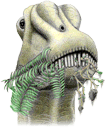
Diplodocinae is the gracile, ultra-elongate subfamily of Diplodocidae, including Diplodocus, Barosaurus, and Galeamopus from the Late Jurassic of North America and Portugal. These sauropods pushed the diplodocid plan to its extreme: exceptionally long, lightly built necks; extraordinarily extended tails that narrowed into a fine, whip-like tip; and a low, narrow skull with forward-projecting, pencil-shaped teeth restricted to the front of the jaws.
Their forelimbs were shorter than the hind limbs, producing a gentle slope from hip to shoulder, while the limb bones themselves were relatively slender. Barosaurus exaggerated this pattern further, adding extra cervical vertebrae to create one of the longest necks known. Extensive vertebral pneumaticity reduced skeletal mass and is consistent with a bird-style air-sac system.
Diplodocines were specialised low browsers: their flexible, laterally sweeping necks and narrow snouts were adapted for efficiently harvesting understory vegetation across broad floodplain landscapes.
Click here to view Dinochecker's A-Z list of diplodocines.
Etymology
Diplodocinae is derived from the Greek "diploos" (double) and "dokos" (beam), and the Latin "-inae" (subfamily).
Relationships
References
• Marsh OC (1883) "Principal characters of American Jurassic dinosaurs. Restoration of Brontosaurus". Geological Magazine, 10(9): 385-388. DOI: 10.1017/S0016756800166786.
• Marsh OC (1884) "Principal characters of American Jurassic dinosaurs. Part VII. Diplodocidae, a new family of the Sauropoda". American Journal of Science, 27: 161-167.
• Barrett PM and Upchurch P (1994) "Feeding mechanisms of Diplodocus". Gaia, 10: 195-204.
• Myhrvold N and Currie PJ (1997) "Supersonic sauropods? Tail dynamics in the diplodocids". Paleobiology, 23(4): 393-409. DOI: 10.1017/S0094837300019801.
• Upchurch P and Barrett PM (2000) "The evolution of sauropod feeding mechanism". In Sues (ed.) "Evolution of Herbivory in Terrestrial Vertebrates".
• Witmer LM (2001) "Nostril position in dinosaurs and other vertebrates and its significance for nasal function". Science, 293(5531): 850–853. DOI: 10.1126/science.1062681.
• Upchurch P, Barrett PM and Dodson P (2004) "Sauropoda". Page 259-322 in Weishampel, Dodson and Osmolska (eds.) "The Dinosauria: Second Edition".
• Carpenter K and Tidswell V (2005) "Thunder Lizards: The Sauropodomorph Dinosaurs".
• Taylor MP and Naish D (2005) "The phylogenetic taxonomy of Diplodocoidea (Dinosauria: Sauropoda)". PaleoBios, 25(2): 1-7.
• Knoll F, Galton PM and López-Antoñanzas R (2006) "Paleoneurological evidence against a proboscis in the sauropod dinosaur Diplodocus". Geobios, 39(2): 215–221. DOI: 10.1016/j.geobios.2004.11.005.
• Schwarz D, Frey E and Meyer CA (2007) "Pneumaticity and soft-tissue reconstructions in the neck of diplodocid and dicraeosaurid sauropods".  Acta Palaeontologica Polonica, 52(1): 167-188.
• Whitlock JA (2011) "Inferences of Diplodocoid (Sauropoda: Dinosauria) Feeding Behavior from Snout Shape and Microwear Analyses". PLoS ONE, 6(4): e18304. DOI: 10.1371/journal.pone.0018304.
• Young MT, Rayfield EJ, Holliday CM, Witmer LM, Button DJ, Upchurch P and Barrett PM (2012) "Cranial biomechanics of Diplodocus (Dinosauria, Sauropoda): testing hypotheses of feeding behaviour in an extinct megaherbivore". Naturwissenschaften, 99(8): 637–643. DOI: 10.1007/s00114-012-0944-y.
• Tschopp E and Mateus O (2015) "A specimen-level phylogenetic analysis and taxonomic revision of Diplodocidae (Dinosauria, Sauropoda)".
PeerJ, 3: e857. DOI: 10.7717/peerj.857.
• Baron MG (2021) "Tactile tails: a new hypothesis for the function of the elongate tails of diplodocid sauropods". Historical Biology, 33(10): 2057–2066. DOI: 10.1080/08912963.2020.1769092.
• Gallagher T, Poole J and Schein JP (2021) "Evidence of integumentary scale diversity in the late Jurassic Sauropod Diplodocus sp. from the Mother’s Day Quarry, Montana". PeerJ, 9: e11202. DOI: 10.7717/peerj.11202.
• Conti S, Tschopp E, Mateus O, Zanoni A, Masarati P and Sala G (2022)
"Multibody analysis and soft tissue strength refute supersonic dinosaur tail". Scientific Reports, 12: 19245.
DOI: 10.1038/s41598-022-21633-2.
• Gallina PA, Apesteguía S, Carballido JL and Garderes JP (2022) "Southernmost Spiny Backs and Whiplash Tails: Flagellicaudatans from South America". Page 209–236 in Otero, Carballido and Pol (eds.) "South American Sauropodomorph Dinosaurs: Record, Diversity and Evolution".
• Gallagher T, Folkes D, Pittman M, Kaye TG, Storrs GW and Schein JP (2025) "Fossilized melanosomes reveal colour patterning of a sauropod dinosaur".
Royal Society Open Science, 12(12): 251232.
DOI: 10.1098/rsos.251232.
Acta Palaeontologica Polonica, 52(1): 167-188.
• Whitlock JA (2011) "Inferences of Diplodocoid (Sauropoda: Dinosauria) Feeding Behavior from Snout Shape and Microwear Analyses". PLoS ONE, 6(4): e18304. DOI: 10.1371/journal.pone.0018304.
• Young MT, Rayfield EJ, Holliday CM, Witmer LM, Button DJ, Upchurch P and Barrett PM (2012) "Cranial biomechanics of Diplodocus (Dinosauria, Sauropoda): testing hypotheses of feeding behaviour in an extinct megaherbivore". Naturwissenschaften, 99(8): 637–643. DOI: 10.1007/s00114-012-0944-y.
• Tschopp E and Mateus O (2015) "A specimen-level phylogenetic analysis and taxonomic revision of Diplodocidae (Dinosauria, Sauropoda)".
PeerJ, 3: e857. DOI: 10.7717/peerj.857.
• Baron MG (2021) "Tactile tails: a new hypothesis for the function of the elongate tails of diplodocid sauropods". Historical Biology, 33(10): 2057–2066. DOI: 10.1080/08912963.2020.1769092.
• Gallagher T, Poole J and Schein JP (2021) "Evidence of integumentary scale diversity in the late Jurassic Sauropod Diplodocus sp. from the Mother’s Day Quarry, Montana". PeerJ, 9: e11202. DOI: 10.7717/peerj.11202.
• Conti S, Tschopp E, Mateus O, Zanoni A, Masarati P and Sala G (2022)
"Multibody analysis and soft tissue strength refute supersonic dinosaur tail". Scientific Reports, 12: 19245.
DOI: 10.1038/s41598-022-21633-2.
• Gallina PA, Apesteguía S, Carballido JL and Garderes JP (2022) "Southernmost Spiny Backs and Whiplash Tails: Flagellicaudatans from South America". Page 209–236 in Otero, Carballido and Pol (eds.) "South American Sauropodomorph Dinosaurs: Record, Diversity and Evolution".
• Gallagher T, Folkes D, Pittman M, Kaye TG, Storrs GW and Schein JP (2025) "Fossilized melanosomes reveal colour patterning of a sauropod dinosaur".
Royal Society Open Science, 12(12): 251232.
DOI: 10.1098/rsos.251232.
Acta Palaeontologica Polonica, 52(1): 167-188.
• Whitlock JA (2011) "Inferences of Diplodocoid (Sauropoda: Dinosauria) Feeding Behavior from Snout Shape and Microwear Analyses". PLoS ONE, 6(4): e18304. DOI: 10.1371/journal.pone.0018304.
• Young MT, Rayfield EJ, Holliday CM, Witmer LM, Button DJ, Upchurch P and Barrett PM (2012) "Cranial biomechanics of Diplodocus (Dinosauria, Sauropoda): testing hypotheses of feeding behaviour in an extinct megaherbivore". Naturwissenschaften, 99(8): 637–643. DOI: 10.1007/s00114-012-0944-y.
• Tschopp E and Mateus O (2015) "A specimen-level phylogenetic analysis and taxonomic revision of Diplodocidae (Dinosauria, Sauropoda)".
PeerJ, 3: e857. DOI: 10.7717/peerj.857.
• Baron MG (2021) "Tactile tails: a new hypothesis for the function of the elongate tails of diplodocid sauropods". Historical Biology, 33(10): 2057–2066. DOI: 10.1080/08912963.2020.1769092.
• Gallagher T, Poole J and Schein JP (2021) "Evidence of integumentary scale diversity in the late Jurassic Sauropod Diplodocus sp. from the Mother’s Day Quarry, Montana". PeerJ, 9: e11202. DOI: 10.7717/peerj.11202.
• Conti S, Tschopp E, Mateus O, Zanoni A, Masarati P and Sala G (2022)
"Multibody analysis and soft tissue strength refute supersonic dinosaur tail". Scientific Reports, 12: 19245.
DOI: 10.1038/s41598-022-21633-2.
• Gallina PA, Apesteguía S, Carballido JL and Garderes JP (2022) "Southernmost Spiny Backs and Whiplash Tails: Flagellicaudatans from South America". Page 209–236 in Otero, Carballido and Pol (eds.) "South American Sauropodomorph Dinosaurs: Record, Diversity and Evolution".
• Gallagher T, Folkes D, Pittman M, Kaye TG, Storrs GW and Schein JP (2025) "Fossilized melanosomes reveal colour patterning of a sauropod dinosaur".
Royal Society Open Science, 12(12): 251232.
DOI: 10.1098/rsos.251232.


Time stands still for no man, and research is ongoing. If you spot an error, or want to expand, edit or suggest an entry feel free to drop us a line. Go here to answer an FAQ.
© 2010-2026 Dinochecker unless stated | Rss feed | Kindly site donations here.
All dinos are GM free, and no herbivores were eaten during site construction! To cite this page:
Atkinson, L. "DinoChecker FAQ entry :: What is Diplodocinae?"
‹http://www.dinochecker.com/dinosaurfaqs/what-is-diplodocinae›. Web access: 02nd Jun 2026.
All dinos are GM free, and no herbivores were eaten during site construction! To cite this page:
Atkinson, L. "DinoChecker FAQ entry :: What is Diplodocinae?"
‹http://www.dinochecker.com/dinosaurfaqs/what-is-diplodocinae›. Web access: 02nd Jun 2026.
