







Date of Birth: June 14, 1928
Place of Birth: Rosario, Santa Fe, Argentina
Parents: Héctor Elías Bonaparte Lacroix and Margarita Ibarrola
Spouse: ?
Date of death: February 18, 2020
Place of death: Mercedes, Buenos Aires, Argentina
Legacy: Architect of South American palaeontology,
Major Patagonian fossil discoveries
Major Patagonian fossil discoveries
José Fernando Bonaparte
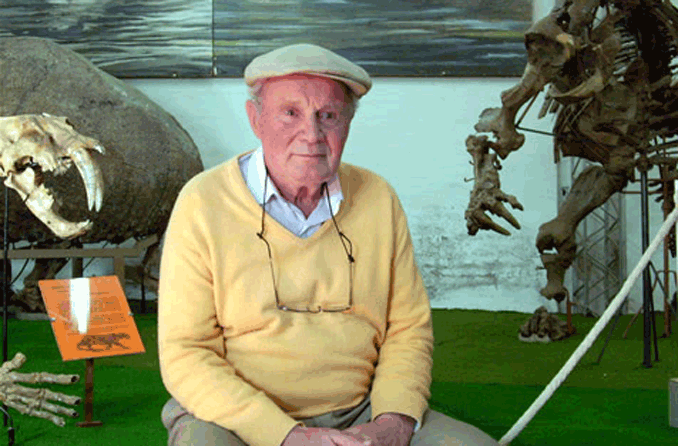
José Fernando Bonaparte was born on 14 June 1928 in Rosario, Argentina, the son of an Italian sailor, but with no familial connection to Napoleon's line, and grew up in Mercedes, Buenos Aires. With no formal academic training in paleontology, he began collecting fossils as a boy and even founded a small museum in his hometown — an early sign of the autodidactic drive that would define his career. His talent and persistence earned him a position at the National University of Tucumán, where he eventually became curator and received an honorary doctorate in 1974. By the late 1970s he had joined the Museo Argentino de Ciencias Naturales in Buenos Aires as a senior scientist, supported by Guggenheim Fellowships and periodic National Geographic Society funding.
Bonaparte’s fieldwork from the 1960s through the 1990s transformed South American paleontology. Working across Patagonia and northwestern Argentina, he uncovered a remarkable array of dinosaurs and fossil vertebrates that revealed the distinct evolutionary pathways of Gondwana after its separation from Laurasia. His discoveries showed how southern faunas diverged dramatically from their northern counterparts — a pattern that helped clarify continental drift and global biogeographic history.
Among his most significant contributions was the excavation of Saltasaurus between 1975 and 1977, where he and colleagues identified bony armour (osteoderms) in titanosaurs — a revelation that reshaped sauropod biology. He also recognized and named the clade Abelisauridae, identifying a lineage of short-faced, thick-skulled theropods that dominated Cretaceous Gondwana. His work on southern hadrosaurs and lambeosaurines led him to propose large-scale faunal exchanges between the Americas late in the Cretaceous.
Bonaparte described or co-described an extraordinary number of taxa — from the horned carnivore Carnotaurus to the immense Argentinosaurus, from early mammals like Vincelestes to bizarre forms such as Amargasaurus and Noasaurus. His output exceeded 120 scientific works and earned him the nickname "Master of the Mesozoic", as Robert Bakker once remarked. Peter Dodson went further, noting that Bonaparte was "almost singlehandedly responsible for Argentina becoming the sixth country in the world in kinds of dinosaurs". In 2008, the Society of Vertebrate Paleontology awarded him the Romer–Simpson Medal, its highest honor, recognizing a lifetime of discoveries that reshaped the global map of dinosaur evolution.
Though intense and famously driven, prone to angry outbursts, and plain rude to students and collaborators on occasion, Bonaparte was also a mentor who trained a new generation of Argentine palaeontologists — including Rodolfo Coria, Leonardo Salgado, and Jorge Calvo — ensuring that his influence extended far beyond his own discoveries.
José Fernando Bonaparte died in his sleep on 18 February 2020 at age 91. His legacy is immense: a transformed understanding of Gondwanan dinosaurs, a revitalized South American paleontological tradition, and a body of work that permanently altered the trajectory of vertebrate paleontology.
Bonaparte’s fieldwork from the 1960s through the 1990s transformed South American paleontology. Working across Patagonia and northwestern Argentina, he uncovered a remarkable array of dinosaurs and fossil vertebrates that revealed the distinct evolutionary pathways of Gondwana after its separation from Laurasia. His discoveries showed how southern faunas diverged dramatically from their northern counterparts — a pattern that helped clarify continental drift and global biogeographic history.
Among his most significant contributions was the excavation of Saltasaurus between 1975 and 1977, where he and colleagues identified bony armour (osteoderms) in titanosaurs — a revelation that reshaped sauropod biology. He also recognized and named the clade Abelisauridae, identifying a lineage of short-faced, thick-skulled theropods that dominated Cretaceous Gondwana. His work on southern hadrosaurs and lambeosaurines led him to propose large-scale faunal exchanges between the Americas late in the Cretaceous.
Bonaparte described or co-described an extraordinary number of taxa — from the horned carnivore Carnotaurus to the immense Argentinosaurus, from early mammals like Vincelestes to bizarre forms such as Amargasaurus and Noasaurus. His output exceeded 120 scientific works and earned him the nickname "Master of the Mesozoic", as Robert Bakker once remarked. Peter Dodson went further, noting that Bonaparte was "almost singlehandedly responsible for Argentina becoming the sixth country in the world in kinds of dinosaurs". In 2008, the Society of Vertebrate Paleontology awarded him the Romer–Simpson Medal, its highest honor, recognizing a lifetime of discoveries that reshaped the global map of dinosaur evolution.
Though intense and famously driven, prone to angry outbursts, and plain rude to students and collaborators on occasion, Bonaparte was also a mentor who trained a new generation of Argentine palaeontologists — including Rodolfo Coria, Leonardo Salgado, and Jorge Calvo — ensuring that his influence extended far beyond his own discoveries.
José Fernando Bonaparte died in his sleep on 18 February 2020 at age 91. His legacy is immense: a transformed understanding of Gondwanan dinosaurs, a revitalized South American paleontological tradition, and a body of work that permanently altered the trajectory of vertebrate paleontology.
References
• Lessem D (1993) "Jose Bonaparte: Master of the Mesozoic — Paleontologist". Omni.
• Spalding DAE (1993) "Dinosaur Hunters".
• Novas FE (2009) "The Age of Dinosaurs in South America".
• Novas FE (2021) "José Fernando Bonaparte (1928–2020)". Ameghiniana, 58(2): 177-179. DOI: 10.5710/1851-8044-58.2.177.
• Martinelli AG and Forasiepi AM (2021) "The legacy of JOSÉ FERNANDO BONAPARTE (1928-2020): From dinosaurs to mammals from the Mesozoic Era of South America". Prehistoric Times, #139.

Discoveries and descriptions ...


