




Date of Birth: June 13, 1911
Place of Birth: San Francisco, California, USA
Parents: Walter C. Alvarez and Harriet Smythe
Spouse: (1) Geraldine Smithwick, (2) Janet L. Landis
Date of expiry: September 1, 1988
Place of expiry: Berkeley, California, USA
Legacy: The Alvarez hypothesis: that an asteroid-impact caused the end-Cretaceous (K-Pg) extinction of dinosaurs
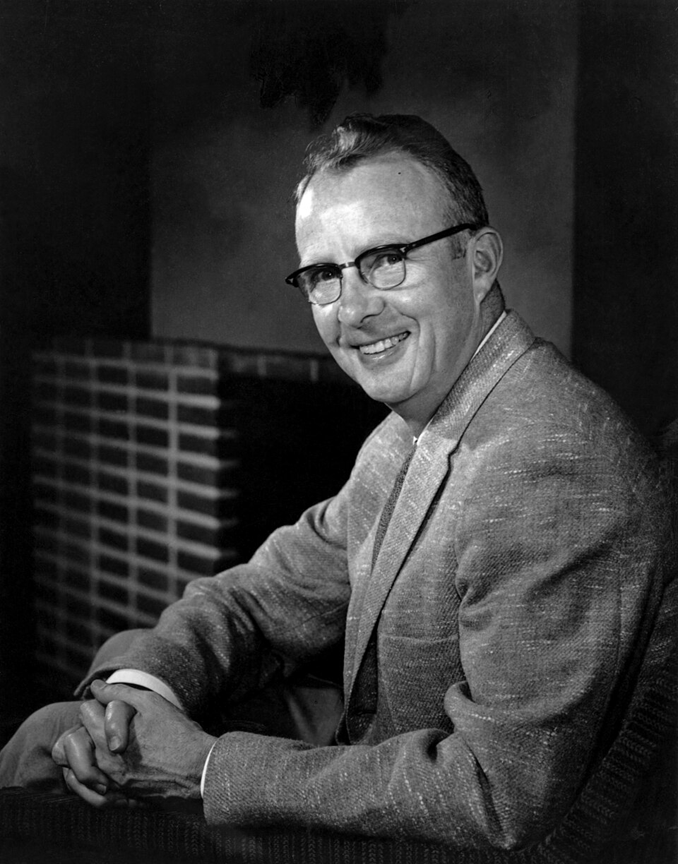
Luis Walter Alvarez
Luis Walter Alvarez was born on 13 June 1911 in San Francisco, the son of Walter C. Alvarez, a prolific medical author, and the grandson of Luis F. Alvarez, a physician who developed an improved diagnostic method for macular leprosy. Raised in an intellectually charged household, he developed an early fascination with mechanical systems and the physical world. After studying physics at the University of Chicago, where he earned his Ph.D. in 1936 under Arthur Compton, Alvarez joined the Radiation Laboratory at Berkeley — a move that placed him at the centre of the most dynamic experimental culture in American physics.
At Berkeley, Alvarez distinguished himself as a gifted experimentalist with an instinct for elegant instrumentation. He developed the Alvarez–Bloch nuclear magnetic resonance method, built innovative particle detectors, and designed the time-of-flight techniques that became standard in high-energy physics. During the Second World War he joined the MIT Radiation Laboratory, contributing to the development of radar systems, and later worked at Los Alamos on the Manhattan Project, where he helped design the detonators for the implosion-type plutonium bomb. His postwar work at Berkeley's Bevatron led to the discovery of numerous short-lived resonances and earned him the 1968 Nobel Prize in Physics for the development of the hydrogen bubble chamber and the analysis techniques that transformed particle physics into a photographic science.
Yet Alvarez’s most famous — and most controversial — scientific contribution came from a collaboration far outside particle physics. In 1977, while examining the Cretaceous–Paleogene boundary with his geologist son Walter Alvarez, he proposed that the mass extinction 66 million years ago had been triggered by the impact of a large extraterrestrial object. The evidence began with an anomalous layer of iridium, thousands of times richer than typical crustal concentrations, and expanded into a global geochemical signature. Their 1980 paper argued that a ten-kilometre asteroid had struck Earth, throwing dust into the atmosphere, shutting down photosynthesis, and collapsing ecosystems. By the 1990s, the impact theory had become the dominant explanation for the end-Cretaceous extinction, which wiped out roughly seventy-five percent of Earth's species, including all non-bird dinosaurs.
Alvarez’s scientific life was marked by a restless curiosity that refused disciplinary boundaries. He applied cosmic-ray muons to probe the interior of the Pyramid of Khafre, investigated the Zapruder film with high-speed optics, and proposed novel methods for airport security screening. His approach was always the same: identify a problem, build an instrument, and let the data speak. This experimental pragmatism — sometimes impatient with theoretical nuance — made him one of the most distinctive scientific personalities of the twentieth century.
Luis Walter Alvarez died on 1 September 1988 in Berkeley, California. His legacy spans nuclear physics, particle detection, geophysics, archaeology, and planetary science. He was a builder of instruments, a solver of problems, and a scientist unafraid to propose bold ideas when the evidence demanded them. In the impact hypothesis he offered a new vision of Earth’s history — one in which catastrophe, not slow change alone, could reshape the living world. His career stands as a testament to the power of experimental imagination and the unexpected paths that data can open.
At Berkeley, Alvarez distinguished himself as a gifted experimentalist with an instinct for elegant instrumentation. He developed the Alvarez–Bloch nuclear magnetic resonance method, built innovative particle detectors, and designed the time-of-flight techniques that became standard in high-energy physics. During the Second World War he joined the MIT Radiation Laboratory, contributing to the development of radar systems, and later worked at Los Alamos on the Manhattan Project, where he helped design the detonators for the implosion-type plutonium bomb. His postwar work at Berkeley's Bevatron led to the discovery of numerous short-lived resonances and earned him the 1968 Nobel Prize in Physics for the development of the hydrogen bubble chamber and the analysis techniques that transformed particle physics into a photographic science.
Yet Alvarez’s most famous — and most controversial — scientific contribution came from a collaboration far outside particle physics. In 1977, while examining the Cretaceous–Paleogene boundary with his geologist son Walter Alvarez, he proposed that the mass extinction 66 million years ago had been triggered by the impact of a large extraterrestrial object. The evidence began with an anomalous layer of iridium, thousands of times richer than typical crustal concentrations, and expanded into a global geochemical signature. Their 1980 paper argued that a ten-kilometre asteroid had struck Earth, throwing dust into the atmosphere, shutting down photosynthesis, and collapsing ecosystems. By the 1990s, the impact theory had become the dominant explanation for the end-Cretaceous extinction, which wiped out roughly seventy-five percent of Earth's species, including all non-bird dinosaurs.
Alvarez’s scientific life was marked by a restless curiosity that refused disciplinary boundaries. He applied cosmic-ray muons to probe the interior of the Pyramid of Khafre, investigated the Zapruder film with high-speed optics, and proposed novel methods for airport security screening. His approach was always the same: identify a problem, build an instrument, and let the data speak. This experimental pragmatism — sometimes impatient with theoretical nuance — made him one of the most distinctive scientific personalities of the twentieth century.
Luis Walter Alvarez died on 1 September 1988 in Berkeley, California. His legacy spans nuclear physics, particle detection, geophysics, archaeology, and planetary science. He was a builder of instruments, a solver of problems, and a scientist unafraid to propose bold ideas when the evidence demanded them. In the impact hypothesis he offered a new vision of Earth’s history — one in which catastrophe, not slow change alone, could reshape the living world. His career stands as a testament to the power of experimental imagination and the unexpected paths that data can open.
More Alvarez
• The Nobel Prize (1968) "Nobel Prize in Physics 1968: Luis Walter Alvarez". NobelPrize.org.
• Alvarez LW, Alvarez W, Asaro F and Michel HV (1980) "Extraterrestrial Cause for the Cretaceous-Tertiary Extinction: Experiment and Theory". Science, 208(4448): 1095-1108.
• Tina Randall (2005) "Luis Walter Alvarez (Hispanic-American Biographies)".
Discoveries and descriptions ...
| Name | Type |
|---|


