








Date of Birth: December 29, 1899
Place of Birth: 600 Milton Road, Rye, New York, USA
Parents: Henry and Harriet Slater Bird
Spouse: Hazel Russell Bird
Date of death: January 24, 1978
Place of death: Rye, New York, USA
Legacy: Glen Rose trackways,
Dinosaur locomotion insights
Dinosaur locomotion insights
Roland Thaxter Bird
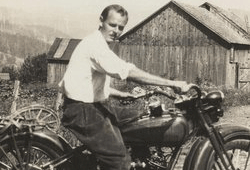
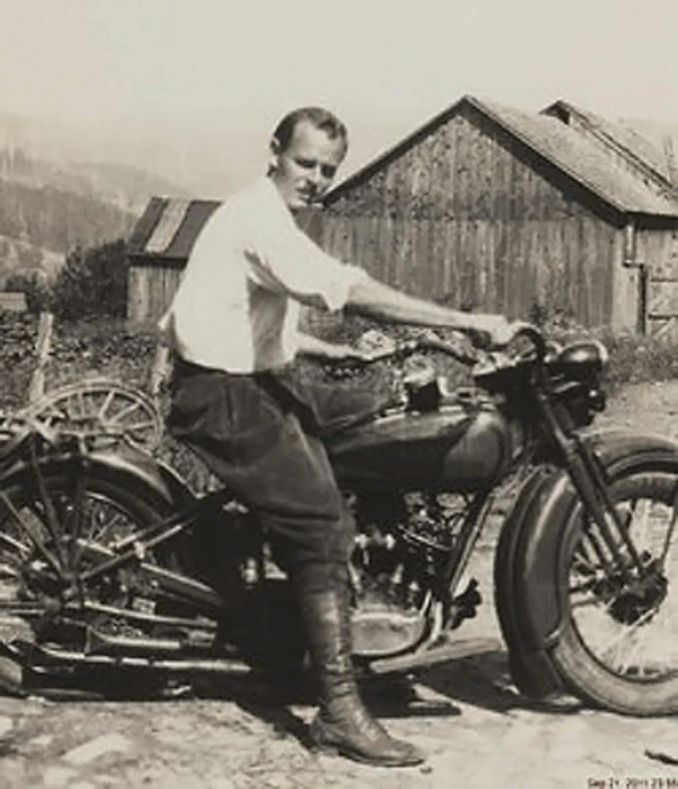
Roland Thaxter Bird was born in 1899 in Rye, New York, into a family whose quiet scientific curiosity shaped him more than any classroom ever did. His father, an amateur entomologist, encouraged careful observation but not convention, and Bird himself had almost no formal schooling: a respiratory illness forced him to leave school at fourteen, and he never returned. Instead, he educated himself on the road, drifting across the American West on a Harley-Davidson with a homemade sidecar camper, learning geology and natural history by handling the land directly. When he found the natural cast of an unusual fossil amphibian skull in Arizona in 1932 and mailed it to his father—who passed it to Barnum Brown at the American Museum of Natural History—Bird’s life changed. The specimen proved new to science, and Brown hired him as a collector, launching a career built on instinct, grit, and fieldcraft rather than academic training.
Bird’s character was shaped by that unconventional path. He was restless, observant, and happiest outdoors, with habits that blended wanderer’s independence and collector’s precision. He kept meticulous field notes, sketched constantly, and had a knack for spotting fossils others walked past. His quirks were legendary: he preferred sleeping rough to staying in town, trusted his eye more than any instrument, and approached paleontology with the improvisational confidence of someone who had taught himself everything he knew. Yet he was also modest and unpretentious, a man who valued the work more than the spotlight and who retained a kind of Depression-era practicality even as he became one of the museum’s most valuable field men.
Bird's work reshaped ichnology and American paleontology. His most famous achievement was the discovery and excavation of the Glen Rose trackways along the Paluxy River in Texas—vast sauropod and theropod footprints that became foundational specimens for the AMNH and helped establish trackways as rigorous scientific evidence rather than curiosities. He also investigated and debunked the so-called "giant human footprints" of the Southwest, exposing carved fakes that had fueled creationist claims. Across decades of fieldwork—from the Howe Quarry in Wyoming to the riverbeds of Texas—Bird combined intuition, persistence, and careful documentation, leaving behind track slabs, field notes, and a posthumously published autobiography, Bones for Barnum Brown. By the time of his death in 1978, he had become the quintessential American fossil hunter: self-taught, sharp-eyed, and responsible for discoveries that permanently altered how scientists read the traces dinosaurs left behind.
The primitive amphibian skull cast that shaped Bird's life proved to be new to science, and it was named Stanocephalosaurus birdi in his honour, by Barnum Brown in 1933.
Bird’s character was shaped by that unconventional path. He was restless, observant, and happiest outdoors, with habits that blended wanderer’s independence and collector’s precision. He kept meticulous field notes, sketched constantly, and had a knack for spotting fossils others walked past. His quirks were legendary: he preferred sleeping rough to staying in town, trusted his eye more than any instrument, and approached paleontology with the improvisational confidence of someone who had taught himself everything he knew. Yet he was also modest and unpretentious, a man who valued the work more than the spotlight and who retained a kind of Depression-era practicality even as he became one of the museum’s most valuable field men.
Bird's work reshaped ichnology and American paleontology. His most famous achievement was the discovery and excavation of the Glen Rose trackways along the Paluxy River in Texas—vast sauropod and theropod footprints that became foundational specimens for the AMNH and helped establish trackways as rigorous scientific evidence rather than curiosities. He also investigated and debunked the so-called "giant human footprints" of the Southwest, exposing carved fakes that had fueled creationist claims. Across decades of fieldwork—from the Howe Quarry in Wyoming to the riverbeds of Texas—Bird combined intuition, persistence, and careful documentation, leaving behind track slabs, field notes, and a posthumously published autobiography, Bones for Barnum Brown. By the time of his death in 1978, he had become the quintessential American fossil hunter: self-taught, sharp-eyed, and responsible for discoveries that permanently altered how scientists read the traces dinosaurs left behind.
The primitive amphibian skull cast that shaped Bird's life proved to be new to science, and it was named Stanocephalosaurus birdi in his honour, by Barnum Brown in 1933.
More Roland T. Bird
• Bird RT (1941) "A Dinosaur Walks into the Museum".
• Bird RT, Schreiber VT, Farlow JO and Colbert EH (1985) "Bones for Barnum Brown: Adventures of a Dinosaur Hunter".
• Falkingham PL, Bates KT and Farlow JO (2014) "Historical Photogrammetry: Bird's Paluxy River Dinosaur Chase Sequence Digitally Reconstructed as It Was prior to Excavation 70 Years Ago". PLOS ONE, 9(4): e93247. DOI: 10.1371/journal.pone.0093247.
• Thomas M (2015) "Roland T. Bird - Paleontologist". Mark Thomas - Geology Blog.

Discoveries and descriptions ...
| Name | Type |
|---|


