



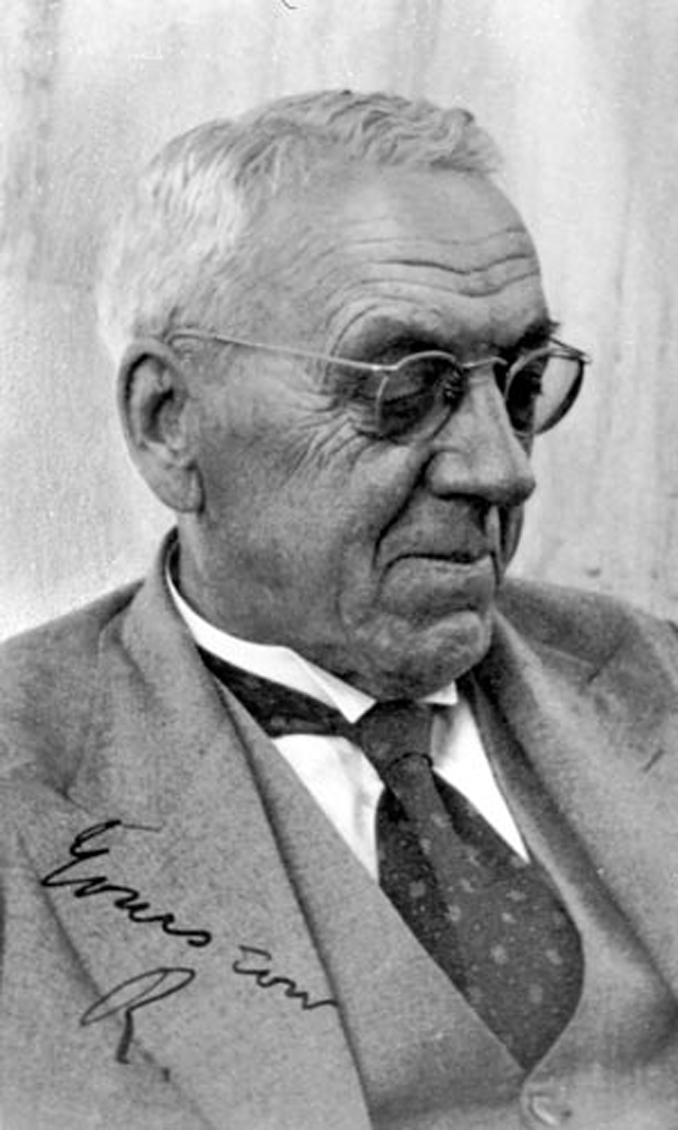
Date of Birth: November 30, 1866
Place of Birth: Paisley, Renfrewshire, Scotland
Parents: John Broom and Agnes Hunter Shearer
Spouse: Mary Baird Baillie
Died: April 6, 1951 (aged 84)
Place of death: Pretoria, South Africa
Legacy: Reshaped the story of human origins and the rise of mammals,
"Mrs. Ples"
Robert Broom
Robert Broom was born on 30 November 1866 at 66 Back Sneddon Street in Paisley, Scotland, and married his childhood sweetheart, Mary Baird Baillie, with whom he would have three children, in 1893. He trained as a medical doctor at the University of Glasgow, qualifying in 1895.
Although he specialised in midwifery, he was already fascinated by the origin of mammals and the deep history of life, a curiosity reflected in his early anatomical studies on Jacobson’s organ, the structure of monotremes, and the homologies of the vomer.
After a brief period in Australia, he settled in South Africa in 1897, supporting himself through medicine while pursuing palaeontology with increasing intensity. From 1903 to 1910 he served as Professor of Zoology and Geology at Victoria College, Stellenbosch, until his evolutionary views brought him into conflict with the institution’s conservative leadership. He was elected a Fellow of the Royal Society in 1920, recognition earned largely through his work on the deep evolutionary origins of mammals in the South African Karoo.
Broom was eccentric, brilliant, and utterly devoted to fossils. He had a reputation for being both charming and stubborn, capable of great generosity but also fierce scientific independence. He cultivated no personal rivalries of the Cope–Marsh variety, but he did clash with religious authorities and academic administrators who resisted evolutionary science. His own views blended strict anatomical reasoning with a speculative "spiritual-evolution" philosophy, which held that life’s increasing complexity reflected a guiding creative force. In the field he was indefatigable, often buying fossils directly from miners before leading his own excavations. His enthusiasm for South Africa’s cave deposits and karst systems made him a fixture at sites that would later become world-famous. In 1934 he joined the Transvaal Museum in Pretoria as Curator of Palaeontology, a position that finally gave him the institutional footing his work deserved.
Beginning in the 1930s, Broom transformed palaeoanthropology by uncovering and describing key hominin fossils from Sterkfontein, Kromdraai, and Swartkrans. His discoveries included Paranthropus robustus, the celebrated "Mrs. Ples" skull (now Australopithecus africanus), and the partial skeleton STS-14, whose pelvis and lumbar vertebrae provided some of the clearest early evidence for habitual bipedalism. These finds helped establish Africa—not Europe or Asia—as the cradle of humankind. At the same time, he continued his lifelong work on the mammal-like reptiles, clarifying the evolutionary transition from reptiles to mammals and producing monographs that remained influential for decades.
Broom wrote until virtually his last breath. In early April 1951, gravely ill but determined to finish his final monograph on the australopithecines, he completed the last pages from his bed. Handing the manuscript to his nephew, he whispered, "Now that's finished ... and so am I". He died on 6 April 1951 in Pretoria, having received the Royal Medal, the Daniel Giraud Elliot Medal, and the Wollaston Medal for his contributions.
Broom was eccentric, brilliant, and utterly devoted to fossils. He had a reputation for being both charming and stubborn, capable of great generosity but also fierce scientific independence. He cultivated no personal rivalries of the Cope–Marsh variety, but he did clash with religious authorities and academic administrators who resisted evolutionary science. His own views blended strict anatomical reasoning with a speculative "spiritual-evolution" philosophy, which held that life’s increasing complexity reflected a guiding creative force. In the field he was indefatigable, often buying fossils directly from miners before leading his own excavations. His enthusiasm for South Africa’s cave deposits and karst systems made him a fixture at sites that would later become world-famous. In 1934 he joined the Transvaal Museum in Pretoria as Curator of Palaeontology, a position that finally gave him the institutional footing his work deserved.
Beginning in the 1930s, Broom transformed palaeoanthropology by uncovering and describing key hominin fossils from Sterkfontein, Kromdraai, and Swartkrans. His discoveries included Paranthropus robustus, the celebrated "Mrs. Ples" skull (now Australopithecus africanus), and the partial skeleton STS-14, whose pelvis and lumbar vertebrae provided some of the clearest early evidence for habitual bipedalism. These finds helped establish Africa—not Europe or Asia—as the cradle of humankind. At the same time, he continued his lifelong work on the mammal-like reptiles, clarifying the evolutionary transition from reptiles to mammals and producing monographs that remained influential for decades.
Broom wrote until virtually his last breath. In early April 1951, gravely ill but determined to finish his final monograph on the australopithecines, he completed the last pages from his bed. Handing the manuscript to his nephew, he whispered, "Now that's finished ... and so am I". He died on 6 April 1951 in Pretoria, having received the Royal Medal, the Daniel Giraud Elliot Medal, and the Wollaston Medal for his contributions.
More Broom
• "Robert Broom". South African History Online.
• Broom R (1930) "The Origin of the Human Skeleton".
• Broom R (1933) "Evolution: is there intelligence behind it?". South African Journal of Science, 29: 1-19.
• Broom R (1933) "The Coming of Man: Was it Accident or Design?".
• Broom R (1946) "The South Africa Fossil Ape-Men, The Australopithecinae".
• Watson DMS (1952) "Robert Broom. 1866–1951". Obituary Notices of Fellows of the Royal Society, 8(21): 36-70. DOI: 10.1098/rsbm.1952.0004.
• Findlay G (1972) "Dr. Robert Broom, F.R.S.; palaeontologist and physician, 1866-1951: a biography, appreciation and bibliography".
• Broom R (1975) "Finding the Missing Link".
• Strkalj G (2003) "Robert Broom's theory of evolution". Transactions of the Royal Society of South Africa, 58(1): 35-39.
DOI:10.1080/00359190309519933.
• Morell V (2011) "Ancestral Passions: The Leakey Family and the Quest for Humankind's Beginnings".
• S2A3 "Broom, Dr Robert (palaeontology, palaeo-anthropology)". S2A3 Biographical Database of Southern African Science.
Discoveries and descriptions ...
| Name | Type |
|---|---|
| ALGOASAURUS |  |


