



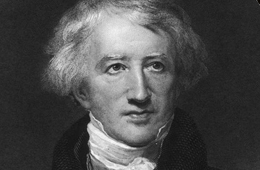
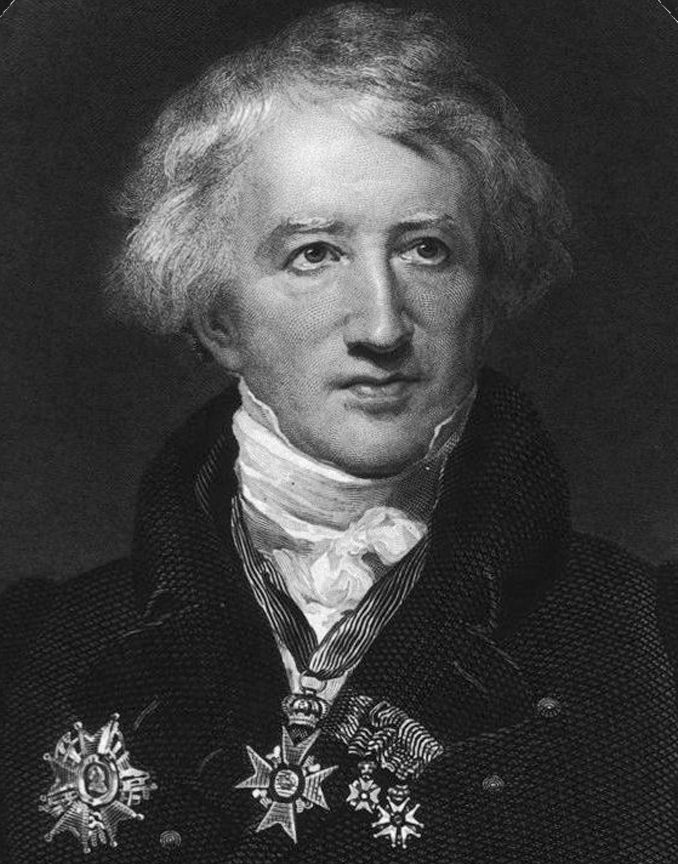
Date of Birth: August 23, 1769
Place of Birth: Montbéliard, France
Parents: Jean-Georges Cuvier and Anne Clémence Chatel
Spouse: Anne Marie Sophie Loquet de Trazay
Date of expiry: May 13, 1832
Place of expiry: Paris, France
Legacy: A pioneer of comparative anatomy, the "father of palaeontology",
established extinction as a scientific reality
Jean Léopold Nicolas Frédéric Cuvier
Jean Léopold Nicolas Frédéric Cuvier — sometimes referred to as Jean Léopold Chrétien Frederic Dagobert Cuvier or derivatives thereof, but known universally as Georges Cuvier since his brother Georges died in infancy and Jean inherited his name — was born on 23 August 1769 in Montbéliard, then a French-speaking enclave of the Duchy of Württemberg. A gifted child with a prodigious memory, he excelled in classical languages and natural history, eventually earning the patronage that sent him to the Caroline Academy in Stuttgart, where he studied comparative anatomy and developed the disciplined, structural approach that would define his scientific career.
After several years as a tutor in Normandy, Cuvier’s early manuscripts on marine invertebrates reached Paris, prompting Étienne Geoffroy Saint-Hilaire to invite him to the Muséum national d’Histoire naturelle in 1795. Within a decade he became professor of comparative anatomy and one of the most influential figures in French science. His Leçons d’anatomie comparée (1800–1805) articulated his principle of the correlation of parts — the idea that every anatomical structure is functionally integrated with the whole organism. This principle allowed him to reconstruct extinct animals from fragmentary remains with unprecedented accuracy, a skill that became legendary among contemporaries.
Cuvier’s comparative method led him to a radical conclusion: many fossil forms had no living counterparts. In his Essay on the Theory of the Earth (1813), he argued that these vanished organisms represented genuine extinctions, not variants of existing species. At a time when extinction was widely rejected on theological and philosophical grounds, Cuvier’s demonstration — grounded in anatomy, stratigraphy, and the fossil record — transformed natural history. His work with Alexandre Brongniart on the strata of the Paris Basin established the foundations of biostratigraphy, showing that fossil assemblages change systematically through geological layers.
From these observations, Cuvier developed catastrophism, proposing that Earth’s history was punctuated by sudden, global events that wiped out faunas and were followed by new creations. He rejected evolutionary transformation as advocated by Lamarck and Geoffroy Saint-Hilaire, insisting instead on the stability of species between catastrophes. This opposition culminated in the famous 1830 debate with Geoffroy, a clash of structural philosophies later reframed — somewhat anachronistically — as a precursor to Darwinian controversies.
Cuvier’s scientific reach was vast. He identified the American "mammoth" as a distinct extinct species (the mastodon), recognized the giant South American Megatherium, named the pterosaur Pterodactylus, and established genera such as Palaeotherium and Anoplotherium from fragmentary remains. His taxonomic reforms grouped animals into four major embranchements — vertebrates, molluscs, articulates, and radiates — a structural framework that shaped nineteenth-century zoology.
Beyond science, Cuvier became a powerful administrator: professor at the Collège de France, director of the museum, state councillor under Napoleon, and later a peer of France. His influence on education, museums, and scientific institutions was as enduring as his intellectual legacy.
Georges Cuvier died in Paris on 13 May 1832. By then he had remade natural history: he had given paleontology its methods, comparative anatomy its rigor, and extinction its scientific reality. His work stands at the threshold of modern biology — a monument to the power of structure, evidence, and disciplined imagination.
After several years as a tutor in Normandy, Cuvier’s early manuscripts on marine invertebrates reached Paris, prompting Étienne Geoffroy Saint-Hilaire to invite him to the Muséum national d’Histoire naturelle in 1795. Within a decade he became professor of comparative anatomy and one of the most influential figures in French science. His Leçons d’anatomie comparée (1800–1805) articulated his principle of the correlation of parts — the idea that every anatomical structure is functionally integrated with the whole organism. This principle allowed him to reconstruct extinct animals from fragmentary remains with unprecedented accuracy, a skill that became legendary among contemporaries.
Cuvier’s comparative method led him to a radical conclusion: many fossil forms had no living counterparts. In his Essay on the Theory of the Earth (1813), he argued that these vanished organisms represented genuine extinctions, not variants of existing species. At a time when extinction was widely rejected on theological and philosophical grounds, Cuvier’s demonstration — grounded in anatomy, stratigraphy, and the fossil record — transformed natural history. His work with Alexandre Brongniart on the strata of the Paris Basin established the foundations of biostratigraphy, showing that fossil assemblages change systematically through geological layers.
From these observations, Cuvier developed catastrophism, proposing that Earth’s history was punctuated by sudden, global events that wiped out faunas and were followed by new creations. He rejected evolutionary transformation as advocated by Lamarck and Geoffroy Saint-Hilaire, insisting instead on the stability of species between catastrophes. This opposition culminated in the famous 1830 debate with Geoffroy, a clash of structural philosophies later reframed — somewhat anachronistically — as a precursor to Darwinian controversies.
Cuvier’s scientific reach was vast. He identified the American "mammoth" as a distinct extinct species (the mastodon), recognized the giant South American Megatherium, named the pterosaur Pterodactylus, and established genera such as Palaeotherium and Anoplotherium from fragmentary remains. His taxonomic reforms grouped animals into four major embranchements — vertebrates, molluscs, articulates, and radiates — a structural framework that shaped nineteenth-century zoology.
Beyond science, Cuvier became a powerful administrator: professor at the Collège de France, director of the museum, state councillor under Napoleon, and later a peer of France. His influence on education, museums, and scientific institutions was as enduring as his intellectual legacy.
Georges Cuvier died in Paris on 13 May 1832. By then he had remade natural history: he had given paleontology its methods, comparative anatomy its rigor, and extinction its scientific reality. His work stands at the threshold of modern biology — a monument to the power of structure, evidence, and disciplined imagination.
More Cuvier
• Cuvier G (1840) "Cuvier's Animal Kingdom, Arranged According To Its Organization: Forming The Basis For A Natural History Of Animals".
• Smith JC (1992) "George Cuvier: An Annotated Bibliography of His Published Works".
• Capinera JL (2008) "Encyclopedia of Entomology". DOI: 10.1007/978-1-4020-6359-6_10146.
Discoveries and descriptions ...
| Name | Type |
|---|


