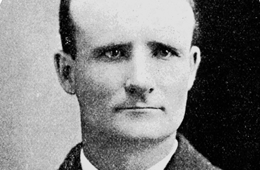
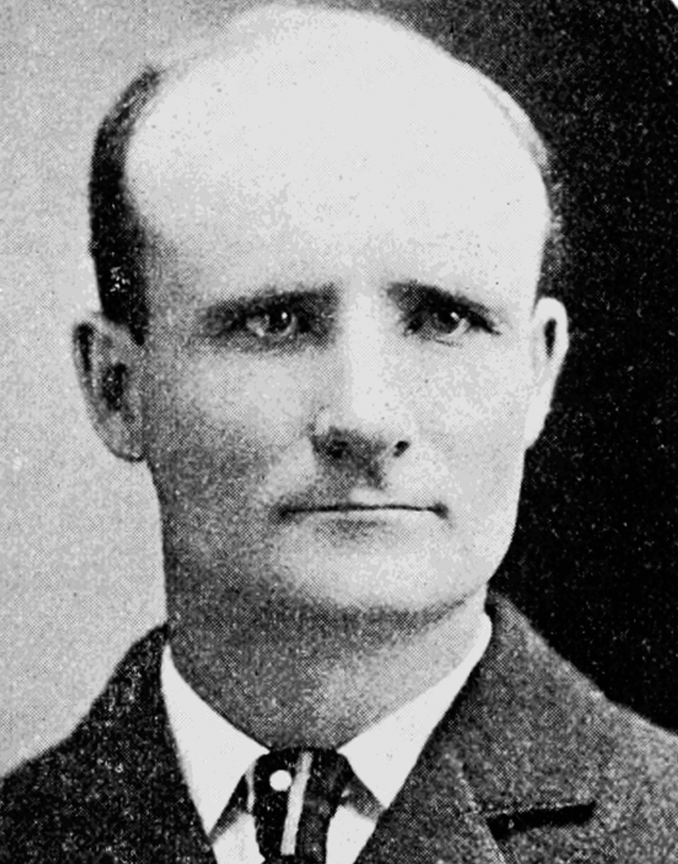
Date of Birth: October 11, 1861
Place of Birth: Cooperstown, Illinois
Parents: John B. Hatcher and Margaret Columbia O'Neal
Spouse: Anna Matilda Peterson (m. 1887)
Date of expiry: July 3, 1904 (42)
Place of expiry: Pittsburgh, Pennsylvania
Legacy: Diplodocus carnegii
John Bell Hatcher
John Bell Hatcher was born on 11 October 1861 in Cooperstown, Illinois, the son of a farming family whose expectations ran toward practical work rather than scientific ambition. He studied intermittently at Grinnell College, supporting himself through teaching and farm labor, before drifting westward in search of opportunity. It was in the badlands of Dakota Territory that he discovered his true vocation: the patient, physically demanding, and often solitary work of fossil hunting. His skill in reading the landscape — in knowing where bone would weather out, how to follow a fragment to its source, and how to extract a skeleton intact — soon brought him to the attention of Othniel Charles Marsh at Yale's Peabody Museum. In 1889 Marsh hired him as a field collector for an initial salary of US$50 per month, initiating one of the most productive partnerships in the history of American paleontology.
For the next decade Hatcher ranged across Wyoming, Colorado, South Dakota, and Montana, supplying Marsh with a steady stream of spectacular specimens. He uncovered the first well-preserved skulls of Triceratops, clarified the anatomy of Stegosaurus, and collected the great horned dinosaurs of the Lance and Laramie formations. His field notebooks reveal a collector of unusual precision: he mapped quarries, recorded stratigraphic positions, and documented taphonomic details at a time when many collectors focused solely on the bones themselves. Yet his relationship with Marsh was fraught. Marsh's chronic financial mismanagement left Hatcher unpaid for long stretches, and the credit for discoveries flowed almost entirely to New Haven. By 1899, after years of frustration, Hatcher resigned — a decision that freed him to pursue his own scientific identity.
That same year he joined the Carnegie Museum in Pittsburgh under William Jacob Holland, who recognized both his field expertise and his scholarly potential, succeededing Jacob Lawson Wortman as curator of paleontology and osteology, and taking responsibility for the museum's rapidly expanding vertebrate collections. Hatcher led expeditions to the badlands of Wyoming and Montana, collecting the material that would form the basis of the museum's celebrated dinosaur mounts. He also turned increasingly to research, producing monographs on ceratopsians and hadrosaurs. His 1901 volume on the great sauropod Diplodocus — a meticulous synthesis of anatomy, posture, and biomechanics — remains one of the classic works of early twentieth-century vertebrate paleontology. When Andrew Carnegie commissioned casts of Diplodocus carnegii for European museums, it was Hatcher's anatomical reconstruction that traveled the world, shaping public understanding of sauropods for decades.
In 1903 Hatcher accepted a position at Princeton University as curator of vertebrate paleontology, where he collaborated with William Berryman Scott and Henry Fairfield Osborn on the monumental Princeton Expedition to Patagonia reports. His contributions to the Patagonian volumes, especially on the extinct South American ungulates, demonstrated a breadth that extended far beyond the dinosaurs that had made his reputation. He married Anna Matilda Peterson in 1887, and though his field seasons kept him away for long periods, their correspondence reveals a partnership marked by affection and intellectual respect.
John Bell Hatcher died on 3 July 1904 at the age of forty-two, his health worn down by years of hard fieldwork, financial stress, and relentless travel. He left behind no grand theoretical system, no sweeping evolutionary argument — only the bones themselves, collected with care, documented with precision, and interpreted with a clarity that shaped the foundations of American vertebrate paleontology. His legacy lies in the quarries he opened, the specimens he secured, and the quiet professionalism he brought to a discipline still emerging from its frontier phase. He was, above all, a field man: patient, exacting, and indispensable.