



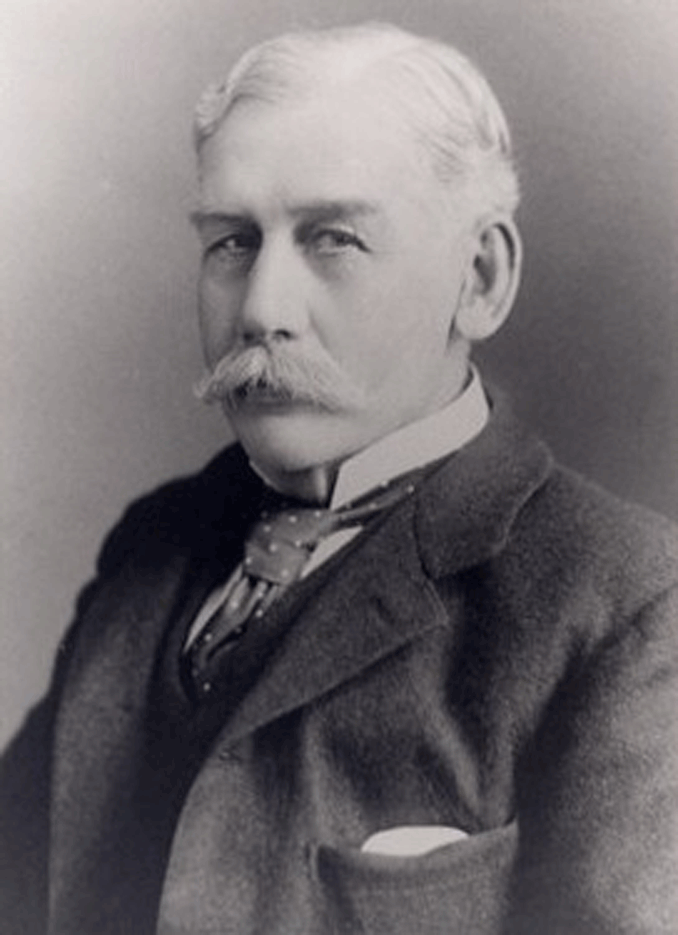
Date of Birth: July 25, 1849
Place of Birth: London, England
Parents: Gerard Wolfe Lydekker and Marianne Emily Brougham
Spouse: Lucy Davys
Date of Death: April 16, 1915
Place of Death: Harpenden, Hertfordshire, England
Legacy: Catalogued British Museum fossil collections
Richard Lydekker
Richard Lydekker was born on 25 July 1849 in London, England, the son of Gerard Wolfe Lydekker, a prosperous landowner, and Marianne Emily Brougham, and the family moved to Harpenden soon after. Educated at Trinity College, Cambridge, he took a first in the Natural Sciences Tripos in 1871 and soon joined the Geological Survey of India — an appointment that placed him within one of the most ambitious scientific enterprises of the British Empire. In India he undertook extensive fieldwork in the Siwalik Hills, mapping fossil-bearing strata and assembling the great collections of Tertiary mammals that would later define his early career. His meticulous field notes and stratigraphic observations formed the backbone of the multi-volume Fauna of British India series, to which he contributed both geological and zoological volumes, establishing himself as a disciplined observer and a gifted synthesizer.
Returning to England in 1882, Lydekker joined the Natural History Museum in South Kensington as a cataloguer — a role that suited his extraordinary capacity for order, classification, and descriptive precision. Over the next two decades he produced the monumental Catalogue of the Fossil Mammalia in the British Museum (Natural History), a multi-volume work that brought coherence to one of the world’s largest paleontological collections. He also authored the Catalogue of the Fossil Reptilia and Amphibia, extending his reach across vertebrate paleontology. Though not a theorist in the mold of Huxley or a field collector on the scale of Marsh, Lydekker was a systematist of rare endurance: he wrote more than a thousand papers and over forty books, ranging from technical monographs to popular natural-history works that introduced Victorian and Edwardian readers to the diversity of the animal kingdom.
Lydekker’s scientific life was shaped by the intellectual culture of late-imperial Britain — a world in which museums, catalogues, and imperial collections were central to the production of knowledge. His writing combined clarity with breadth, and he became a familiar public voice through contributions to The Field, Knowledge, and other periodicals. He was elected a Fellow of the Royal Society in 1894, a recognition of both his scholarly output and his role in organizing the museum’s vast holdings. In 1902 he retired from the Natural History Museum but continued to write prolifically, producing works on mammals, birds, and biogeography well into his later years. He never married, devoting his life instead to the steady, cumulative labor of description and classification.
Richard Lydekker died on 16 April 1915 in Harpenden, not far from where he had been raised. His legacy lies not in a single transformative theory but in the infrastructure of knowledge he built: the catalogues that stabilized names, the monographs that clarified relationships, and the popular works that carried natural history into the homes of ordinary readers. He was a custodian of collections, a master of orderly description, and a figure whose quiet industry helped shape the foundations of modern vertebrate paleontology and biogeography.
Returning to England in 1882, Lydekker joined the Natural History Museum in South Kensington as a cataloguer — a role that suited his extraordinary capacity for order, classification, and descriptive precision. Over the next two decades he produced the monumental Catalogue of the Fossil Mammalia in the British Museum (Natural History), a multi-volume work that brought coherence to one of the world’s largest paleontological collections. He also authored the Catalogue of the Fossil Reptilia and Amphibia, extending his reach across vertebrate paleontology. Though not a theorist in the mold of Huxley or a field collector on the scale of Marsh, Lydekker was a systematist of rare endurance: he wrote more than a thousand papers and over forty books, ranging from technical monographs to popular natural-history works that introduced Victorian and Edwardian readers to the diversity of the animal kingdom.
Lydekker’s scientific life was shaped by the intellectual culture of late-imperial Britain — a world in which museums, catalogues, and imperial collections were central to the production of knowledge. His writing combined clarity with breadth, and he became a familiar public voice through contributions to The Field, Knowledge, and other periodicals. He was elected a Fellow of the Royal Society in 1894, a recognition of both his scholarly output and his role in organizing the museum’s vast holdings. In 1902 he retired from the Natural History Museum but continued to write prolifically, producing works on mammals, birds, and biogeography well into his later years. He never married, devoting his life instead to the steady, cumulative labor of description and classification.
Richard Lydekker died on 16 April 1915 in Harpenden, not far from where he had been raised. His legacy lies not in a single transformative theory but in the infrastructure of knowledge he built: the catalogues that stabilized names, the monographs that clarified relationships, and the popular works that carried natural history into the homes of ordinary readers. He was a custodian of collections, a master of orderly description, and a figure whose quiet industry helped shape the foundations of modern vertebrate paleontology and biogeography.
References
(1915) "Obituary". Ibis, 57(3): 619-620.
•
Lydekker R (1888) "Catalogue of the fossil Reptilia and Amphibia in the British Museum (Natural history)". Part I . Containing the orders Ornithosauria, Crocodilia, Dinosauria, Squamata, Rhynchocephalia, and Proterosauria.
• Lydekker R (1889) "Catalogue of the fossil Reptilia and Amphibia in the British Museum (Natural history)". Part II. Containing the orders Ichthyopterygia and Sauropterygia.
• Lydekker R (1889) "Catalogue of the fossil Reptilia and Amphibia in the British Museum (Natural history)". Part III. Containing the order Chelonia.
• Lydekker R (1890) "Catalogue of the fossil Reptilia and Amphibia in the British Museum (Natural history)". Part IV. Containing the orders Anomodontia, Ecaudata, Caudata, and Labyrinthodontia; and Supplement.
Discoveries and descriptions ...
| Name | Type |
|---|---|
| ARGYROSAURUS |  |
| SARCOLESTES |  |
| TITANOSAURUS | |


