








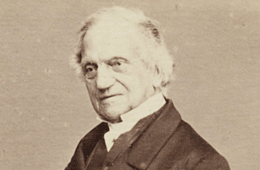
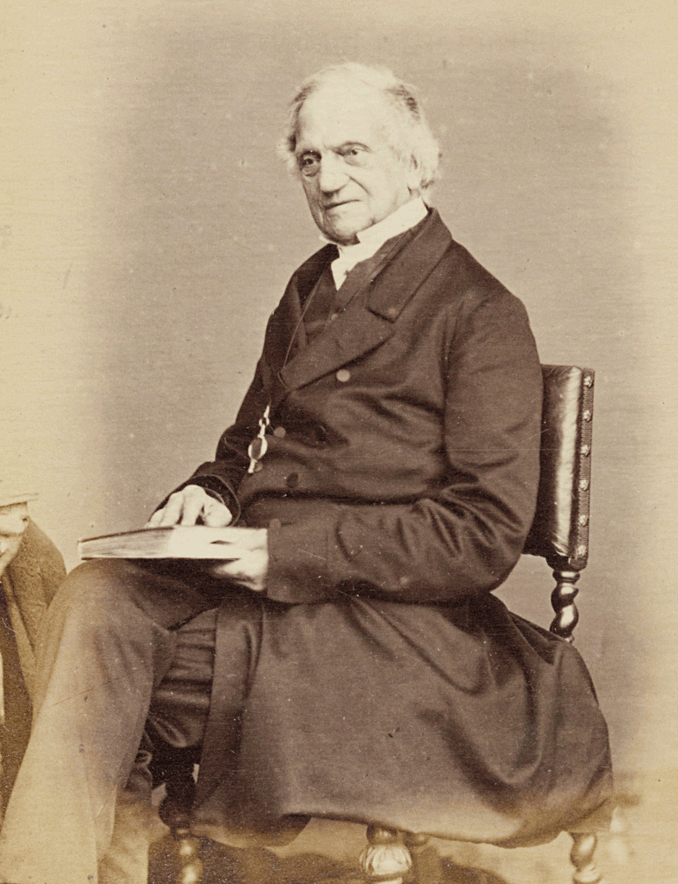
Date of Birth: March 22, 1785
Place of Birth: Dent, Yorkshire, England
Parents: Rev. Richard Sedgwick and Margaret (née Sturgis).
Spouse: n/a
Date of expiry: January 27, 1873 (aged 87)
Place of expiry: Cambridge, England
Legacy: founder of the Cambrian System, architect of modern geology, generations of students shaped by his teaching.
Adam Sedgewick
Adam Sedgwick was born on 22 March 1785 in Dent, Yorkshire, the third child of the local vicar, Richard Sedgwick, who taught at Dent Grammar School, where Adam received a classical education. He later attended Sedbergh School before going on to Trinity College, Cambridge, where he studied mathematics and theology, became a fellow in 1810, and subsequently took holy orders. Sedgwick had no formal geological training — the discipline barely existed — but he rapidly became one of its founders after being appointed Woodwardian Professor of Geology in 1818. His early fieldwork in Wales and the Lake District laid the groundwork for the stratigraphic systems he would later define. In the mid-1820s he also accepted the prevailing distinction between alluvial and "diluvial" deposits, interpreting certain gravels and erratics as evidence of a recent catastrophic inundation. Although he used the standard geological language of a "general deluge", he did not explicitly identify this event with Noah’s Flood, a point he later emphasised when reflecting on the early errors of the discipline.
Sedgwick was known for his booming voice, energetic field presence, and a personality that mixed pastoral warmth with fierce intellectual conviction. He was a meticulous observer in the field, often walking enormous distances across rugged terrain well into his later years. His most famous scientific rivalry was with Roderick Murchison, with whom he initially collaborated on the Paleozoic sequence before their interpretations diverged. Their dispute over the boundary between the Cambrian and Silurian systems became one of the most consequential stratigraphic controversies of the nineteenth century. Sedgwick was also an influential teacher, counting Charles Darwin among his students — a relationship that later became strained as Darwin’s evolutionary ideas diverged sharply from Sedgwick’s theological commitments. In social matters he was far more conservative: he strongly opposed the admission of women to the University of Cambridge, dismissing early advocates of women’s education in language that reflected the entrenched academic attitudes of his era. In his words, aspiring female students were "nasty forward minxes".
Sedgwick’s most enduring contribution was the formal establishment of the Cambrian System, named for Cambria — the classical Latin term for Wales — in recognition of the Welsh terrain where he carried out the extensive mapping that defined its characteristic strata. His stratigraphic work helped define the structure of the early Paleozoic and provided a framework that remains foundational to modern geology. Sedgwick was also a major institutional figure: he helped shape the early Geological Society of London, expanded the Cambridge geological collections, and advocated for geology as a rigorous scientific discipline rather than a gentleman's pastime. He died on 27 January 1873, leaving behind a legacy that spans field geology, pedagogy, and the intellectual architecture of the geological timescale itself — as well as the more complicated imprint of his social and theological convictions.
Mount Sedgwick in British Columbia, Canada, is named in Sedgwick's honour.
Sedgwick was known for his booming voice, energetic field presence, and a personality that mixed pastoral warmth with fierce intellectual conviction. He was a meticulous observer in the field, often walking enormous distances across rugged terrain well into his later years. His most famous scientific rivalry was with Roderick Murchison, with whom he initially collaborated on the Paleozoic sequence before their interpretations diverged. Their dispute over the boundary between the Cambrian and Silurian systems became one of the most consequential stratigraphic controversies of the nineteenth century. Sedgwick was also an influential teacher, counting Charles Darwin among his students — a relationship that later became strained as Darwin’s evolutionary ideas diverged sharply from Sedgwick’s theological commitments. In social matters he was far more conservative: he strongly opposed the admission of women to the University of Cambridge, dismissing early advocates of women’s education in language that reflected the entrenched academic attitudes of his era. In his words, aspiring female students were "nasty forward minxes".
Sedgwick’s most enduring contribution was the formal establishment of the Cambrian System, named for Cambria — the classical Latin term for Wales — in recognition of the Welsh terrain where he carried out the extensive mapping that defined its characteristic strata. His stratigraphic work helped define the structure of the early Paleozoic and provided a framework that remains foundational to modern geology. Sedgwick was also a major institutional figure: he helped shape the early Geological Society of London, expanded the Cambridge geological collections, and advocated for geology as a rigorous scientific discipline rather than a gentleman's pastime. He died on 27 January 1873, leaving behind a legacy that spans field geology, pedagogy, and the intellectual architecture of the geological timescale itself — as well as the more complicated imprint of his social and theological convictions.
Mount Sedgwick in British Columbia, Canada, is named in Sedgwick's honour.
References
• Herbert 1991, pp. 170–174, Sedgwick, Adam (April 1831). "Address to the Geological Society, delivered on the Evening of the 18th of February 1831, by the Rev. Professor Sedgwick, M.A. F.R.S. &c. on retiring from the President's chair". Philosophical Magazine, 9: 312–315.
• Sedgwick A (1834) "On the Studies of the University". Cambridge, Pitt Press. pp. 148-153.
• "Darwin Correspondence Project – Letter 2548 – Sedgwick, Adam to Darwin, C. R., 24 Nov 1859".
• "Sedgwick, Adam (SGWK803A)". A Cambridge Alumni Database. University of Cambridge.
• Clark JW and Hughes TM (1890) "The life and letters of the Reverend Adam Sedgwick". University of California Libraries. Cambridge, University Press.
• Rudwick MJS (2008) "Worlds Before Adam: The Reconstruction of Geohistory in the Age of Reform". Chapter 13: "The last revolution (1824–30)".
• Roberts MB (2009) "Adam Sedgwick (1785-1873): Geologist and evangelical". Geological Society London Special Publications, 310(1): 155-170.
DOI: 10.1144/SP310.18.
• Rudwick MJS (2009) "Biblical Flood and geological deluge: the amicable dissociation of geology and Genesis". Geological Society London Special Publications, 310(1): 103-110.
DOI: 10.1144/SP310.13.
• American Philosophical Society Manuscript Collections Search. "Adam Sedgwick Collection".
• "The Sedgwick Geological Trail". KGG.
• Cambridge Philosophical Society. "Adam Sedgwick". The Cambridge Philosophical Society. Cambridge University.
• The Victorian Web. "Adam Sedgwick (1785-1873), Geologist".
• Park C (2017) "Wedded to the Rocks: The Life and Work of Adam Sedgwick (1785-1873)".
• The Sedgwick Museum of Earth Sciences.

Discoveries and descriptions ...
| Name | Type |
|---|


