









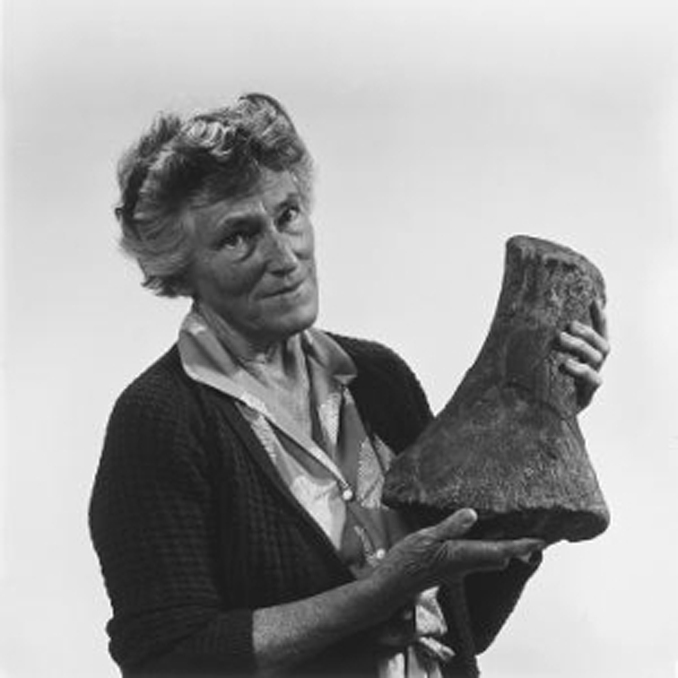
Date of Birth: 4 February 1922
Place of Birth: Mount Eden, Auckland, New Zealand
Parents: Alfred Ernest and Ivy Pedersen
Spouse: Montagu Arthur "Pont" Wiffen (m. 1953)
Date of expiry: 30 June 2009
Place of expiry: Hastings Hospital, New Zealand
Legacy: First dinosaurs of New Zealand
Joan Wiffen
Joan Wiffen was born on 4 February 1922 in Mount Eden, Auckland, and adopted the following year by Alfred and Ivy Pedersen, a rural couple whose work took the family through the King Country and Hawke’s Bay. Her childhood was shaped by practical labour and limited schooling; she left formal education at twelve, her father convinced that further study was wasted on girls. During the Second World War she joined the Women's Auxiliary Air Force, serving for six years as a runner, radar plotter, and medical clerk before returning to Hawke’s Bay in 1948. There she worked in a radio shop, met Montagu “Pont” Wiffen, and after their marriage in 1953 the couple bought a small farm on Tuki Tuki Road, in the seaside town of Haumoana on Hawke's Bay, where they raised their two children, Christopher (born 1956) and Judith (born 1961). To make ends meet they grew glasshouse tomatoes and cucumbers and outdoor asparagus, a life that reinforced Joan's practical, hands-on approach to problem-solving and her comfort with physical labour.
Her entry into science began quietly at home, sparked by the natural-history books she bought for her young children. That interest deepened in the 1960s when Pont fell ill and could not attend his geology night class; Joan went in his place and found herself captivated. What followed was an entirely self-directed education: she taught herself stratigraphy, fossil preparation, and vertebrate anatomy, building collegial relationships with professional palaeontologists who helped verify her finds. After Pont suffered a series of heart attacks, the family left the farm and moved to a smaller house on Beach Road, Haumoana, but Joan's fieldwork only intensified. She spent decades exploring the remote Cretaceous outcrops of the Mangahouanga Stream, often working alone, carrying heavy gear through steep bush, and developing an extraordinary eye for bone fragments in coarse conglomerates.
In 1975, Wiffen uncovered the first dinosaur fossils ever found in New Zealand — a discovery that overturned decades of geological assumption and placed the country firmly on the global palaeontological map. Over the next three decades she identified remains of theropods, ankylosaurs, hypsilophodonts, pterosaurs, plesiosaurs, and mosasaurs, culminating in her 1991 book Valley of the Dragons. Honoured with an honorary doctorate from Massey University in 1994 and a C.B.E. for services to science the following year, she remained a modest, quietly determined figure whose achievements grew from curiosity rather than credential. When she died on 30 June 2009, she left a transformed New Zealand fossil record and a legacy built not on institutional authority but on perseverance and self-taught expertise that made her a respected figure in a field that had long excluded women and amateurs from major discoveries.
Her entry into science began quietly at home, sparked by the natural-history books she bought for her young children. That interest deepened in the 1960s when Pont fell ill and could not attend his geology night class; Joan went in his place and found herself captivated. What followed was an entirely self-directed education: she taught herself stratigraphy, fossil preparation, and vertebrate anatomy, building collegial relationships with professional palaeontologists who helped verify her finds. After Pont suffered a series of heart attacks, the family left the farm and moved to a smaller house on Beach Road, Haumoana, but Joan's fieldwork only intensified. She spent decades exploring the remote Cretaceous outcrops of the Mangahouanga Stream, often working alone, carrying heavy gear through steep bush, and developing an extraordinary eye for bone fragments in coarse conglomerates.
In 1975, Wiffen uncovered the first dinosaur fossils ever found in New Zealand — a discovery that overturned decades of geological assumption and placed the country firmly on the global palaeontological map. Over the next three decades she identified remains of theropods, ankylosaurs, hypsilophodonts, pterosaurs, plesiosaurs, and mosasaurs, culminating in her 1991 book Valley of the Dragons. Honoured with an honorary doctorate from Massey University in 1994 and a C.B.E. for services to science the following year, she remained a modest, quietly determined figure whose achievements grew from curiosity rather than credential. When she died on 30 June 2009, she left a transformed New Zealand fossil record and a legacy built not on institutional authority but on perseverance and self-taught expertise that made her a respected figure in a field that had long excluded women and amateurs from major discoveries.
References
• Wiffen J (1991) "Valley of the dragons: the story of New Zealand's dinosaur woman".
• McKee J and Wiffen J (1998) "Mangahouanga Stream: New Zealand's Cretaceous dinosaur and marine reptile site". Geological Society of New Zealand miscellaneous publication; 96: 1-18.
• Wiffen J (2003) "The Mangahouanga Stream fossil site". Geological Society of New Zealand Newsletter, 131: 5-13.
• Te Ara Encyclopedia of New Zealand. "Biography: Wiffen, Joan".
• Museum of New Zealand Te Papa Tongarewa "Joan Wiffen, a fossil expert".
• Scott M (1 August 2009) "Rocky road: Joan Wiffen".
• New Zealand Herald (2 July 2009) "Dinosaur Lady' Joan Wiffen dies at 87".
• Radio New Zealand (2014) "Joan Wiffen and her Dinosaurs".
Discoveries and descriptions ...
| Name | Type |
|---|


