



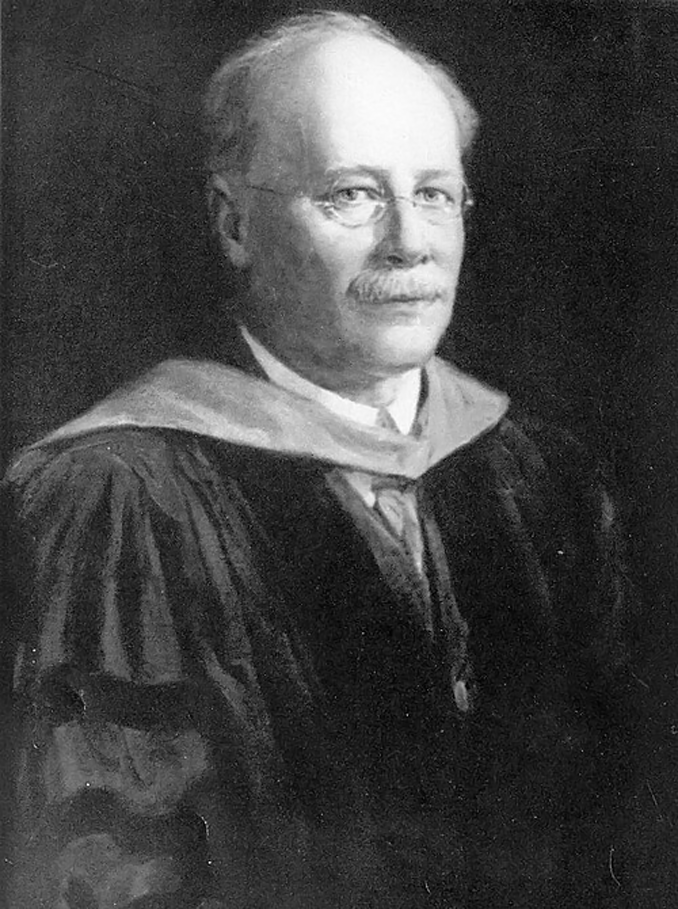
Date of Birth: July 10, 1852
Place of Birth: Boston, Massachusetts, USA
Parents: Samuel Williston and Jane A. Turner
Spouse: Annie I. Hathaway (m. December 1881)
Date of expiry: August 30, 1918 (aged 66)
Place of expiry: Chicago, Illinois, USA
Legacy: Terrestrial origin of bird flight,
Diplodocus and Allosaurus discoveries, "Williston's law"
Diplodocus and Allosaurus discoveries, "Williston's law"
Samuel Wendell Williston
Samuel Wendell Williston was born on 10 July 1852 in Boston, the son of blacksmith Samuell Williston and Jane Turner, but his childhood unfolded on the Kansas frontier after his family emigrated west in 1857 under the auspices of the New England Emigrant Aid Company. Raised in Manhattan, Kansas, he attended public school and graduated from Kansas State Agricultural College in 1872, later earning a master's degree from the same institution. His early fascination with natural history — collecting leaves, rocks, fossils, and even attempting to "plant" toads in the garden to watch them grow — foreshadowed the scientific life he would carve out through determination rather than privilege.
In 1874 Williston joined Othniel Charles Marsh's Yale expeditions under the mentorship of Benjamin Franklin Mudge, and by 1877 he was leading field parties of his own. Working with Mudge, he helped uncover the first fossils of Allosaurus and Diplodocus, illustrating the specimens with a precision that became one of his trademarks. He spent several years at Yale as a postgraduate student and faculty member, earning an M.D. in 1880 and later a Ph.D., while simultaneously establishing himself as a leading authority on Diptera. Around this time he proposed the first explicit model for the terrestrial origin of bird flight, arguing that early birds developed flight by running rather than leaping from trees — a hypothesis that would echo through later debates on avian evolution.
Williston returned to Kansas in 1890 as professor of geology and anatomy at the University of Kansas, where he became the first dean of the new School of Medicine in 1899. His career blended paleontology, anatomy, and entomology with unusual fluency: he authored more than 280 publications, including foundational works on North American Diptera, and articulated Williston's Law, the evolutionary principle that repeated parts (such as arthropod limbs) tend to become fewer and more specialized over time. In 1902 he accepted the chair of paleontology at the University of Chicago, where he continued to teach, write, and mentor students until his death in 1918. He was elected to the National Academy of Sciences and held memberships in the Geological Society of America, the American Academy of Arts and Sciences, and the American Philosophical Society — distinctions that reflected the breadth of his scientific influence.
Samuel Wendell Williston died on 30 August 1918 in Chicago, honored by colleagues who admired both his scholarship and the frontier resolve that shaped his life. From the log-cabin schoolrooms of Kansas to the fossil beds of the American West and the lecture halls of Yale and Chicago, he embodied the self-made naturalist: meticulous, wide-ranging, and quietly transformative. His legacy endures in the dinosaurs he helped discover, the evolutionary principles he articulated, and the generations of students who followed the trail he blazed across the early landscape of American paleontology.
In 1874 Williston joined Othniel Charles Marsh's Yale expeditions under the mentorship of Benjamin Franklin Mudge, and by 1877 he was leading field parties of his own. Working with Mudge, he helped uncover the first fossils of Allosaurus and Diplodocus, illustrating the specimens with a precision that became one of his trademarks. He spent several years at Yale as a postgraduate student and faculty member, earning an M.D. in 1880 and later a Ph.D., while simultaneously establishing himself as a leading authority on Diptera. Around this time he proposed the first explicit model for the terrestrial origin of bird flight, arguing that early birds developed flight by running rather than leaping from trees — a hypothesis that would echo through later debates on avian evolution.
Williston returned to Kansas in 1890 as professor of geology and anatomy at the University of Kansas, where he became the first dean of the new School of Medicine in 1899. His career blended paleontology, anatomy, and entomology with unusual fluency: he authored more than 280 publications, including foundational works on North American Diptera, and articulated Williston's Law, the evolutionary principle that repeated parts (such as arthropod limbs) tend to become fewer and more specialized over time. In 1902 he accepted the chair of paleontology at the University of Chicago, where he continued to teach, write, and mentor students until his death in 1918. He was elected to the National Academy of Sciences and held memberships in the Geological Society of America, the American Academy of Arts and Sciences, and the American Philosophical Society — distinctions that reflected the breadth of his scientific influence.
Samuel Wendell Williston died on 30 August 1918 in Chicago, honored by colleagues who admired both his scholarship and the frontier resolve that shaped his life. From the log-cabin schoolrooms of Kansas to the fossil beds of the American West and the lecture halls of Yale and Chicago, he embodied the self-made naturalist: meticulous, wide-ranging, and quietly transformative. His legacy endures in the dinosaurs he helped discover, the evolutionary principles he articulated, and the generations of students who followed the trail he blazed across the early landscape of American paleontology.
References
• Blackmar FW (1912) "Kansas; a cyclopedia of state history, embracing events, institutions, industries, counties, cities, towns, prominent persons, etc.". Volume II. Standard Publishing Company. 1-920.
• Williston SW (1914) "Water Reptiles of the Past and Present". University of Chicago Press.
• Osborn HF (1918) "Samuel Wendell Williston 1852-1918". The Journal of Geology, 26(8): 673-689. DOI: 10.1086/622630.
• Aldrich JM (1918) "Samuel Wendell Williston". Entomological News, 29: 322–327.
• Lull RS (1924) "Biographical Memoir of Samuel Wendell Williston, 1852-1918". Memoirs of the National Academy of Sciences, 17(5): 115-141.
• Shor E (1971) "Fossils and Flies: The Life of a Compleat Scientist Samuel Wendell Williston". University of Oklahoma Press.
• Ascarrunz E, Sánchez-Villagr MR, Betancur-R R and Laurin M (2019) "On trends and patterns in macroevolution: Williston's law and the branchiostegal series of extant and extinct osteichthyans". BMC Evolutionary Biology, 19(1): 117. DOI: 10.1186/s12862-019-1436-x.
Discoveries and descriptions ...
| Name | Type |
|---|


