



Date of Birth: 12 March, 1784
Place of Birth: Axminster, Devon, England
Parents: Charles and Elizabeth Buckland
Spouse: Mary Morland (Married December, 1825)
Date of expiry: 14 August, 1856
Place of expiry: London, England
Legacy: Megalosaurus, Coprolites,
Early British geology and palaeoecology
Early British geology and palaeoecology
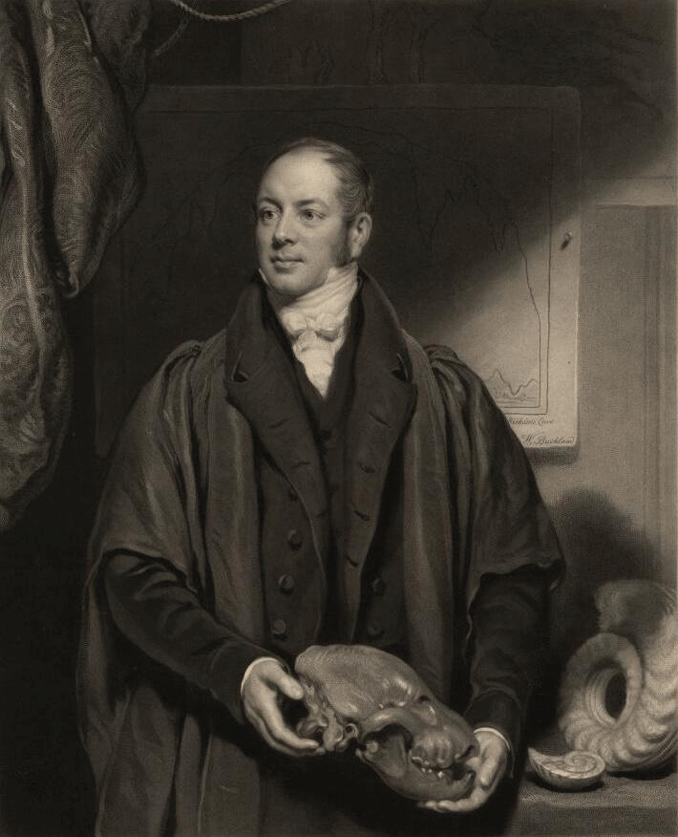
William Buckland
William Buckland was born on 12 March 1784 in Axminster, Devon, the eldest son of Charles Buckland, an Anglican clergyman, and his wife Elizabeth Oke. His early fascination with the natural world was shaped by the fossil-rich quarries of the West Country, where he explored ammonite-laden lias with his father and developed the curiosity that would define his career. Educated at Winchester College and later at Corpus Christi College, Oxford, he rose to become the university’s first Reader in Geology and one of the most influential figures in early British palaeontology. In 1825 he married Mary Morland—already a skilled scientific illustrator and fossil collector—whose drawings, field observations, and organisational brilliance became integral to his geological work. Their year-long geological honeymoon across Europe set the tone for a household where science, specimens, and spirited eccentricity were part of daily life.
William Buckland’s scientific brilliance was matched only by the theatrical oddity of his habits. He lectured in a swirl of academic robes—sometimes even in the field—scrambling over outcrops with a blue collecting bag stuffed with mammoth skin, hyena dung, and whatever else he had prised from the landscape. Visitors to his home were greeted not by Victorian decorum but by a pet donkey nosing around the drawing room and a table inlaid with polished coprolites, a monument to the fossilized dung he studied with almost devotional enthusiasm. Buckland’s curiosity was omnivorous in every sense: he famously attempted to eat his way through the animal kingdom, serving guests hedgehog, crocodile, porpoise, and mice on toast, and declaring mole the worst thing he had ever tasted—until he tried stewed bluebottles. He was even rumoured to have eaten the preserved heart of King Louis XIV, shown to him by Lord Harcourt—a Victorian anecdote too colourful to verify but perfectly in keeping with his reputation. During his honeymoon in 1825 he visited Palermo, where priests proudly showed him the relics of Saint Rosalia; after a brief inspection he announced that the bones belonged not to a woman but to a goat, and the horrified clergy promptly ushered him out. At another European cathedral, he examined the supposedly ever-flowing blood of a martyred saint and identified it as bat urine by licking it, a feat of empiricism that became one of his most famous party-piece stories.
His household blurred the line between natural history museum and mildly alarming menagerie. Exotic animals came and went; geological specimens occupied every surface; and Buckland himself moved through it all with the energy of a man who saw no distinction between scientific inquiry and daily life. Even his clerical role added to the spectacle: an Anglican priest who carried a hyena skull into sermons and once attempted to reconcile Genesis with glacial theory, he embodied the Victorian conviction that the natural world was a divine text waiting to be deciphered, preferably with gusto.
If anyone came close to matching him, it was his son Frank—who also treated Noah's Ark as a culinary checklist, and was only slightly behind his father in the league of Oxford oddballs. Frank kept monkeys, dissected anything the London Zoo lost overnight, and once maintained a young bear named Tiglath-Pileser—"Tig" for short—in his college rooms. Tig was a surprisingly affectionate creature who loved to suck people's fingers, and students delighted in dressing him in a cap and gown for wine parties and boating trips. When the Dean finally intervened, Tig was sent to stay at the Buckland rectory, along with a pet jackal and an eagle. He soon escaped, discovered that the local grocer stocked an excellent supply of sweets, and made repeated raids to devour the sugar-stacked stock. After this final indignity, Tig was dispatched to the London Zoo in 1857, where he died shortly afterwards. But even Frank's exuberant chaos felt like an echo of the original: William Buckland, the man who turned geology into theatre, dining into experiment, and everyday life into a kind of ongoing natural-historical performance.
For all his eccentricities, Buckland was a remarkably acute thinker whose scientific achievements reshaped early palaeontology and geology. He was the first to name and describe Megalosaurus, inaugurating the formal study of dinosaurs decades before the word “dinosaur” existed. His most celebrated insight came at Kirkdale Cave in Yorkshire, where fossil bones of elephant, rhinoceros, hippopotamus, horse, ox, deer, hyena, tiger, bear, wolf, fox, rodents, and birds were widely assumed to be relics of the biblical Flood. Buckland recognised instead—on the basis of their splintered, gnawed condition and the distribution of coprolites—that the cave had been a prehistoric hyena den, a revelation that earned him the Royal Society’s Copley Medal and helped shift geology away from scriptural catastrophism. His later work on glaciation, his pioneering studies of fossil feces, and his ability to synthesise field evidence with bold interpretive leaps all mark him as one of the most original scientific minds of his age. Beneath the theatrics and the famously adventurous palate was a scholar of extraordinary insight, whose legacy endures far beyond the oddities that made him unforgettable.
William Buckland’s scientific brilliance was matched only by the theatrical oddity of his habits. He lectured in a swirl of academic robes—sometimes even in the field—scrambling over outcrops with a blue collecting bag stuffed with mammoth skin, hyena dung, and whatever else he had prised from the landscape. Visitors to his home were greeted not by Victorian decorum but by a pet donkey nosing around the drawing room and a table inlaid with polished coprolites, a monument to the fossilized dung he studied with almost devotional enthusiasm. Buckland’s curiosity was omnivorous in every sense: he famously attempted to eat his way through the animal kingdom, serving guests hedgehog, crocodile, porpoise, and mice on toast, and declaring mole the worst thing he had ever tasted—until he tried stewed bluebottles. He was even rumoured to have eaten the preserved heart of King Louis XIV, shown to him by Lord Harcourt—a Victorian anecdote too colourful to verify but perfectly in keeping with his reputation. During his honeymoon in 1825 he visited Palermo, where priests proudly showed him the relics of Saint Rosalia; after a brief inspection he announced that the bones belonged not to a woman but to a goat, and the horrified clergy promptly ushered him out. At another European cathedral, he examined the supposedly ever-flowing blood of a martyred saint and identified it as bat urine by licking it, a feat of empiricism that became one of his most famous party-piece stories.
His household blurred the line between natural history museum and mildly alarming menagerie. Exotic animals came and went; geological specimens occupied every surface; and Buckland himself moved through it all with the energy of a man who saw no distinction between scientific inquiry and daily life. Even his clerical role added to the spectacle: an Anglican priest who carried a hyena skull into sermons and once attempted to reconcile Genesis with glacial theory, he embodied the Victorian conviction that the natural world was a divine text waiting to be deciphered, preferably with gusto.
If anyone came close to matching him, it was his son Frank—who also treated Noah's Ark as a culinary checklist, and was only slightly behind his father in the league of Oxford oddballs. Frank kept monkeys, dissected anything the London Zoo lost overnight, and once maintained a young bear named Tiglath-Pileser—"Tig" for short—in his college rooms. Tig was a surprisingly affectionate creature who loved to suck people's fingers, and students delighted in dressing him in a cap and gown for wine parties and boating trips. When the Dean finally intervened, Tig was sent to stay at the Buckland rectory, along with a pet jackal and an eagle. He soon escaped, discovered that the local grocer stocked an excellent supply of sweets, and made repeated raids to devour the sugar-stacked stock. After this final indignity, Tig was dispatched to the London Zoo in 1857, where he died shortly afterwards. But even Frank's exuberant chaos felt like an echo of the original: William Buckland, the man who turned geology into theatre, dining into experiment, and everyday life into a kind of ongoing natural-historical performance.
For all his eccentricities, Buckland was a remarkably acute thinker whose scientific achievements reshaped early palaeontology and geology. He was the first to name and describe Megalosaurus, inaugurating the formal study of dinosaurs decades before the word “dinosaur” existed. His most celebrated insight came at Kirkdale Cave in Yorkshire, where fossil bones of elephant, rhinoceros, hippopotamus, horse, ox, deer, hyena, tiger, bear, wolf, fox, rodents, and birds were widely assumed to be relics of the biblical Flood. Buckland recognised instead—on the basis of their splintered, gnawed condition and the distribution of coprolites—that the cave had been a prehistoric hyena den, a revelation that earned him the Royal Society’s Copley Medal and helped shift geology away from scriptural catastrophism. His later work on glaciation, his pioneering studies of fossil feces, and his ability to synthesise field evidence with bold interpretive leaps all mark him as one of the most original scientific minds of his age. Beneath the theatrics and the famously adventurous palate was a scholar of extraordinary insight, whose legacy endures far beyond the oddities that made him unforgettable.
References
• Oxford University Museum of Natural History "William Buckland"
• Bompas GC (1885) "The Life of Frank Buckland".
• Chisholm H ed. (1911) "Buckland, William". Encyclopædia Britannica (11th ed.).
• Rupke N (1983) "The Great Chain of History: William Buckland and the English School of Geology 1814–1850".
• Armstrong JR (1990) "William Buckland in Retrospect".
• McGowan C (2001) "The dragon seekers".
• Duffin CJ (2006) "William Buckland (1784–1856)". Geology Today, 22(3): 104-108. DOI: 10.1111/j.1365-2451.2006.00562.x.
• Koenig C (21st February 2008) "Either you or your bear must go".
• Gordon EO and Buckland W (2010) "The Life and Correspondence of William Buckland, D.D., F.R.S.: Sometime Dean of Westminster, Twice President of the Geological Society, and First President of the British Association". Cambridge Library Collection - Earth Science.
• The Geological Society Blog (23 December 2014) "Door 23: The Heart of a King".
• Chapman A (18 Mar 2022) "Caves, Coprolites and Catastrophes: The Story of Pioneering Geologist and Fossil-Hunter William Buckland"
• Simmonds PL (2023) "The Curiosities of Food: Or the Dainties and Delicacies of Different Nations Obtained from the Animal Kingdom". Original publication: London: Richard Bentley, 1859.
• Donofrio C (January 19, 2017) "The Father and Son Who Ate Every Animal Possible William and Francis Buckland saw Noah’s Ark as a dinner menu". Atlas Obscura.
• Sullivan P (Nov 06, 2025) "The Life and Times of Tiglath-pileser.
The Ursa Major of Oxfordshire.
Discoveries and descriptions ...
| Name | Type |
|---|---|
| MEGALOSAURUS |  |


