








Date of Birth: March 11, 1874
Place of Birth: Pavilion, New York, USA
Parents: John Edward Gilmore and Caroline Maria Whitney
Spouse: Laure Coutant (m. October 1902)
Date of expiry: September 27, 1945 (aged 71)
Place of expiry: Park View, District of Columbia, USA
Legacy: Classic Smithsonian dinosaur mounts including the first mounted Triceratops, Early American dinosaur monographs
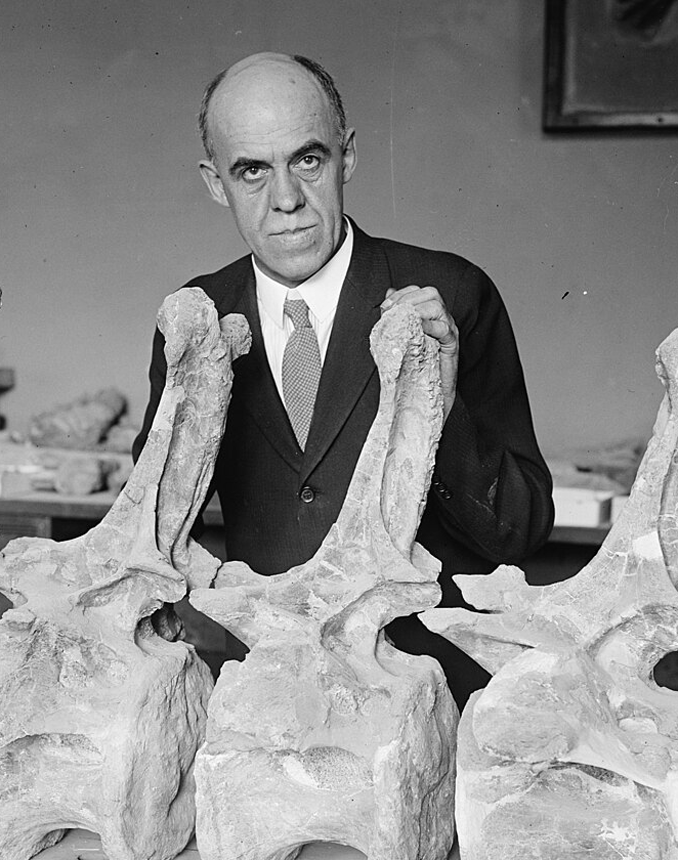
Charles Whitney Gilmore
Charles Whitney Gilmore was born on 11 March 1874 in Pavilion, New York, where his path toward palaeontology began unusually early. At the age of six, during a visit with his aunt to Ward’s Natural Science Establishment at the University of Rochester, he encountered mounted skeletons that fixed in his mind the idea of a life spent in museums. Two years later his family moved to Howell, Michigan, but the ambition remained. Upon finishing high school and still intent on a museum career, he traveled west to enroll at the University of Wyoming, where the closest available subject to paleontology was mining engineering. There he came under the influence of Wilbur Knight, the mentor who would introduce him to collecting dinosaurian remains in
Wyoming, and Charles Schuchert, both of whom recognized his steadiness in the field and his natural skill with fossils.
In May 1898 Gilmore enlisted for service in the Spanish–American War, a commitment that proved brief — he was honorably discharged that October — and by 1900 he had returned to Wyoming. That June he met John Bell Hatcher, then leading dinosaur fieldwork for the Carnegie Museum. Hatcher had received favorable reports from Knight and Schuchert and was impressed by the young student; he hired Gilmore for the summer expedition to the Jurassic beds of Wyoming, while Gilmore’s mother, who was visiting him at the time, was pressed into service as camp cook. The field season was highly productive: among the finds was the juvenile sauropod described by Olaf A. Peterson and Gilmore as Elosaurus parvus (1902), later recognized as a young Apatosaurus, and later still Brontosaurus.
The year 1902 was pivotal for Gilmore in more ways than one. In addition to joining the Carnegie Museum as a full-time preparator, he returned to Laramie to marry his sweetheart Laure Coutant, with whom he would have three daughters. The combination of professional opportunity and personal stability marked the beginning of a steady ascent in American vertebrate paleontology.
His move to the Smithsonian followed soon after. When O. C. Marsh died in 1899, the United States Geological Survey transferred roughly eighty tons of "Bone Wars" fossil material to the U.S. National Museum. In 1903 Gilmore received a contract to prepare a Triceratops skull from this collection. The quality of his work led to his appointment as a full-time preparator in 1904, and by 1905 — assisted by Norman H. Boss, another Carnegie alumnus — he had mounted the museum’s now-famous "Hatcher" Triceratops, the first complete skeleton of the species ever displayed. The mounting of a 70-foot Diplodocus longus, that became one of the Smithsonian's most popular displays for two decades, followed.
Fieldwork remained central to Gilmore's career. He led expeditions across Utah, Wyoming, Alberta, Alaska, and beyond, collecting dinosaurs, fossil mammals, and the occasional surprise. His 1913–1914 work in the Two Medicine Formation of Montana yielded the first scientifically described dinosaur eggs from North America, a quiet but significant expansion of the continent's paleobiological record. Gilmore was not a showman in the mold of Barnum Brown or Roy Chapman Andrews; his expeditions were orderly, methodical, and focused on building the Smithsonian's collections rather than chasing headlines. Yet the material he gathered — from hadrosaurs to ceratopsians to Jurassic sauropods — became foundational to the museum’s research and exhibits for generations.
Within the Smithsonian, Gilmore rose steadily, becoming Curator of Vertebrate Paleontology in 1924, and brought the same quiet rigor he applied to the museum’s iconic displays to his monographs on Stegosaurus (1914), Allosaurus (1920), Apatosaurus (1936), and the juvenile Camarasaurus from the Carnegie collections (1925). Colleagues remembered him as a genial and modest man, kindness personified, and while wary of the "dinomania" that others embraced with gusto, he remained the steady, stabilizing presence whose work shaped the Smithsonian's vertebrate paleontology program during a period of institutional growth and scientific consolidation.
Gilmore’s personal life was modest and largely private. He and Laure raised their three daughters in Washington, D.C., balancing the demands of fieldwork and museum responsibilities with a quiet domestic life. Even in later years, as administrative duties increased, he continued to publish careful anatomical studies, refining the taxonomy and morphology of dinosaurs and fossil reptiles with the same disciplined clarity that had marked his early career.
Charles Whitney Gilmore died on 27 September 1945, leaving behind a body of work that remains central to the descriptive foundations of American vertebrate paleontology. His legacy lies not in sweeping theoretical frameworks but in the precision of his anatomical scholarship, the stability of his taxonomic judgments, and the collections and mounts that continue to anchor the Smithsonian’s paleontological research. He was, above all, a craftsman of scientific description — a curator whose quiet rigor helped define the standards of twentieth-century vertebrate paleontology and whose influence endures in the bones he prepared, the papers he wrote, and the museum he helped shape.
In May 1898 Gilmore enlisted for service in the Spanish–American War, a commitment that proved brief — he was honorably discharged that October — and by 1900 he had returned to Wyoming. That June he met John Bell Hatcher, then leading dinosaur fieldwork for the Carnegie Museum. Hatcher had received favorable reports from Knight and Schuchert and was impressed by the young student; he hired Gilmore for the summer expedition to the Jurassic beds of Wyoming, while Gilmore’s mother, who was visiting him at the time, was pressed into service as camp cook. The field season was highly productive: among the finds was the juvenile sauropod described by Olaf A. Peterson and Gilmore as Elosaurus parvus (1902), later recognized as a young Apatosaurus, and later still Brontosaurus.
The year 1902 was pivotal for Gilmore in more ways than one. In addition to joining the Carnegie Museum as a full-time preparator, he returned to Laramie to marry his sweetheart Laure Coutant, with whom he would have three daughters. The combination of professional opportunity and personal stability marked the beginning of a steady ascent in American vertebrate paleontology.
His move to the Smithsonian followed soon after. When O. C. Marsh died in 1899, the United States Geological Survey transferred roughly eighty tons of "Bone Wars" fossil material to the U.S. National Museum. In 1903 Gilmore received a contract to prepare a Triceratops skull from this collection. The quality of his work led to his appointment as a full-time preparator in 1904, and by 1905 — assisted by Norman H. Boss, another Carnegie alumnus — he had mounted the museum’s now-famous "Hatcher" Triceratops, the first complete skeleton of the species ever displayed. The mounting of a 70-foot Diplodocus longus, that became one of the Smithsonian's most popular displays for two decades, followed.
Fieldwork remained central to Gilmore's career. He led expeditions across Utah, Wyoming, Alberta, Alaska, and beyond, collecting dinosaurs, fossil mammals, and the occasional surprise. His 1913–1914 work in the Two Medicine Formation of Montana yielded the first scientifically described dinosaur eggs from North America, a quiet but significant expansion of the continent's paleobiological record. Gilmore was not a showman in the mold of Barnum Brown or Roy Chapman Andrews; his expeditions were orderly, methodical, and focused on building the Smithsonian's collections rather than chasing headlines. Yet the material he gathered — from hadrosaurs to ceratopsians to Jurassic sauropods — became foundational to the museum’s research and exhibits for generations.
Within the Smithsonian, Gilmore rose steadily, becoming Curator of Vertebrate Paleontology in 1924, and brought the same quiet rigor he applied to the museum’s iconic displays to his monographs on Stegosaurus (1914), Allosaurus (1920), Apatosaurus (1936), and the juvenile Camarasaurus from the Carnegie collections (1925). Colleagues remembered him as a genial and modest man, kindness personified, and while wary of the "dinomania" that others embraced with gusto, he remained the steady, stabilizing presence whose work shaped the Smithsonian's vertebrate paleontology program during a period of institutional growth and scientific consolidation.
Gilmore’s personal life was modest and largely private. He and Laure raised their three daughters in Washington, D.C., balancing the demands of fieldwork and museum responsibilities with a quiet domestic life. Even in later years, as administrative duties increased, he continued to publish careful anatomical studies, refining the taxonomy and morphology of dinosaurs and fossil reptiles with the same disciplined clarity that had marked his early career.
Charles Whitney Gilmore died on 27 September 1945, leaving behind a body of work that remains central to the descriptive foundations of American vertebrate paleontology. His legacy lies not in sweeping theoretical frameworks but in the precision of his anatomical scholarship, the stability of his taxonomic judgments, and the collections and mounts that continue to anchor the Smithsonian’s paleontological research. He was, above all, a craftsman of scientific description — a curator whose quiet rigor helped define the standards of twentieth-century vertebrate paleontology and whose influence endures in the bones he prepared, the papers he wrote, and the museum he helped shape.
References
• Peterson OA and Gilmore CW (March 1902) "Elosaurus parvus: a new genus and species of the Sauropoda". Annals of the Carnegie Museum, 1(3): 490-499. DOI: 10.5962/p.78087.
• Gilmore CW (1908) "Smithsonian exploration in Alaska in 1907 in search of Pleistocene fossil vertebrates". Smithsonian Miscellaneous Collections, 51(3) 3-38.
• Gilmore CW (1914) "Osteology of the armored Dinosauria in the United States National Museum, with special reference to the genus Stegosaurus". Bulletin of the United States National Museum, 89: 1-143.
• Gilmore CW (1920) "Osteology of the carnivorous Dinosauria in the United States National museum, with special reference to the genera Antrodemus (Allosaurus) and Ceratosaurus".
• Gilmore C (1925) "A nearly complete articulated skeleton of Camarasaurus, a saurischian dinosaur from the Dinosaur National Monument". Memoirs of the Carnegie Museum. 10: 347–384. DOI: 10.5962/p.217807.
• Gilmore CW (1936) "Osteology of Apatosaurus, with special references to specimens in the Carnegie Museum". Memoirs of the Carnegie Museum, 11(4): 175-300. DOI: 10.5962/p.234849.
• Colbert EH (1984) "The Great Dinosaur Hunters and Their Discoveries".
• Park View, D.C. (2010) "Historic Profile: Charles W. Gilmore (1874-1944)". Park View, D.C. blog.
Discoveries and descriptions ...


