








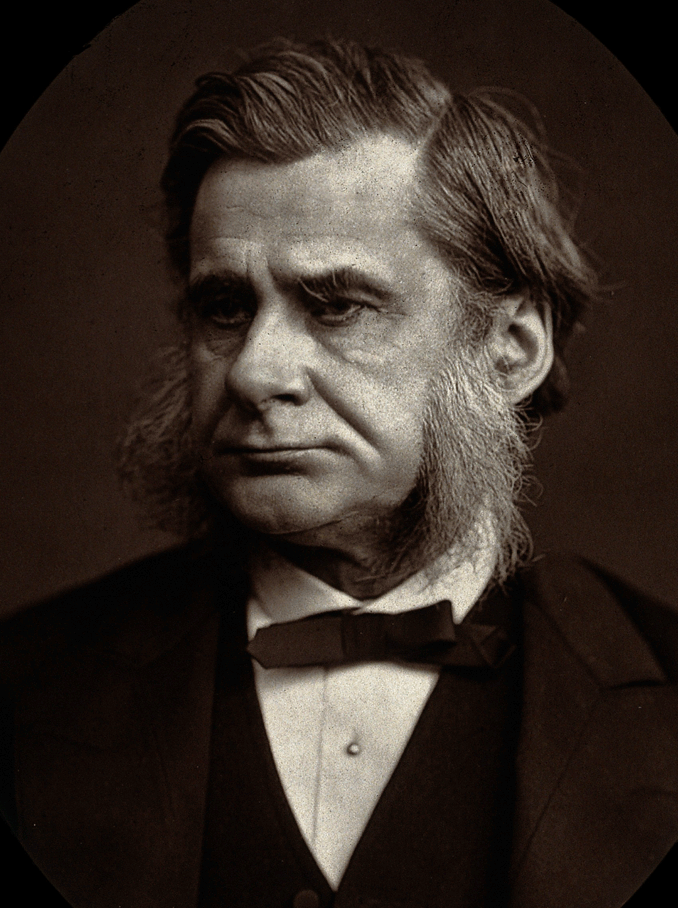
Date of Birth: May 4, 1825
Place of Birth: Ealing, London, England
Parents: George Huxley and Rachel Withers
Spouse: Henrietta Anne Heathorn
Died: June 29, 1895
Place of death: Eastbourne, Sussex, England
Legacy: Early advocate of dinosaur—bird evolution,
"Darwin's Bulldog", the term "agnosticism"
"Darwin's Bulldog", the term "agnosticism"
Thomas Henry Huxley
Thomas Henry Huxley was born on 4 May 1825 in Ealing, London, the seventh of eight children in a family of modest means. With only two years of formal schooling, he educated himself through voracious reading in science, philosophy, and German literature. At fifteen he began a medical apprenticeship, later winning a scholarship to Charing Cross Hospital, where he trained as a surgeon. In 1846 he entered the Royal Navy as assistant surgeon aboard HMS Rattlesnake, spending four years surveying the waters of Australia and New Guinea. Despite miserable shipboard conditions, he produced pioneering research on marine invertebrates — work that earned him election to the Royal Society at age 26 and the Royal Medal in 1852.
Returning to London in 1851, Huxley struggled to find paid scientific work but soon secured positions at the Royal School of Mines, the Geological Survey, and the Royal Institution. His lectures — especially his evening talks for working men — helped establish him as one of Britain's most compelling scientific communicators. By the mid-1850s he had become a close correspondent of Charles Darwin, advising him on barnacle anatomy and German scientific literature. Though initially skeptical of transmutation, Huxley recognized the power of Darwin's theory when On the Origin of Species appeared in 1859. In a famous letter he vowed to defend Darwin "to the stake if requisite", sharpening his "claws and beak" for the coming controversy.
Huxley's moment came in 1860 at Oxford, where he confronted Bishop Samuel Wilberforce, who had been coached by Richard Owen. The exchange — later mythologized but rooted in real conflict — marked Huxley as Darwin's most formidable public defender. He dismantled Owen's anatomical claims about the human brain and championed the evolutionary connection between humans and apes, a stance that reshaped public understanding of human origins. His broader scientific work was equally influential: he clarified relationships among invertebrates, demonstrated that birds evolved from small carnivorous dinosaurs after comparing Archaeopteryx with Compsognathus, and coined the term "agnosticism" in 1869 to describe the limits of human knowledge.
By the 1870s and 1880s, Huxley had become a central architect of British scientific education. He reformed curricula, professionalized biology, and used his public platform to argue for secular, evidence-based science. His honors included the Wollaston Medal (1876), Clarke Medal (1880), Copley Medal (1888), and Linnean Medal (1890), reflecting his stature across multiple disciplines.
Thomas Henry Huxley died on 29 June 1895 in Eastbourne, Sussex. He left behind a transformed intellectual landscape: a Britain in which evolution had moved from scandal to scientific foundation, and a generation of students — including Michael Foster and H. G. Wells — who carried his influence forward. Fierce, brilliant, and unafraid of controversy, Huxley was the Victorian era's most effective champion of evolutionary thought — the anatomist who fought, and won, the battle for Darwin's ideas.
Returning to London in 1851, Huxley struggled to find paid scientific work but soon secured positions at the Royal School of Mines, the Geological Survey, and the Royal Institution. His lectures — especially his evening talks for working men — helped establish him as one of Britain's most compelling scientific communicators. By the mid-1850s he had become a close correspondent of Charles Darwin, advising him on barnacle anatomy and German scientific literature. Though initially skeptical of transmutation, Huxley recognized the power of Darwin's theory when On the Origin of Species appeared in 1859. In a famous letter he vowed to defend Darwin "to the stake if requisite", sharpening his "claws and beak" for the coming controversy.
Huxley's moment came in 1860 at Oxford, where he confronted Bishop Samuel Wilberforce, who had been coached by Richard Owen. The exchange — later mythologized but rooted in real conflict — marked Huxley as Darwin's most formidable public defender. He dismantled Owen's anatomical claims about the human brain and championed the evolutionary connection between humans and apes, a stance that reshaped public understanding of human origins. His broader scientific work was equally influential: he clarified relationships among invertebrates, demonstrated that birds evolved from small carnivorous dinosaurs after comparing Archaeopteryx with Compsognathus, and coined the term "agnosticism" in 1869 to describe the limits of human knowledge.
By the 1870s and 1880s, Huxley had become a central architect of British scientific education. He reformed curricula, professionalized biology, and used his public platform to argue for secular, evidence-based science. His honors included the Wollaston Medal (1876), Clarke Medal (1880), Copley Medal (1888), and Linnean Medal (1890), reflecting his stature across multiple disciplines.
Thomas Henry Huxley died on 29 June 1895 in Eastbourne, Sussex. He left behind a transformed intellectual landscape: a Britain in which evolution had moved from scandal to scientific foundation, and a generation of students — including Michael Foster and H. G. Wells — who carried his influence forward. Fierce, brilliant, and unafraid of controversy, Huxley was the Victorian era's most effective champion of evolutionary thought — the anatomist who fought, and won, the battle for Darwin's ideas.
More Huxley
• Huxley TH (1863) "Man's Place in Nature".
• Huxley L (1900) "Life and Letters of Thomas Henry Huxley".
• Lyons SL (1999) "Thomas Henry Huxley: The Evolution of a Scientist".
• Cosans CE (2009) "Owen's Ape and Darwin's Bulldog: Beyond Darwinism and Creationism".
• Hauserman S (2013) "Thomas Henry Huxley (1825-1895)". Embryo Project Encyclopedia.
• LibriVox "Works by Thomas Henry Huxley". Public domain audiobooks.

Discoveries and descriptions ...
| Name | Type |
|---|---|
| ACANTHOPHOLIS |  |
| EUSKELOSAURUS |  |
| HYPSILOPHODON |  |


